Leveraging Deep Learning and Rare Event Sampling to Study Climate Extremes Impacting the Power System
Explore deep learning and rare event sampling techniques for analyzing climate extremes' impact on power systems.
平成の災害に学ぶ災害への備え - 阪神・淡路大震災 - Ch.2
阪神・淡路大震災の教訓から、効果的な防災対策と災害への備えについて学び、将来の災害に対する理解を深める実践的な知識を習得する
Adaptive Regularization and Linearization for Nonsmooth and Degenerate Problems
Explore advanced mathematical techniques for solving nonsmooth and degenerate problems in flow and transport, focusing on adaptive regularization methods and Newton-based linearization approaches.
Computer-Assisted Global Analysis of Non-Smooth Impact Dynamics Inspired by Energy Harvesting
Delve into advanced mathematical analysis of vibro-impact dynamics, exploring computational methods for energy harvesting systems and non-smooth impact phenomena through novel return map approaches.
The Harder-Narasimhan Filtration and Stability Conditions for Vector Bundles
Delve into the mathematical theory of stability conditions and Harder-Narasimhan filtration for vector bundles, exploring their applications in geometric invariant theory and moduli spaces.

The Discrete Fourier Transform - Most Important Algorithm Ever?
Explore the Discrete Fourier Transform's derivation, properties, and significance in modern technology through a discovery-oriented approach, from basic concepts to complex exponentials.

Axis IMU - Review of Basic Trigonometry
Review of basic trigonometry concepts for rotating systems in Vpython, focusing on practical applications with Arduino and IMU sensors.
Everything About the Degrees of Freedom of a Robot - Fundamentals of Robotics
Comprehensive exploration of robot degrees of freedom, covering rigid body motion, joint types, and Grübler's formula for various mechanisms including Stewart platforms and Delta robots.

Complex Numbers for Audio Signal Processing
Explore complex numbers visually for audio signal processing, covering Cartesian and polar representations, Euler's formula, and their application in Fourier transforms.
Dealing with Linear Constraints via Random Permutation
Explore linear constraint optimization using random permutation techniques, focusing on ADMM variants, spectral analysis, and convergence rates for large-scale problems.
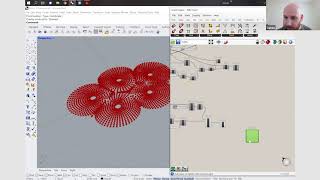
Designing with Complex Geometry - Class 4
Explore advanced Grasshopper techniques including L-Systems, attractor points, vector lines, and fields. Learn to create complex geometries and enhance your parametric design skills.
Convolution and the Fourier Series
Explore convolution and its relation to Fourier series, unraveling complex mathematical concepts through clear explanations and real-world analogies.
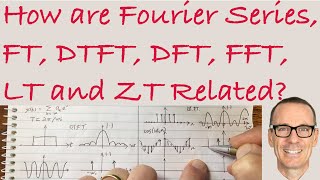
How Are the Fourier Series, Fourier Transform, DTFT, DFT, FFT, LT and ZT Related?
Comprehensive exploration of Fourier analysis techniques, from series to transforms, explaining relationships and applications in signal processing and communications.
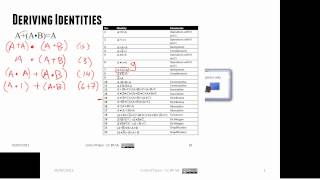
Digital Circuits Boolean Algebra
Learn Boolean algebra fundamentals and digital circuit simplification techniques, including key rules and operations for efficient logic design and analysis.
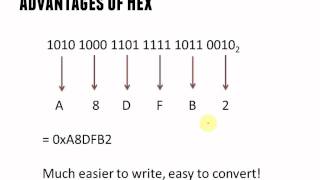
Digital Circuits Number Systems
Learn about number systems in digital circuits, including decimal, binary, and hexadecimal conversions. Explore power representations and practical examples for a solid foundation in digital logic.
Remarks on the Discrete Cube
Explore probability theory on the discrete cube, covering Fourier analysis, Poisson inequality, and random walks, with applications in high-dimensional geometry and computation.
Sets, Logic and Graphs - Math Terminology - NJ Wildberger
Review of high school math language and notation for sets, logic, and basic graph theory. Covers key concepts like union, intersection, subsets, logical statements, and graph circuits, providing essential foundations for advanced mathematics.
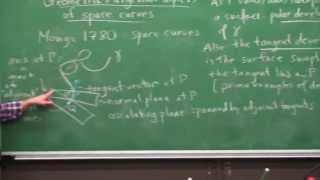
Geometric and Algebraic Aspects of Space Curves - Differential Geometry
Explore geometric and algebraic aspects of space curves, including tangent vectors, normal planes, curvature, torsion, and associated surfaces. Learn about Monge's contributions and invariant properties.
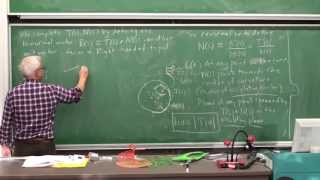
The Frenet Serret Equations - Differential Geometry
Explore the Frenet-Serret equations, describing space curves' behavior using vector-valued derivatives. Learn about tangent, normal, and bi-normal vectors, curvature, and torsion in 3D space.
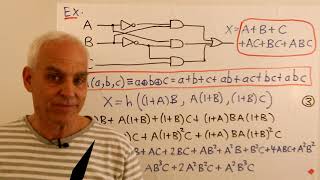
Boole Reduction - A Challenge for Programmers - MathFoundations - N J Wildberger
Exploring challenges in implementing Boole reduction for circuit analysis, including programming strategies and SAT solver development in the Algebra of Boole context.
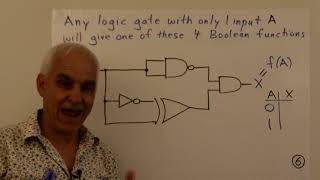
Canonical Forms for Logic Circuits - Math Foundations
Explore canonical forms for logic circuits, Boolean functions, and their geometric interpretations. Learn to express Boolean functions algebraically using Boolean algebra and Boole's original algebra.