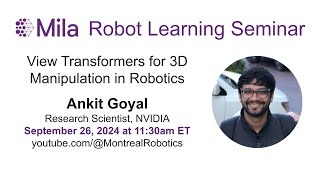
View Transformers for 3D Manipulation in Robotics
Explore state-of-the-art View Transformers for 3D object manipulation in robotics, including RVT and RVT-2, offering improved task success, faster training, and real-world applicability.
Mila Robot Learning Seminar
Explore cutting-edge robot learning techniques and advancements in AI-driven robotics through expert presentations and discussions at the Mila seminar.
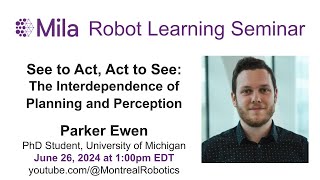
See to Act, Act to See - The Interdependence of Planning and Perception in Robotics
Explore the interdependence of planning and perception in robotics, focusing on physical property learning, multi-modal sensing, and uncertainty modeling for improved task performance.
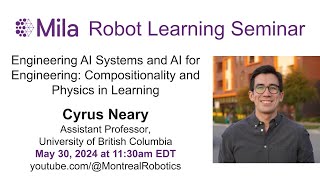
Engineering AI Systems and AI for Engineering: Compositionality and Physics in Learning
Explore compositional AI system design and physics-integrated learning algorithms for robotics and autonomy. Discover methodologies for reliable deployment and rapid hardware control implementation.
Becoming Bionic: Advancements in Smart Prosthetic Limbs
Explore cutting-edge research in prosthetics and smart limb control. Discover open problems and current solutions in neuroprosthetics, reinforcement learning, and human-robot interaction for improved functionality and usability.
Foundational Models for Robot Control
Explore recent advancements in using large pretrained networks for robot control, from basic concepts to practical applications in robotics research.
Efficient Action Representation for Robot Learning
Explore efficient action representation techniques for enhancing robot learning, focusing on helpful abstractions and theoretical aspects of reinforcement learning.
Building General-Purpose Home Robots
Explore advancements in general-purpose home robots, including vision-language models, rapid skill learning, and multi-fingered dexterity. Discover challenges and solutions for creating adaptable, cost-effective domestic assistants.
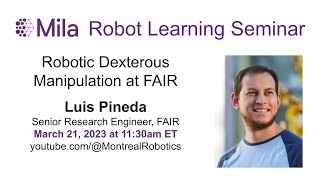
Robotic Dexterous Manipulation - Advances in Learning and Teleoperation
Explore advancements in robotic manipulation, combining classical and learned methods. Discover projects on extrinsic contact learning, visuo-tactile SLAM, and in-hand object rotation using vision and touch.
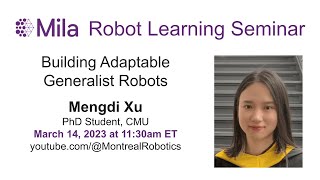
Building Adaptable Generalist Robots
Explore cutting-edge approaches for building adaptable generalist robots, focusing on in-context learning, unsupervised reinforcement learning, and leveraging foundation models for improved generalization and task versatility.
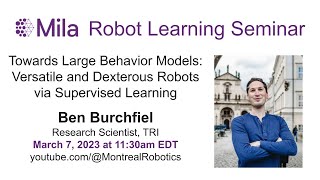
Towards Large Behavior Models: Versatile and Dexterous Robots via Supervised Learning
Explore advancements in machine learning for robotics, focusing on creating versatile and dexterous robots through supervised learning and the development of Large Behavior Models.
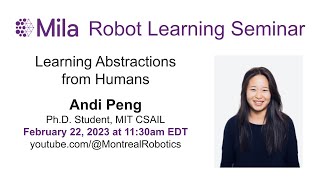
Learning Abstractions from Humans for Generalizable Robot Learning
Explore methods for integrating human knowledge into robot learning abstractions, focusing on feedback as a prior, personalized interface, and framework for user-aligned reward functions.
Visual Whole-Body Manipulation and Locomotion for Legged Robots
Explore visual feedback integration for precise legged robot coordination in challenging terrains and manipulation tasks, focusing on dynamic, scalable skills for real-world applications.
Robotics as an Enabler and Inhibitor of Sustainable Development Goals
Explore robotics' dual role in achieving UN Sustainable Development Goals. Analyze potential to enable 46% of targets while inhibiting 19%, focusing on economic, social, and environmental impacts.
Learning Structured World Models From and For Physical Interactions
Explore structured world models for physical interactions in robotics. Learn novel representations and structural priors for effective model-based planning and complex manipulation tasks.

Sim2Robot - Training Robots for the Real-World with Imperfect Simulators
Explore innovative methods for training robots using imperfect simulators, focusing on navigation and pick-and-place tasks. Learn about leveraging large-scale learning, hierarchical control, and foundation models for real-world deployment.

RoboCat - A Self-Improving Generalist for Robotic Manipulation
Explore RoboCat, a multi-embodiment, multi-task generalist agent for robotic manipulation. Learn about its ability to generalize across tasks and robots, and its potential for autonomous improvement.

Data-Driven Fine Manipulation: Pushing Boundaries in Robotic Precision
Explore data-driven solutions for fine robotic manipulation, enabling low-cost hardware to perform intricate tasks with superhuman precision using imitation and reinforcement learning techniques.
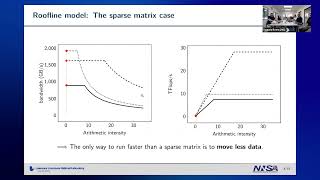
Empowering MFEM Using libCEED - MFEM Workshop 2023
Explore MFEM's enhanced capabilities through libCEED integration, including support for simplices, mixed meshes, and p-adaptivity. Discover performance gains across various HPC architectures.
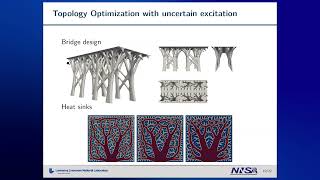
Scalable Design and Optimization with MFEM
Explore scalable design and optimization using MFEM for large-scale scientific simulations. Learn about topology and shape optimization algorithms, gradient-based techniques, and implementation strategies for industrial problems.
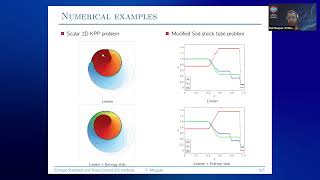
MFEM Workshop 2023 - Student Lightning Talks Part 1
Explore cutting-edge finite element research through student presentations on topics like µFEA, entropy stabilization, Maxwell's equations, and thermo-mechanical solves using MFEM.