
Hierarchical Perspective on Robotic Control
Explore hierarchical control strategies for complex robotic systems, focusing on dynamically stable behaviors in 3D hopping and planar bipedal robots. Learn about geometric and nonlinear control in hierarchical architectures.

From Words to Actions - Foundation Models for Generalist Robot Brains
Explore the potential of Foundation models in robotics, discussing lessons from scaling robot data collection and strategies to leverage these models for practical applications.

Foundation Reward Models for General Robot Skill Acquisition
Explore foundation reward models for general robot skill acquisition, leveraging non-robot data to enhance adaptability in unstructured environments.
Developing Robots that Autonomously Learn and Plan in the Real World
Explore autonomous robot learning and planning, covering challenges, techniques, and future directions in creating versatile AI agents capable of solving complex real-world tasks.
Water Transport in Boron Nitride Nanotube Membranes
Explore water transport in boron nitride nanotube membranes, comparing with carbon nanotubes. Analyze flow resistance factors and simulation challenges to understand contradictions in literature.
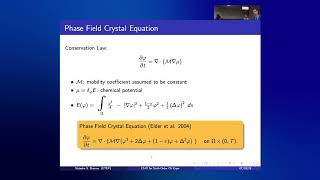
Continuous Interior Penalty Method Framework for 6th Order Cahn-Hilliard Equations
Explore unconditionally stable numerical methods for sixth-order Cahn-Hilliard equations, focusing on crystal growth and microemulsion systems. Gain insights into complex physical phenomena modeling.
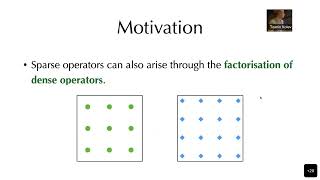
FSSpMDM - Accelerating Small Sparse Matrix Multiplications by Run-Time Code Generation
Explore code generation strategies for accelerating small sparse matrix multiplications in high-order finite element solvers, focusing on performant operator kernels for prismatic and hexahedral elements.
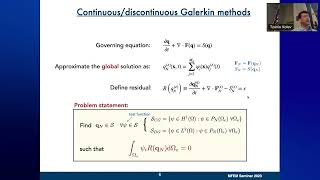
Using High-Order Element-based Galerkin Methods to Capture Hurricane Intensification
Explore high-order element-based Galerkin methods for capturing hurricane intensification, including multirate time integration and multi-modeling frameworks for improved atmospheric modeling.
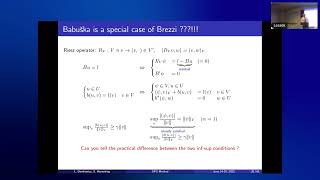
Full Envelope DPG Approximation for Electromagnetic Waveguides
Explore advanced finite element analysis for electromagnetic waveguides, focusing on stability and convergence of full envelope DPG approximation in optical amplifier simulations.
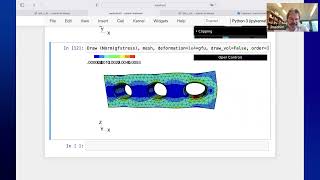
The Netgen/NGSolve Finite Element Software - Overview and Applications
Explore Netgen/NGSolve finite element software: overview, Python scripting, teaching applications, and recent developments in matrix-valued elements, GPU utilization, and time-dependent problems.
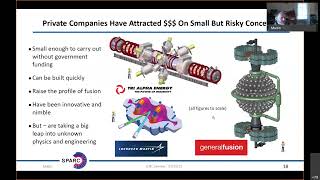
SPARC and the High-Field Path to Fusion Energy
Explore SPARC's high-field approach to fusion energy, its potential impact, and the latest advancements in this cutting-edge research field.
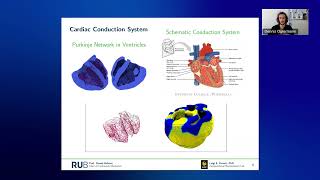
Computing Meets Cardiology: Making Heart Simulations Fast and Accurate
Explore advanced computational techniques for simulating heart function, focusing on efficient ECG calculations and electromechanical models using MFEM for improved cardiac disease understanding and treatment.
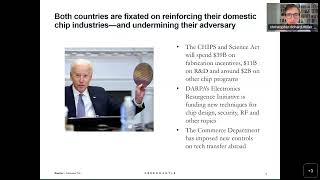
Chip War: The Fight for the World's Most Critical Technology
Explore the geopolitical battle for microchip supremacy and its impact on global power dynamics, military superiority, and economic prosperity.
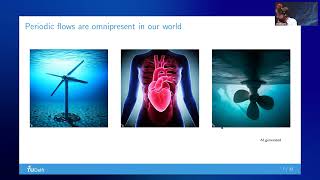
Computation and Reduced Order Modelling of Periodic Flows
Explore efficient computation and reduced order modeling techniques for periodic flows using MFEM, focusing on space-time domain solutions and hyper-reduced POD Galerkin models.
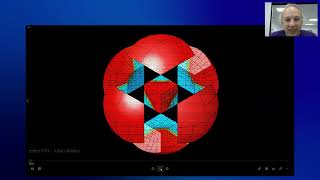
MFEM Workshop 2022 - Wrap-Up and Simulation Contest Winners
Explore MFEM Workshop 2022 highlights, including simulation contest winners showcasing advanced scientific visualizations in epilepsy research, heat sink optimization, and electromagnetic field modeling.
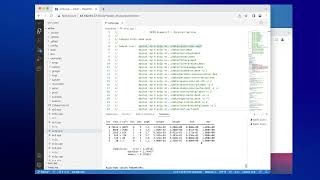
MFEM in the Cloud: AWS Tutorial for Scalable Finite Element Applications
Learn to use MFEM in the cloud for scalable finite element discretization application development with step-by-step instructions and hands-on demonstration.
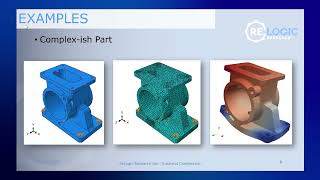
Accelerated Deployment of MFEM Based Solvers in Large Scale Industrial Problems
Explore MFEM-based Minerva platform for industrial-scale simulations, integrating with commercial software and enhancing solver capabilities for large-scale design and optimization problems.
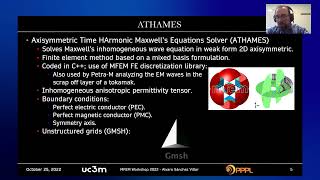
MFEM Application to EM-Wave Simulation in ECR Space Plasma Thrusters
Explore EM-wave simulation in ECR space plasma thrusters using MFEM. Learn about Maxwell equations, cold-plasma approximation, and finite element discretization for space propulsion applications.
MFEM Workshop 2022 - Welcome and Overview
Explore MFEM's high-order mathematical calculations for scientific simulations, community updates, and development roadmap in this workshop overview.
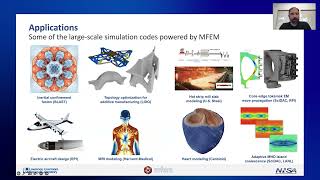
The State of MFEM - Workshop 2022
Explore MFEM's high-order mathematical calculations for scientific simulations, including key capabilities, examples, and future plans. Learn about the project's growth and recent software release.
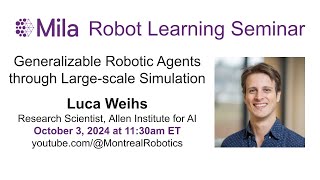
Generalizable Robotic Agents Through Large-Scale Simulation
Explore how large-scale simulation training produces proficient robotic agents capable of real-world navigation and manipulation using only RGB sensors, guided by language instructions.