
The Role of Frontend Code in Reducing Carbon Emissions
Explore strategies for reducing carbon emissions through frontend code optimization, covering sustainable web design principles and practical techniques for eco-friendly development.

Machine Learning Based on Stochastic Magnetic Tunnel Junctions
Explore spintronics-based neuromorphic systems for efficient machine learning, addressing device variability through in situ learning in Boltzmann machines for autonomous AI applications.
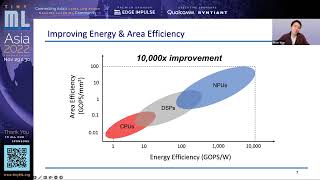
Software-Driven TinyML Hardware Co-Design for AI Power Smart Devices
Explore software-hardware co-design for efficient TinyML systems, focusing on processing-in-memory accelerators to reduce power consumption and enhance AI inference in smart devices.
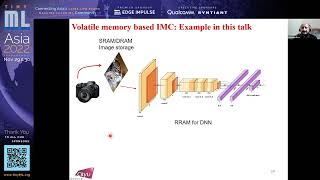
In-memory Computing and Dynamic Vision Sensors for Internet of Video Things
Exploring neuromorphic technologies, dynamic vision sensors, and in-memory computing for energy-efficient IoT video applications, with focus on innovative solutions for intelligent transportation and unattended ground sensors.
Neuromorphic Engineering Algorithms for Edge ML and Spiking Neural Networks
Explore cutting-edge neuromorphic engineering algorithms for edge ML, including hardware-friendly learning, spike-based intelligence, surrogate gradients, and meta-learning techniques.
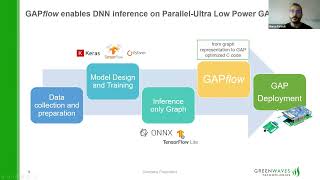
TinyML Auto ML Deep Dive: GAPflow - From TFLite and ONNX to Optimized C Code
Explore GAPflow: transform neural networks into optimized C code for ultra-low-power GAP processors. Learn quantization, validation, and memory allocation for efficient AI deployment on energy-constrained devices.
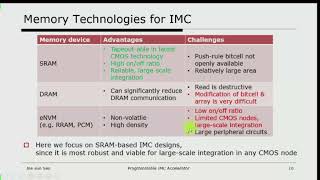
Programmable In-Memory Computing Accelerator with 100 SRAM IMC Macros
Explore programmable in-memory computing accelerators for efficient deep neural network processing, featuring 100 SRAM IMC macros and innovative architecture design for improved energy efficiency.
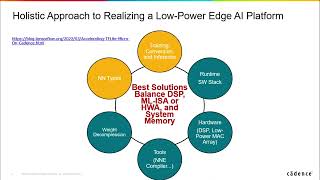
Dissecting a Low Power AI/ML Edge Application - Noise Suppression
Explore noise suppression in AI/ML edge applications, focusing on energy-efficient implementation for battery-powered devices and software frameworks for optimal user experience.
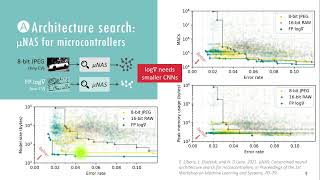
Improving Energy Efficiency and Robustness of tinyML Computer Vision Using Log-Gradient Input Images
Explore innovative techniques to enhance energy efficiency and robustness in tinyML computer vision, focusing on log-gradient input images and architecture optimization for microcontrollers.
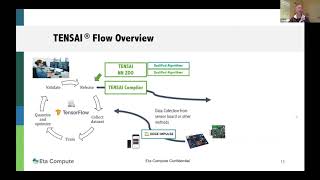
Enabling Neural Network at the Low Power Edge - A Neural Network Compiler
Explore neural network deployment in IoT devices, addressing challenges and optimizing for ultra-low power operation through hardware-software co-optimization and automatic code generation.
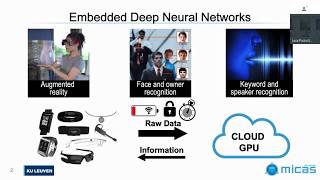
From Small to Tiny: Co-designing ML Models, Computational Precision, and Circuits - Energy-Accuracy Trade-offs
Explore co-designing ML models, computational precision, and circuits for energy-efficient tinyML systems. Learn about cross-layer optimization and cascaded networks for embedded applications.

Visual AI in Milliwatts - A Grand Challenge and Massive Opportunity
Explore visual AI's potential in low-power devices, discussing challenges, opportunities, and applications in security cameras and beyond. Learn about deep learning, processors, and algorithms driving this technology.
Energy-efficient On-device Processing for Next-generation Endpoint ML - tinyML Summit 2020
Explore energy-efficient on-device processing for endpoint machine learning, focusing on Arm's Cortex-M55 CPU and Ethos-U55 NPU for next-generation AI applications.
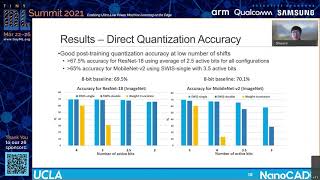
SWIS: Shared Weight Bit Sparsity for Efficient Neural Network Acceleration
Explore SWIS, a quantization framework for efficient neural network inference acceleration, offering improved performance and storage compression through weight decomposition and scheduling algorithms.
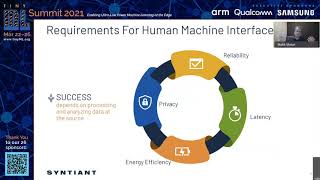
tinyML: Impact and Growth of Always-On Devices
Explore the growing impact of tinyML devices in everyday life, from always-on voice in phones to environmental sensing in machines, and learn about the market's rapid expansion and technological requirements.
Be the Change Our Planet Seeks: How You Can Contribute to Running Environment-Friendly Workloads on Kubernetes
Discover sustainable software engineering principles for Kubernetes workloads and learn actionable steps to reduce carbon footprint in your projects, contributing to a greener tech industry.
Use Knative When You Can and Kubernetes When You Must - Benefits and Best Practices
Explore Knative's advantages over Kubernetes for deploying services, including automation, simplification, auto-scaling, and improved security, while reducing costs and energy consumption.
Minimizing Energy Consumption in Bare Metal Kubernetes Clusters
Explore strategies to reduce energy consumption in bare metal Kubernetes clusters, covering hardware configuration, power management, and operational techniques while considering performance impacts.
Function Dedicated Network Deployment Model in DPU/IPU-Like Devices for Composable Disaggregated Infrastructure
Explore innovative hardware architectures and function dedicated networks using DPU/IPU technologies to reduce energy consumption and enhance performance in cloud-native infrastructures.
Optimizing Full-Stack Sustainability in a Real World Data Center - Practices and Lessons Learned
Explore practices for optimizing sustainability across heterogeneous computing systems. Learn about real-time data analysis, AI-driven failure prediction, and smart job scheduling to maximize efficiency and minimize power consumption.
Adding Runtime Power Management Capabilities to Device Drivers
Learn to implement Runtime Power Management in device drivers, focusing on the RPM subsystem, callback functions, and power optimization techniques using a light sensor driver example.