
FFT and Image Compression
Explore FFT-based image compression techniques, including natural image analysis, compression algorithms, and practical examples for efficient data representation.

Fourier Transforms
Explore the powerful Fourier transform, its applications in engineering, and its connection to orthogonal basis functions and Fourier series in this comprehensive mathematical lecture.
Alexander Volberg: The Probability of Buffon Needle to Land Near Cantor Set
Explore the probability of Buffon's needle landing near Cantor sets, delving into unexpected connections with various mathematical fields and theories.
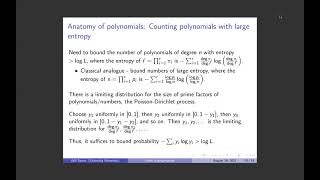
Sums in Progressions to Squarefree Moduli Among Polynomials Over a Finite Field
Explore polynomial sums in progressions to squarefree moduli over finite fields, covering Fourier analysis, polynomial anatomy, and arithmetic functions.
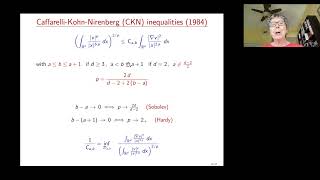
Functional Inequalities and Improvements: Stability - Part 2
Explore functional inequalities, their optimal constants, and stability properties. Learn strategies for addressing these issues and recent developments in improved inequalities for non-optimizers.
Splines and Imaging - From Compressed Sensing to Deep Neural Networks
Explore splines in imaging, from compressed sensing to deep neural networks. Unser demonstrates spline optimality in inverse problems and their connection to deep learning, offering insights into ReLU architecture and activation optimization.
Introduction to Dynamical Systems - Lecture 1
Explore dynamical systems, from linear ODEs to nonlinear chaos. Learn about equilibrium points, eigenvalues, attractors, and bifurcations. Gain insights into Lorenz systems, Poincaré maps, and iterative methods.
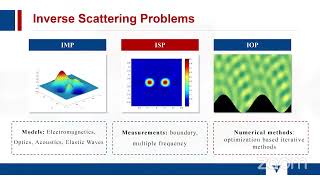
Mathematical Analysis and Numerical Methods for Inverse Scattering Problems
Explore mathematical analysis and numerical methods for inverse scattering problems, covering applications, challenges, algorithms, and recent progress in stability analysis and deep learning approaches.
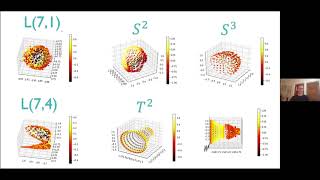
Intrinsic Topological Transforms via the Distance Kernel Embedding
Explore topological transforms for abstract metric spaces using distance kernel embedding, combining persistent homology with Euclidean embeddings for enhanced shape analysis and discrimination.
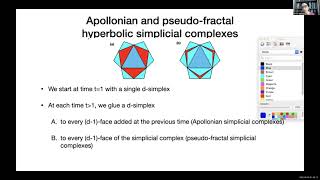
The Topological Dirac Operator and the Dynamics of Topological Signals
Explore topological signals, higher-order Laplacians, and the Dirac operator in network science. Learn about spectral properties, diffusion dynamics, and topological synchronization in simplicial complexes and multiplex networks.
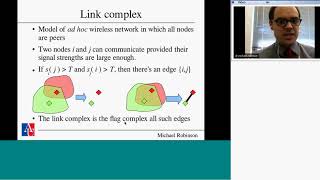
Sheaf Based Modeling of Wireless Communications
Explore sheaf-based modeling for wireless communications, covering topology, simplicial complexes, interference, and network activation. Learn about persistence, homological invariants, and simulation examples.
Michael Baake - A Cocycle Approach to the Fourier Transform of Rauzy Fractals
Explore Fourier transforms of Rauzy fractals and their role in analyzing spectra of Pisot inflation tilings, with applications to diffraction theory and dynamical systems.
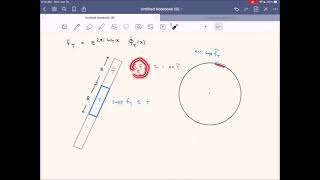
The Restriction Problem and the Polynomial Method - Lecture I
Explore Stein's restriction conjecture, the Kakeya conjecture, and the polynomial method in harmonic analysis. Learn about wave packet decomposition and its applications in studying hypersurface-supported functions.
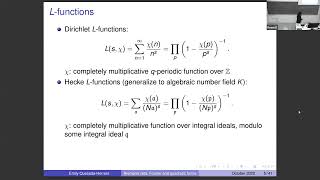
On the Riemann Zeta-Function, Fourier Optimization and Quadratic Forms
Explore the Riemann zeta-function, Fourier analysis, and quadratic forms in number theory. Delve into Selberg's theorem, Berry's conjecture, and representation of integers by quadratic forms.
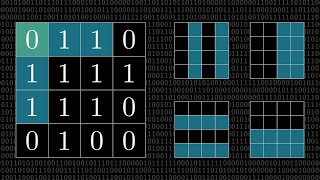
How to Send a Self-Correcting Message - Hamming Codes
Discover error correction codes through an engaging exploration of Hamming codes, learning how to create self-correcting messages for reliable data transmission.
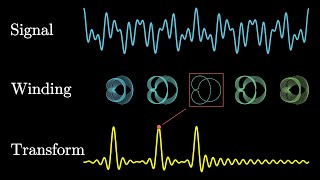
What is the Fourier Transform? A Visual Introduction
Animated exploration of the Fourier Transform, offering a visual and intuitive understanding of this complex mathematical concept. Ideal for those seeking a clear, engaging introduction to signal processing fundamentals.
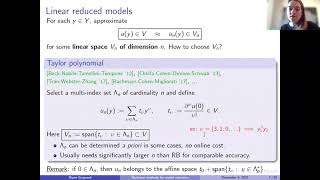
Nonlinear Reduced Models for Parametric/Random PDEs
Explore efficient techniques for constructing reduced models of parametric/random PDEs, focusing on error estimation, library construction, and practical applications in thermal systems and state estimation.

Data-Driven Discovery of Linear Dynamical Systems Over Graphs via Dynamical Sampling
Explore linear dynamical systems on graphs through data-driven discovery, focusing on efficient recovery of missing information and optimal sampling strategies for graph signal processing.
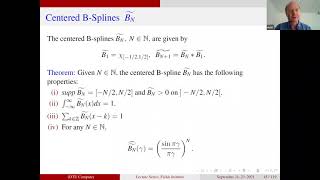
Introduction to Frames and Riesz Bases - Part 2
Explore Fourier transforms, wavelet theory, and Gabor frames in this advanced mathematics lecture, focusing on recent developments in frame theory and Riesz bases.
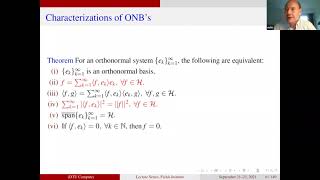
Introduction to Frames and Riesz Bases - Part 1
Explore key concepts of frames and Riesz bases in functional analysis, including characterizations, properties, and applications like Sigma-Delta quantization.
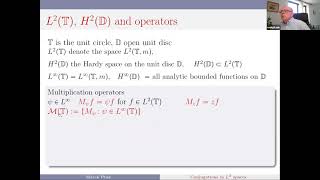
Conjugations in L2 Spaces on the Unit Circle and the Real Line
Explore conjugations in L2 spaces, examining various types and their applications on the unit circle and real line. Includes examples and connections to Fourier transforms.