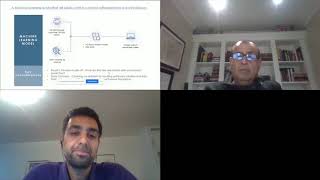
Predicting and Preventing Customer Technical Issues Using Machine Learning and RPA
Predict and proactively resolve customer technical issues using machine learning and robotic process automation, improving service efficiency and customer satisfaction in telecom.
Anarcho-transhumanist Biohacking with Nerves - The Tamagotchi in my Hands
Explore anarcho-transhumanist biohacking through a unique lens: embedding Clippy on a chip in the body, challenging centralized data control and reimagining virtual assistants.
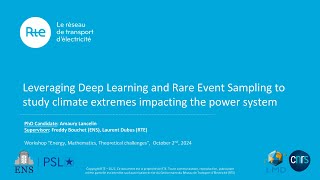
Leveraging Deep Learning and Rare Event Sampling to Study Climate Extremes Impacting the Power System
Explore deep learning and rare event sampling techniques for analyzing climate extremes' impact on power systems.
Adaptive Regularization and Linearization for Nonsmooth and Degenerate Problems
Explore advanced mathematical techniques for solving nonsmooth and degenerate problems in flow and transport, focusing on adaptive regularization methods and Newton-based linearization approaches.

The Discrete Fourier Transform - Most Important Algorithm Ever?
Explore the Discrete Fourier Transform's derivation, properties, and significance in modern technology through a discovery-oriented approach, from basic concepts to complex exponentials.

Complex Numbers for Audio Signal Processing
Explore complex numbers visually for audio signal processing, covering Cartesian and polar representations, Euler's formula, and their application in Fourier transforms.
Dealing with Linear Constraints via Random Permutation
Explore linear constraint optimization using random permutation techniques, focusing on ADMM variants, spectral analysis, and convergence rates for large-scale problems.

Convolution and the Fourier Series
Explore convolution and its relation to Fourier series, unraveling complex mathematical concepts through clear explanations and real-world analogies.
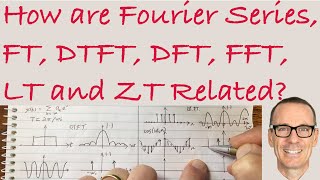
How Are the Fourier Series, Fourier Transform, DTFT, DFT, FFT, LT and ZT Related?
Comprehensive exploration of Fourier analysis techniques, from series to transforms, explaining relationships and applications in signal processing and communications.
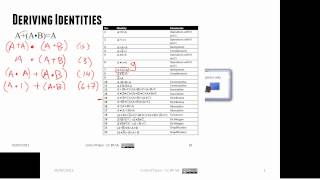
Digital Circuits Boolean Algebra
Learn Boolean algebra fundamentals and digital circuit simplification techniques, including key rules and operations for efficient logic design and analysis.
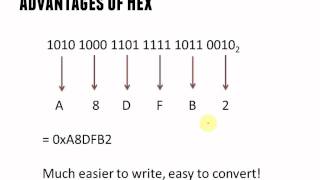
Digital Circuits Number Systems
Learn about number systems in digital circuits, including decimal, binary, and hexadecimal conversions. Explore power representations and practical examples for a solid foundation in digital logic.
Remarks on the Discrete Cube
Explore probability theory on the discrete cube, covering Fourier analysis, Poisson inequality, and random walks, with applications in high-dimensional geometry and computation.
Sets, Logic and Graphs - Math Terminology - NJ Wildberger
Review of high school math language and notation for sets, logic, and basic graph theory. Covers key concepts like union, intersection, subsets, logical statements, and graph circuits, providing essential foundations for advanced mathematics.
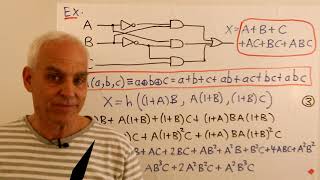
Boole Reduction - A Challenge for Programmers - MathFoundations - N J Wildberger
Exploring challenges in implementing Boole reduction for circuit analysis, including programming strategies and SAT solver development in the Algebra of Boole context.
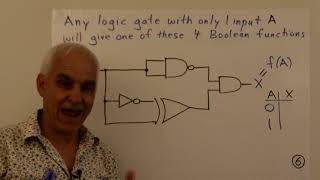
Canonical Forms for Logic Circuits - Math Foundations
Explore canonical forms for logic circuits, Boolean functions, and their geometric interpretations. Learn to express Boolean functions algebraically using Boolean algebra and Boole's original algebra.
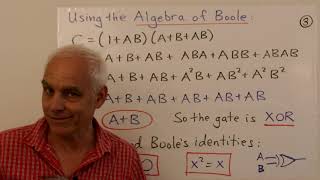
How the Algebra of Boole Simplifies Circuit Analysis - Math Foundations - N J Wildberger
Explore how the Algebra of Boole simplifies circuit analysis, comparing it with traditional Boolean algebra for encoding logic gates and solving engineering problems.
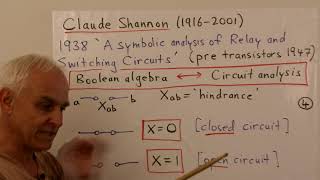
Boolean Algebra and Shannon's Circuit Analysis - Math Foundations - N J Wildberger
Explores Boolean algebra's connection to circuit analysis, focusing on Huntington's formulation and Shannon's groundbreaking 1938 paper linking the two fields.
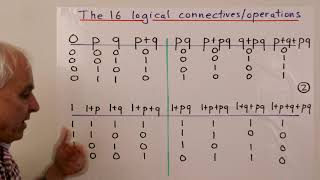
Implication and Logical Operations - Math Foundations - N J Wildberger
Explore 16 logical operations, including AND, OR, XOR, and implication, with applications to Boolean algebra and circuit analysis. Gain insights into Modus Ponens and Boole's algebra for solving electrical engineering problems.
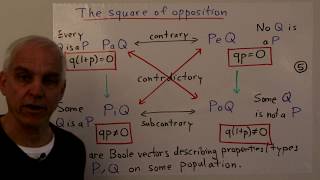
The Algebra of Boole is Not Boolean Algebra - Math Foundations - N J Wildberger
Exploring the Algebra of Boole, its relation to Boolean algebra, and its role in logic and circuit analysis. Discusses syllogisms, the Square of Opposition, and Boole's proofs of Aristotle's arguments.
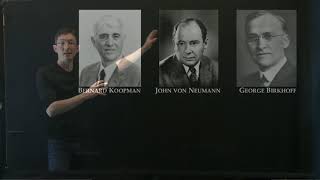
Koopman Spectral Analysis - Overview
Explore Koopman operator theory for dynamical systems, its recent resurgence, and applications like Dynamic Mode Decomposition in this comprehensive overview.
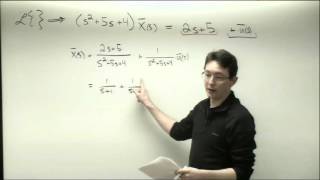
Laplace Transform and ODEs with Forcing and Transfer Functions
Explore Laplace transforms, ODEs, and transfer functions in engineering mathematics, focusing on spring-mass-damper systems and frequency response analysis.