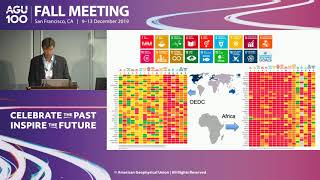
How Space Agencies Are Responding to Grand Challenges in Earth System Science
Explore how space agencies address Earth observation challenges, focusing on energy, water, carbon cycles, and global environmental changes to support understanding, forecasting, and mitigation efforts.
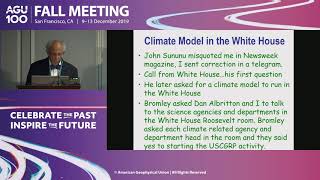
WCRP: Progress in Earth System Climate Science and Predictions
Showcases USGCRP contributions to Earth system climate science, highlighting research milestones, predictability advancements, and model development. Includes agency presentations and community discussions on priorities.

Advent of the Anthropocene Epoch - Quantifying Drivers and Impacts Since 1950 CE
Explores the Anthropocene epoch's onset around 1950, examining human energy consumption, population growth, and their profound impacts on Earth's systems and stratigraphic record.
Benjamin Franklin Lecture - Atmospheric Electricity Research
Explore lightning's impact on Earth's climate and atmosphere with expert Hugh J Christian Jr in this insightful AGU lecture on cutting-edge research and future directions.
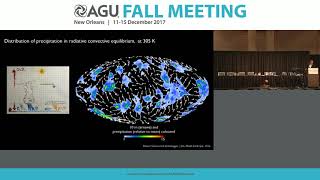
Climate Science and the Charney Problem - 2017 Fall Meeting Lecture
Explore climate sensitivity and cloud feedback with Bjorn B Stevens from Max Planck Institute for Meteorology in this insightful lecture on atmospheric science and climate change.
Understanding Climate Dynamics Through Linear Response Theory
Explore climate dynamics using Linear Response Theory. Learn how this mathematical framework helps predict and analyze complex climate system behaviors, offering insights into future climate scenarios.
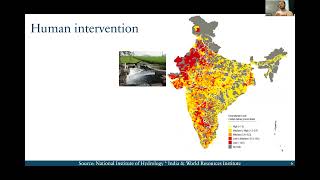
The Sky is Falling - Precipitation Observations and Their Role in Understanding the Earth System
Explore precipitation observations and their impact on Earth system understanding in this seminar for early career atmospheric scientists.
Data Assimilation - Basic Theory
Explore fundamental concepts and methods of data assimilation in weather and climate modeling, including uncertainty estimation and applications in atmospheric and oceanic sciences.
Data Assimilation - Basic Theory - Lecture 2
Explore advanced data assimilation theory, methods, and applications in weather and climate modeling. Gain insights into uncertainty estimation and remote sensing observation utilization.
Weather and Climate Modelling - Advances and Challenges
Explore cutting-edge weather and climate modelling techniques with expert talks and Q&A from leading researchers in the field of Climate Informatics.
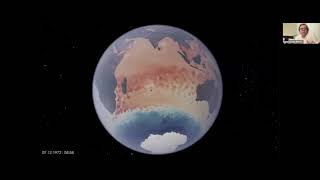
Earth Virtualization Engines (EVE) for Climate Change Modeling
Explore Earth Virtualization Engines (EVE) and their potential impact on climate change research with Bjorn Stevens from MPI Hamburg.
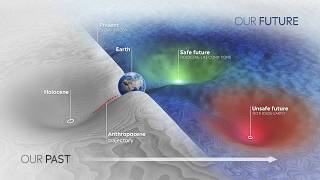
The Tipping Points of Climate Change and Where We Stand
Climate impact scholar Johan Rockström provides an up-to-date scientific assessment of Earth's resilience to human pressure, explaining the current state of climate change and necessary actions to preserve our planet.
Estimating Oxygen in the Southern Ocean Using Argo Temperature and Salinity - Donata Giglio
Explore innovative techniques for estimating oxygen levels in the Southern Ocean using Argo float data. Learn how temperature and salinity measurements contribute to understanding ocean biogeochemistry and climate change impacts.
Representation Learning and Custom Loss Functions for Atmospheric Data - Christian Lessig
Explores representation learning and custom loss functions for atmospheric data analysis, advancing climate science through machine learning techniques to extract insights from complex Earth system observations.
Lessons and Outlook for ML Parameterization of Sub Grid Atmospheric Physics From the Vantage of Emulating Cloud Superparameterization - Mike Pritchard
Exploring machine learning for atmospheric physics parameterization, focusing on cloud superparameterization emulation. Discusses challenges, strategies, and lessons learned in applying ML to climate modeling.
Benefits of Saying I Don't Know When Analyzing and Modeling the Climate System With ML - Elizabeth Barnes
Explore the benefits of acknowledging uncertainty in climate system analysis using machine learning. Learn about state-dependent predictability and controlled abstention networks for improved modeling accuracy.
Interpretable and Generalizable Machine Learning for Fluid Dynamics - Steven Brunton
Explore interpretable and generalizable machine learning techniques for fluid dynamics, focusing on sparse identification of nonlinear dynamics and incorporating physical constraints for improved accuracy.

Sovereignty and the Earth System - A New Legal Approach
Exploring a new legal approach to sovereignty considering Earth System science, proposing integration of Earth System concepts into international law to address global environmental challenges.
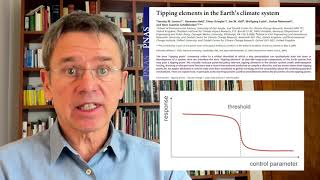
Climate Tipping Points
Erforschung von Kipppunkten im Klimasystem: Risiken, Auswirkungen und Handlungsmöglichkeiten zur Begrenzung der globalen Erwärmung auf 1,5°C, um katastrophale und irreversible Veränderungen zu verhindern.
GENIE: Generative Foundation Models for Automated Climate Science
Explore generative foundation models for automated climate science with Rose Yu's GENIE project, advancing AI applications in environmental research.
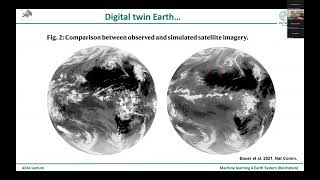
Deep Learning and Process Understanding for Data-Driven Earth System Science - Lecture 37
Explore deep learning applications in Earth System Science, focusing on process understanding and data-driven approaches to environmental research and analysis.