Quantifying Resilience in Complex Systems - From Humans to Ecosystems
Explore quantitative methods for measuring resilience in diverse systems, from ecosystems to human psychology, using critical slowing down and probabilistic approaches to understand tipping points and recovery.
Estimating Fluxes in the Carbon Cycle
Dive into estimating fluxes in the carbon cycle with insights from Anna Michalak's talk at the Keck Institute for Space Studies short course on quantifying emissions.
Enabling Spectral Indices Computation with SpectralIndices.jl
Explore SpectralIndices.jl, a Julia package simplifying spectral indices computation in remote sensing. Learn its features, data compatibility, and user-friendly interface for efficient Earth system research analysis.

Global Environmental Policy - Sagan Lecture Seminar Series
Explore global environmental governance with Michele Betsill, examining how Earth system observations inform policy actions and the role of diverse actors in addressing climate change.
Advancing Earth System Predictability with Machine Learning Methods
Explore machine learning methods for improving Earth system predictions, featuring insights from Dan Lu of Oak Ridge National Laboratory on enhancing climate modeling and forecasting.
Causal Inference for Earth System Sciences - Jakob Runge
Exploring causal inference techniques for Earth system sciences, focusing on advanced methods to uncover complex relationships in climate data and improve understanding of multi-scale processes.
A Deep Learning Parameterization of Gravity Wave Drag Coupled to an Atmospheric Global Climate Model - Aditi Sheshadri
Explores deep learning parameterization of gravity wave drag in climate models, demonstrating improved predictions of atmospheric phenomena like the QBO and potential for generalizing to future climate scenarios.
Earth System Emulation - Duncan Watson-Parris #CLIMATE-C21
Explore Earth system emulation for climate projections, uncertainty analysis, and machine learning applications in weather and climate science. Gain insights into advanced modeling techniques and data-driven approaches.
Contained Chaos - Ensemble Consistency Testing for the Community Earth System Model
Explore ensemble consistency testing for climate models, focusing on the Community Earth System Model. Learn about statistical methods to evaluate model changes and ensure software quality in climate simulations.
Atmospheric Radiation - Using Machine Learning for the Unknowable and Uncomputable - Robert Pincus
Exploring machine learning applications in atmospheric radiation to tackle unknowable and uncomputable aspects, enhancing climate modeling and understanding of Earth's energy balance.
Relating Coastal Sea Level to Its Drivers in the Interior - Abigail Bodner
Explore the connection between coastal sea levels and interior drivers using advanced data analysis and machine learning techniques to enhance climate change understanding and prediction.
Deep Unsupervised Learning for Climate Informatics - Claire Monteleoni
Exploring deep unsupervised learning techniques for climate data analysis, focusing on innovative approaches to extract insights from complex Earth system observations and modeling data.
Exploring Physical and Machine Learning Approaches for Stochastic Modeling and Ensemble Prediction of Weather and Climate
Explores innovative approaches combining physical principles and machine learning for stochastic modeling and ensemble prediction in weather and climate systems, addressing challenges in multi-scale processes and future projections.
Data-Driven Subgrid-Scale Modeling - Stability, Extrapolation, & Interpretation
Explores data-driven subgrid-scale modeling in climate science, focusing on stability, extrapolation, and interpretation. Discusses advancements in theoretical understanding and the potential of machine learning to address complex climate processes.
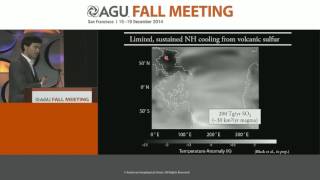
Trouble Upstairs: Reconstructing Permian-Triassic Climate during Siberian Traps Magmatism
Explore the impact of Siberian Traps magmatism on Permian-Triassic climate, examining its effects on atmospheric chemistry, ocean circulation, and potential extinction mechanisms.
History of Global Warming - Stephen Schneider Global Environmental Change Lecture
Comprehensive exploration of global warming's historical development, examining key scientific discoveries, policy milestones, and societal impacts shaping our understanding of climate change.
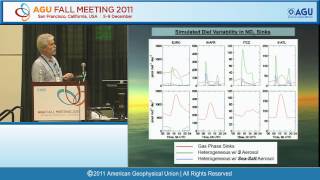
Atmospheric Sciences New Fellows Presentations - Part II
Explore cutting-edge atmospheric science research presented by newly elected AGU Fellows. Gain insights into the latest advancements and discoveries in the field.
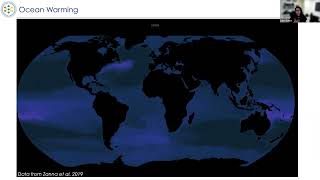
Multiscale Physics in the Climate System
Explore multiscale physics in climate systems with Professor Laure Zanna, delving into complex interactions and their impact on global climate dynamics.
Earth System Perspectives Inspired by Carl Sagan - AGU Lecture
Explore Earth system perspectives inspired by Carl Sagan's work in this lecture featuring expert discussions, Q&A, and an early career panel, honoring Sagan's contributions to astrobiology and science education.

COVID-19 and the Earth System
Explore the impacts of COVID-19 mitigation strategies on emissions, the Earth System, and virus dynamics. Learn about research efforts examining these complex interactions.
World Climate Research Program: Climate Research for the 21st Century
Explore the evolution of climate science, WCRP's role, and future directions. Engage in discussions on Earth system analysis, prediction advancements, and upcoming research challenges.