Teoria Ergódica Diferenciável - Aula 22
Explore advanced concepts in Differentiable Ergodic Theory, including invariant measures, Poincaré and Birkhoff recurrence theorems, ergodic decomposition, and topological entropy in mathematical dynamics.
Fractal Geometry of the Markov and Lagrange Spectra and Their Set Difference
Delve into the fractal geometry of Markov and Lagrange spectra, exploring their set differences and mathematical properties through advanced number theory and geometric analysis.
Mixing Times in Ising Dynamics
Delve into the mathematical analysis of mixing times in Ising dynamics, exploring quantum algorithms and their applications to open quantum systems through advanced theoretical frameworks.
Teoria Ergódica Diferenciável - Aula 21
Explore advanced concepts in Differentiable Ergodic Theory, including invariant measures, Poincaré and Birkhoff recurrence theorems, ergodic decomposition, and topological entropy in mathematical dynamics.
Mathematical Computation in Wolfram Language Version 14.1
Explore the latest mathematical advancements in Wolfram 14.1, including symbolic-dimensional arrays, stability analysis of dynamical systems, and PDE modeling improvements.
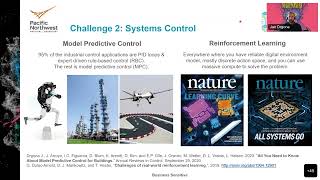
Differentiable Programming for Modeling and Control of Dynamical Systems
Explore differentiable programming for optimal control of dynamical systems, focusing on differentiable predictive control and its applications in building control and power systems optimization.
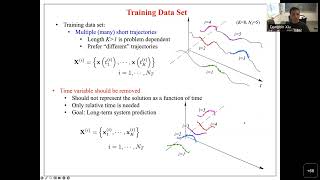
Data-Driven Modeling of Unknown Systems with Deep Neural Networks
Explore data-driven modeling of unknown systems using deep neural networks. Learn to discover and approximate evolution operators for predictive analysis across various problem domains.
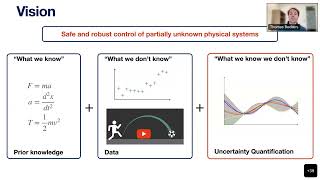
Physics-Enhanced Gaussian Processes for Learning of Electromechanical Systems
Explore physics-enhanced Gaussian processes for modeling electromechanical systems. Learn about GP-PHS and physics-enhanced variational autoencoders to improve data efficiency and ensure physical correctness.
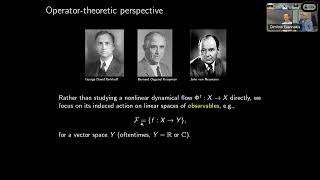
Quantum Information and Data Science for Modeling Classical Dynamics
Explore quantum information and data science approaches for modeling classical dynamics, focusing on operator-theoretic techniques and their applications in dynamical systems and climate modeling.
Turing Patterns in Mathematical Biology
Explore Turing patterns in mathematical biology, examining their formation and applications in biological systems. Gain insights into this fascinating intersection of mathematics and biology.
Koopman Operator Theory Based Machine Learning of Dynamical Systems
Explore Koopman Operator Theory for machine learning of dynamical systems, covering applications in fluid dynamics, power grids, network security, and more.
Cellular Cooperation in Cochlear Mechanics
Explore contrasting views of cochlear mechanics, including Hopf bifurcations and 3-D simulations, to understand nonlinear cochlear responses and their implications.
Geodesic Flow on Surfaces Without Conjugate Points - Part 2
Explore geodesic flow on surfaces without conjugate points in this advanced mathematical lecture, delving into complex dynamics and geometric concepts.
Geodesic Flow on Surfaces Without Conjugate Points - Part 3
Explore geodesic flow on surfaces without conjugate points in this advanced mathematical lecture, focusing on dynamics and geometric analysis.
Geodesic Flow on Surfaces Without Conjugate Points - Part 1
Explore geodesic flow on surfaces without conjugate points in this advanced mathematics lecture. Delve into complex geometric concepts and their applications in surface dynamics.
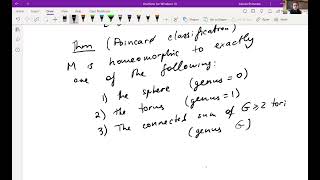
Flexibility Ideas for Geodesic Flow
Explore innovative concepts in geodesic flow flexibility, uncovering dynamic approaches and mathematical insights for advanced understanding.
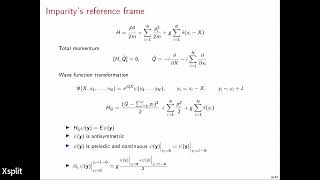
Exact Results for One-Dimensional Mobile Impurity
Explore integrable models of mobile impurities in one-dimensional fermion gases, examining nonperturbative solutions, Fredholm determinants, and phenomena like incomplete relaxation and momentum-dependent statistics.
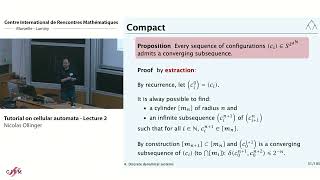
Tutorial on Cellular Automata - Lecture 2
Explore advanced concepts in cellular automata, including complex patterns and computational models, in this in-depth mathematical lecture.
Approximating Entropy and Pressure for Multidimensional Shifts of Finite Type
Explore multidimensional symbolic dynamics and entropy approximation in shifts of finite type with Ronnie Pavlov's advanced mathematical lecture.
Numerical Relativity in Effective Field Theories of Gravity
Explore gravitational-wave astronomy and its implications for testing General Relativity, focusing on waveform predictions, higher curvature corrections, and numerical simulations in effective field theories of gravity.
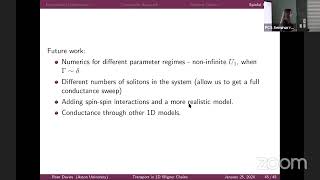
Resonant Fractional Conductance in 1D Wigner Chains
Explore resonant fractional conductance in 1D Wigner chains, focusing on quantum point contacts, fractionally charged solitons, and conductance patterns in spinless and spinful cases.