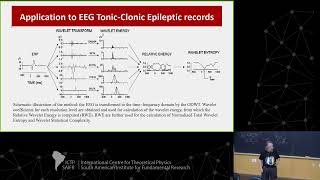
Information Theory Tools for Neuroscience Applications - Class 3
Explore advanced information theory tools and their applications in neuroscience, focusing on complex network analysis and nonlinear dynamics.
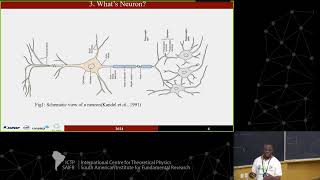
Collective Behaviors in Neuronal Networks Under the Actions of Electric and Magnetic Fields
Explore collective behaviors in neuronal networks influenced by electric and magnetic fields, examining dynamics and implications for complex network processes.
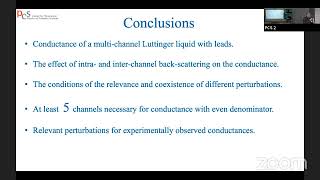
Fractional Conductances in Strongly Interacting 1D Systems
Explore fractional conductances in strongly interacting 1D systems with N channels. Analyze conditions for perturbation coexistence, gap opening, and conductance calculations in complex quantum systems.
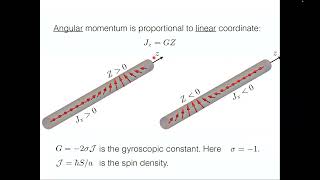
Mechanics of Ferromagnetic Solitons
Explore the fascinating world of ferromagnetic solitons, their mechanics, and potential applications in information storage and processing. Discover surprising behaviors and connections to other areas of mechanics.

The Geometry of the Deep Linear Network
Explore the geometric principles underlying deep linear networks, uncovering their mathematical foundations and implications for machine learning algorithms.
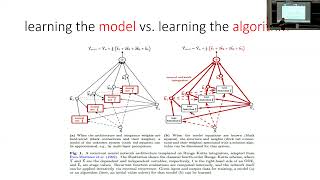
Data and Complex Systems Modeling: Past and Present Perspectives
Explore insights on data-driven modeling of complex systems, blending historical perspectives with current approaches in machine learning and dynamical systems.
Thermalization in Large Classical and Quantum Harmonic Systems
Explore the fascinating dynamics of thermalization processes in classical and quantum harmonic systems, examining their behavior and fundamental principles in complex physical environments.
Renormalization Group of the Inviscid Limit
Explore the renormalization group dynamics in multi-scale systems, focusing on hydrodynamic turbulence and the inviscid limit. Gain insights into RG operators, fixed-point attractors, and chaotic dynamics.
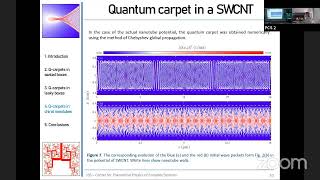
The Quantum Carpets in a Leaky-Box: Poincare's Recurrences in the Continuous Spectrum
Explore quantum carpets in leaky-box systems, generalizing Poincaré recurrences for continuous spectra. Discover novel approaches to resonant state renormalization and coherence analysis using Wigner functions.
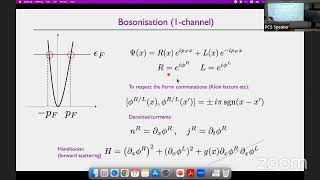
Fractional Conductance in One-Dimensional Constrictions
Explore theoretical models and Luttinger approach for fractional conductance in one-dimensional constrictions, examining recent experimental observations and potential fractions.
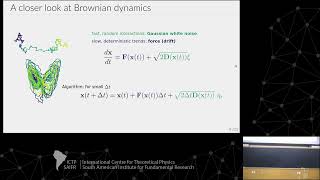
From Trajectories to Models: Data-Driven Approaches to Decipher the Dynamics of Living Systems
Explore data-driven methods for deciphering living systems' dynamics, focusing on transforming trajectories into models for deeper biological insights.
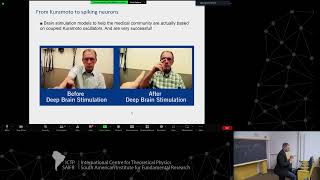
Structure-to-Function Relationship in Neuronal Cultures: Applications to Biological Machine Learning and Reservoir Computing - Class 1 of 3
Explore structure-function relationships in neuronal cultures, focusing on biological machine learning and reservoir computing applications.
Quantitative Foundations of Ecological and Evolutionary Dynamics - Class 02
Explore quantitative foundations of ecology and evolution through advanced mathematical concepts and modeling techniques in this comprehensive lecture.
Quantitative Foundations of Ecological and Evolutionary Dynamics - Class 01
Explore quantitative foundations of ecology and evolution with Joshua Weitz, covering key concepts and mathematical approaches for understanding complex biological systems.
René Thom's Archetypal Morphologies of Human Language and Semiophysics
Explore René Thom's contributions to linguistics and semiotics, focusing on archetypal morphologies and semiophysics. Discover the impact and ongoing developments of his topological and dynamic approach.
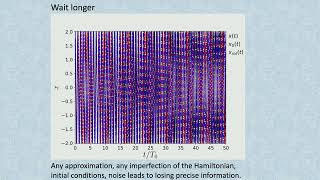
Dynamics Close to Equilibrium and Chaos - Lecture 1
Explore fundamental concepts of dynamics near equilibrium and chaos, delving into theoretical frameworks and applications in condensed matter physics.
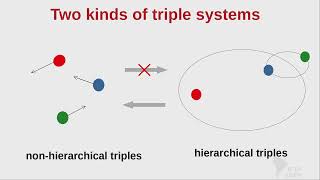
Isles of Regularity in a Sea of Chaos Amid the Gravitational Three-Body Problem
Explore the gravitational three-body problem, uncovering islands of regularity within chaotic dynamics. Gain insights into complex celestial mechanics and their implications.
Nonlinear Dynamics of Neuronal Models with Applications to Bird Song Dynamics - Class 3
Explore nonlinear dynamics in neuronal models and their application to bird song, focusing on advanced concepts and real-world implications in neuroscience.
Time Series Analysis Tools with Applications to Neuroscience - Class 3
Explore advanced time series analysis techniques and their applications in neuroscience, focusing on complex network analysis and information theory.

Mean Field Limit in Neural Network Learning
Explore the mean field limit in neural network learning, examining optimization dynamics, convergence to global optima, and data representation in autoencoders. Gain insights from physics analogies.

The Mathematical Universe Behind Deep Neural Networks - Rothschild Lecture
Explore the mathematical foundations of deep neural networks, covering functional analysis, harmonic analysis, complex analysis, approximation theory, and more with Professor Helmut Bölcskei.