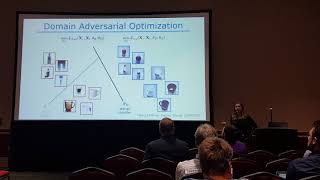
Making Our Models Robust to Changing Visual Environments
Explore techniques for making machine learning models robust to changing visual environments, covering domain adaptation, adversarial optimization, and continuous learning strategies.
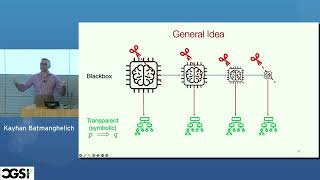
Divide and Conquer: Carving Out Symbolic Models from BlackBox for More Efficient Domain Adaptation
Explore techniques for extracting symbolic models from black-box systems, enhancing domain adaptation efficiency in computational genomics and medical imaging.

RAG vs PEFT - Comparing LLM Domain Adaptation Methods
Delve into LLM 도메인 적용을 위한 RAG와 PEFT 방식의 비교 분석과 SK브로드밴드의 실제 구현 사례를 통한 AWS 환경 구축 및 모델 개발 노하우
Why GenAI Needs Careful Training Data Management
Explore the critical role of training data management in GenAI, including harmonization across stages and its impact on model effectiveness and safety in various domains and languages.
When, Why and How to Fine-Tune LLMs for Enterprise Applications
Explore techniques for customizing large language models in enterprise settings, including when and why to align LLMs and key methods for domain-specific adaptation.

Covariate Shift - Challenges and Good Practice in Machine Learning
Explore challenges and best practices in covariate shift, a crucial concept in machine learning, with insights on improving model performance and adaptability in changing data distributions.
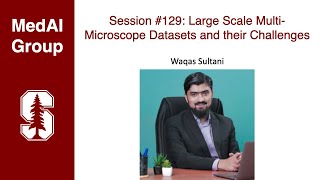
Large Scale Multi-Microscope Datasets and Their Challenges in Medical AI
Explore groundbreaking research on multi-microscope datasets for malaria and leukemia detection, featuring innovative domain adaptation techniques and object detection methods to enhance early disease diagnosis.

Taming Dataset Bias via Domain Adaptation
Explore techniques to address dataset bias in deep learning, including adversarial domain alignment, pixel space alignment, and consistency enforcement for improved model generalization.

Domain Adaptation on Wheels: Closing the Gap to the Open-world
Explore domain adaptation techniques for autonomous driving, from standard unsupervised setups to practical approaches addressing open-world challenges in semantic segmentation and scene understanding.
Domain Adaptation - 20 Years of Theory Chasing Practice
Explore the evolving relationship between theoretical frameworks and practical applications in domain adaptation learning, examining key insights, challenges, and the widening theory-practice gap.
Domain Adaptation and Related Areas in Machine Learning
Dive into domain adaptation concepts and related machine learning areas with Carnegie Mellon expert Zachary Lipton, exploring theoretical frameworks and practical applications.
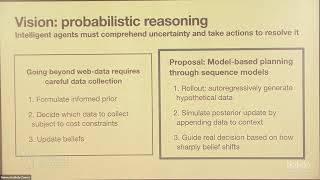
Adaptive Data Collection via Autoregressive Generation in News Recommendation Systems
Discover how autoregressive models can enhance adaptive data collection and decision-making through Thompson sampling, with applications in news recommendation systems and cold-start problems.
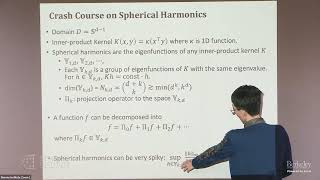
Toward Understanding the Extrapolation of Nonlinear Models to Unseen Domains
Explore advanced concepts in domain adaptation and model extrapolation, focusing on nonlinear models' behavior in unseen domains through theoretical and practical analysis.
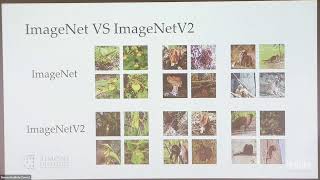
Language-Guided Domain Adaptation
Explore cutting-edge techniques in domain adaptation and language-guided methods with UC Berkeley expert Trevor Darrrell, focusing on advanced machine learning applications and methodologies.
Causally Motivated Robustness to Shortcut Learning in Machine Learning
Delve into techniques for building robust machine learning models that maintain performance under distribution shifts, with a focus on preventing shortcut learning through causal regularization methods.
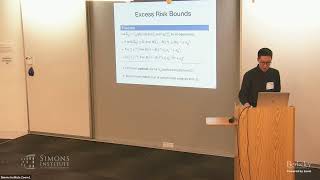
Pseudo-Labeling for Covariate Shift Adaptation in Machine Learning
Explore advanced covariate shift adaptation techniques using pseudo-labeling methods for regression tasks, focusing on kernel ridge regression and bias-variance optimization for target distributions.
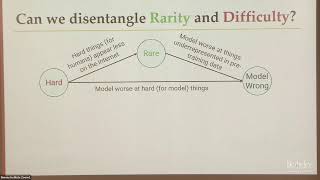
The Evolution of Domain Transfer in the Era of Pre-trained Language Models
Explore the complex relationship between pre-trained language models and domain transfer, examining how pre-training affects model understanding and pattern recognition across different contexts.
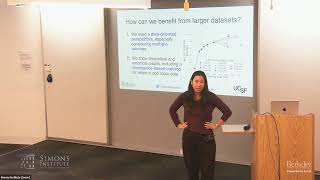
The Data Addition Dilemma: Navigating Distribution Shifts in Machine Learning
Explore the complexities of combining data sources in machine learning, examining when adding more data helps or hurts model performance and fairness across different distributions.
Distribution Shift in Ecological Data - Generalization vs. Specialization
Explore the balance between general and specific computer vision approaches for ecological challenges, focusing on data shifts, adaptation methods, and real-world applications.
Transfer Learning via Local Convergence Rates of the Nonparametric Least Squares Estimator
Explore nonparametric least squares estimator's local convergence properties and their implications for transfer learning under covariate shift, focusing on weighted uniform norm optimization.
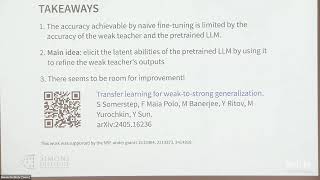
Transfer Learning for Weak-to-Strong Generalization in Language Model Alignment
Explore how to effectively transfer latent knowledge from weak to strong language models, focusing on alignment techniques and practical applications in LLM development.