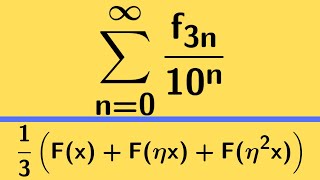
Generating Functions and Combinatorial Identities
Explore techniques for manipulating generating functions to create new combinatorial sum identities, with an application to Fibonacci number sums.
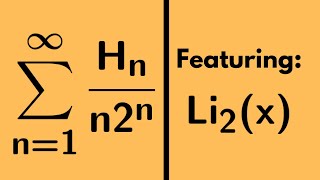
A Series Involving Harmonic Numbers - Featuring the Dilogarithm Function
Explore generating functions to calculate sums of series with harmonic numbers, featuring the dilogarithm function in advanced mathematical analysis.
What Is It Like to Be a Pure Mathematician?
Explore the life of a pure mathematician, delving into abstract algebra, group theory, and partitions. Gain insights into the field's challenges, problem-solving approaches, and the beauty of elegant proofs.
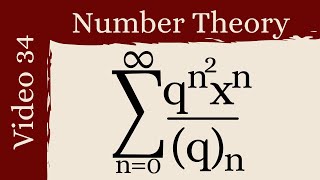
Difference at Distance 1 - Number Theory
Explore number theory concepts focusing on difference 2 at distance 1, with examples, proofs, and generating functions to deepen understanding of this mathematical topic.
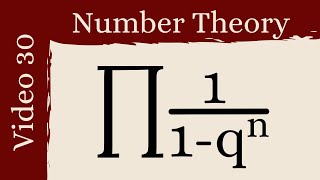
How to Use Generating Functions with Integer Partitions - Number Theory
Explore generating functions in integer partitions, including unrestricted and restricted cases, with applications to odd parts and rational functions in number theory.
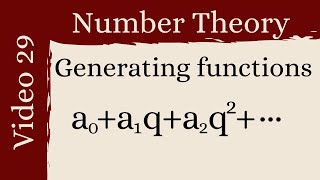
Generating Functions - Number Theory
Explore generating functions in number theory, learning their applications and techniques for solving complex mathematical problems.
Catalan Numbers - Generating Function and Closed Form
Explore generating functions and closed forms for Catalan numbers, building on recursion concepts to derive a comprehensive understanding of this important mathematical sequence.
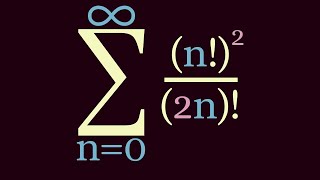
So Many Factorials
Explore advanced mathematical techniques to evaluate complex factorial series, utilizing central binomial coefficients, generating functions, and trigonometric integrals for problem-solving.
A Mysterious Chinese Contest Problem
Explore generating functions for integer partitions to solve a challenging math contest problem, enhancing problem-solving skills and deepening understanding of advanced mathematical concepts.
Daniel Dadush- Integer Programming and the Kannan-Lovasz Conjecture
Explore advanced integer programming techniques, lattice theory, and the Kannan-Lovasz conjecture in this high-level overview of solving n-variable integer programs efficiently, with insights into recent progress and key concepts.
Graph Theory Basics - Types of Graphs - Components of Graph
Explore graph theory fundamentals, including types, components, and applications. Learn about vertex degrees, handshaking lemma, and various graph classifications. Gain insights into adjacency matrices for network analysis.
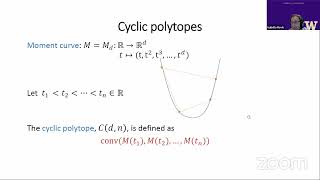
Isabella Novik - Face Numbers - The Upper Bound Side of the Story
Explore face numbers in simplicial polytopes and sphere triangulations, examining upper bounds, maximizers, and central symmetry implications. Recent developments and open problems are discussed.
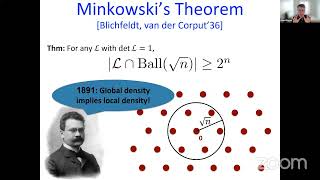
Oded Regev: The Reverse Minkowski Theorem
Explore the Reverse Minkowski Theorem, its applications, and open questions in lattice theory with mathematician Oded Regev in this insightful mathematical lecture.
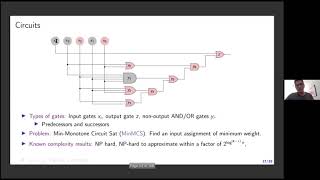
Hardness Results in Discrete Morse Theory for 2-Complexes
Explore inapproximability and parameterized complexity in discrete Morse theory for 2-complexes, focusing on minimizing critical simplices and presenting new hardness results and an approximation algorithm.
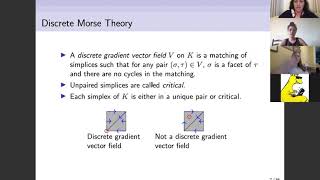
Morse-Based Fibering of the Rank Invariant
Explore multi-parameter persistence in data analysis using discrete Morse theory to compute rank invariants, partition parameter space, and deduce persistence diagrams for equivalent classes of lines.
Ulrich Bauer: Ripser - Efficient Computation of Vietoris–Rips Persistence Barcodes
Explore efficient computation of Vietoris-Rips persistence barcodes using Ripser software. Learn about matrix reduction algorithms, persistent cohomology, and discrete Morse theory applications in topological data analysis.
Invariants of Manifolds from 6 Dimensions
Explore advanced mathematical concepts in gauge theories and differential invariants, focusing on invariants of manifolds from 6 dimensions and their applications in theoretical physics.
Rotations of the Circle and Renormalization
Explore circle rotations, renormalization, and dynamical systems with Corinna Ulcigrai. Learn key concepts, proofs, and applications in this advanced mathematics lecture.
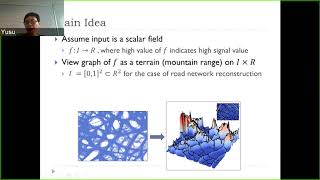
Graph Reconstruction via Discrete Morse Theory
Explore graph reconstruction using discrete Morse theory, focusing on geometric graphs and density data. Learn about theoretical guarantees and applications in road network reconstruction.
Topological Methods in Discrete Geometry - New Developments
Explores recent advancements in topological methods for discrete geometry, focusing on configuration spaces in cooperative game theory and their connections to embedding problems in Euclidean spaces.
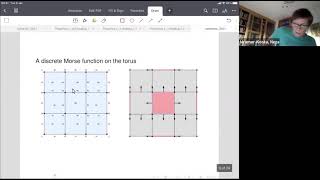
An Application of Discrete Morse Theory to Robot Motion Planning
Explore discrete Morse theory and its variants, learning how to apply this mathematical concept to develop continuous motion planning algorithms for autonomous devices.