Basic Electronics
The course is about basic electronic circuits, both analog and digital. In the analog part, diode circuits, BJT amplifiers, Op-Amp circuits will be covered. In the digital part, combinatorial and sequential circuits will be covered.
Digital Electronic Circuits
Digital systems represent and manipulate digital signals. Such signals represent only finite number of discreet values. A signal can be discreet by nature whereas, a continuous signal can be discretized for digital processing and then converted back.
Digital Circuits
Comprehensive exploration of digital circuits, covering number systems, Boolean algebra, logic gates, arithmetic circuits, sequential circuits, finite state machines, data converters, memory, FPGA, VHDL, and microprocessors.

Logic Gates, Truth Tables, Boolean Algebra - AND, OR, NOT, NAND & NOR
Comprehensive introduction to digital logic fundamentals, covering gates, truth tables, and Boolean algebra. Ideal for electronics beginners and college students in logic design.
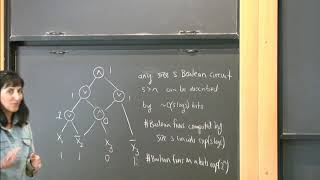
Lower Bounds in Complexity Theory, Communication Complexity, and Sunflowers - Toniann Pitassi
Explore lower bounds in complexity theory, communication complexity, and sunflowers. Delve into Boolean circuits, formulas, and key lemmas with expert insights from Toniann Pitassi.
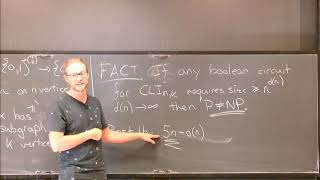
Proof and Circuit Complexity - Robert Robere
Explore proof and circuit complexity with Robert Robere, delving into Boolean circuits, monotone circuits, slice functions, and the Click function to understand computational limitations.
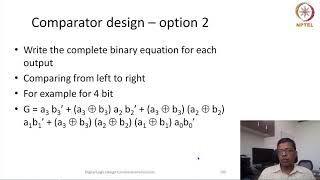
Iterative Circuits: Comparator Design and Parity Generation - Part 1
Design comparators and generate parity with iterative circuits, exploring fundamental concepts for efficient digital system implementation.
Algebraic Structures in Logic and Query Evaluation - Part 2
Explore advanced algebraic structures in logic and their applications to database query evaluation, building on fundamental concepts.
Algebraic Structures in Logic and Query Evaluation - Part 1
Explore algebraic structures' role in logic and query evaluation, focusing on their applications in database theory and AI algorithms.
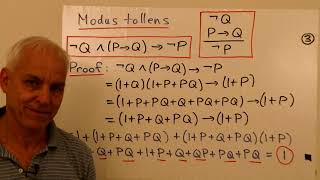
Inference Rules via the Algebra of Boole - MathFoundations 275
Explore propositional logic inference rules using Boolean algebra, simplifying complex logical concepts and eliminating the need for memorization. Includes application to a Lewis Carroll puzzle.
Orthologic with Axioms - Proof Theory and Algorithms
Explore orthologic with axioms, its proof theory, and algorithms. Discover generalized ortholattice reasoning and its applications in verification condition simplification and normalization.
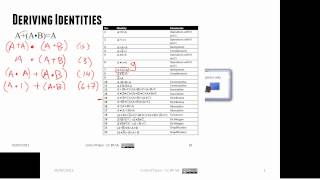
Digital Circuits Boolean Algebra
Learn Boolean algebra fundamentals and digital circuit simplification techniques, including key rules and operations for efficient logic design and analysis.
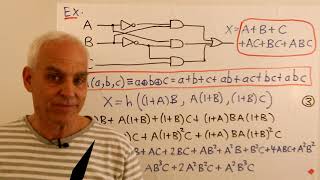
Boole Reduction - A Challenge for Programmers - MathFoundations - N J Wildberger
Exploring challenges in implementing Boole reduction for circuit analysis, including programming strategies and SAT solver development in the Algebra of Boole context.
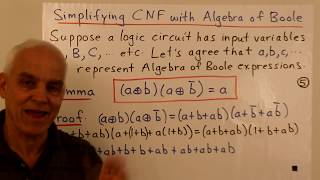
Trying to Sidestep the SAT Problem - N J Wildberger
Explores the SAT problem in Boolean algebra and logic circuits, introducing the Algebra of Boole approach as an alternative for analyzing smaller circuits and potentially addressing larger-scale issues in integrated circuit design.
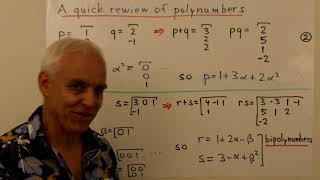
Boole Polynumbers and Equivalent Circuits - Math Foundations - N J Wildberger
Explore Boolean functions and logic circuits through polynumbers, focusing on Boole polynumbers as invariants for equivalent circuits. Learn evaluation techniques and their applications.
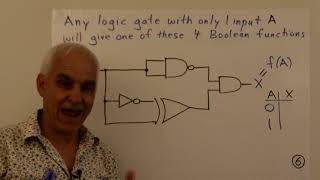
Canonical Forms for Logic Circuits - Math Foundations
Explore canonical forms for logic circuits, Boolean functions, and their geometric interpretations. Learn to express Boolean functions algebraically using Boolean algebra and Boole's original algebra.
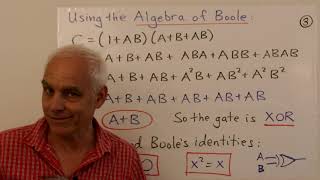
How the Algebra of Boole Simplifies Circuit Analysis - Math Foundations - N J Wildberger
Explore how the Algebra of Boole simplifies circuit analysis, comparing it with traditional Boolean algebra for encoding logic gates and solving engineering problems.
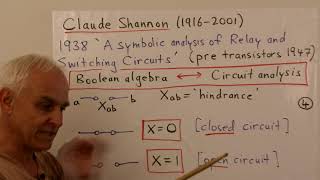
Boolean Algebra and Shannon's Circuit Analysis - Math Foundations - N J Wildberger
Explores Boolean algebra's connection to circuit analysis, focusing on Huntington's formulation and Shannon's groundbreaking 1938 paper linking the two fields.
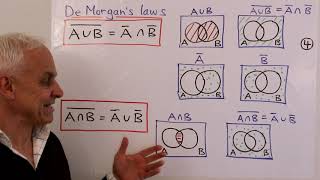
Boolean Algebra and Set Theory - Math Foundations - N J Wildberger
Explore Boolean algebra, set theory, and Venn diagrams. Learn about De Morgan's laws, distributive properties, and their proofs using truth tables and Boole's algebra.
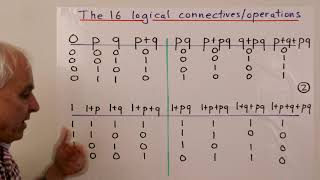
Implication and Logical Operations - Math Foundations - N J Wildberger
Explore 16 logical operations, including AND, OR, XOR, and implication, with applications to Boolean algebra and circuit analysis. Gain insights into Modus Ponens and Boole's algebra for solving electrical engineering problems.
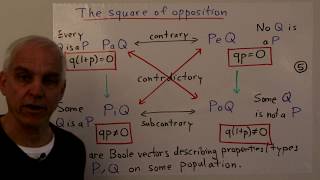
The Algebra of Boole is Not Boolean Algebra - Math Foundations - N J Wildberger
Exploring the Algebra of Boole, its relation to Boolean algebra, and its role in logic and circuit analysis. Discusses syllogisms, the Square of Opposition, and Boole's proofs of Aristotle's arguments.