Machine Learning for Molecular Structures and Drug Discovery
Explore machine learning applications in molecular structures, generative models, and protein analysis. Learn about tools like LigDream, TorchMD, and PlayMolecules for drug discovery and chemistry research.
An Optimal Control Perspective on Diffusion-Based Generative Modeling
Explore optimal control theory's connection to diffusion-based generative modeling. Gain insights into stochastic differential equations, Hamilton-Jacobi-Bellman equations, and novel sampling methods for unnormalized densities.
Transport, Variational Inference and Diffusions
Explore connections between optimal transport and variational inference, focusing on stochastic differential equations and Girsanov transformations. Discover novel sampling and generative modeling techniques.
Predicting Equilibrium Distributions for Molecular Systems with Deep Learning
Explore deep learning techniques for predicting equilibrium distributions in molecular systems, focusing on the novel Distributional Graphormer framework and its applications in various molecular tasks.
PFGM++: Unlocking the Potential of Physics-Inspired Generative Models
Explore PFGM++, a physics-inspired generative model unifying diffusion models and PFGMs. Learn about its flexible embedding, unbiased objectives, and superior performance on image datasets.

Improving and Generalizing Flow-Based Generative Models with Minibatch Optimal Transport
Explore advanced techniques for improving continuous normalizing flows, including generalized conditional flow matching and optimal transport CFM, enhancing generative modeling for various applications.
Particle Guidance: Non-I.I.D. Diverse Sampling with Diffusion Models
Explore particle guidance for diverse sampling in diffusion models, enhancing diversity and efficiency in generative tasks like image and molecular conformer generation.
Mirror Diffusion Models for Constrained and Watermarked Generation
Explore Mirror Diffusion Models for generating data on constrained sets, enhancing watermarking capabilities, and improving AI safety in drug discovery applications.
Stochastic Interpolants: A Unifying Framework for Flows and Diffusions - Lecture
Explore a unified framework for generative models, bridging flow-based and diffusion-based methods using stochastic interpolants. Learn about probability flow equations, likelihood estimation, and applications in AI for drug discovery.
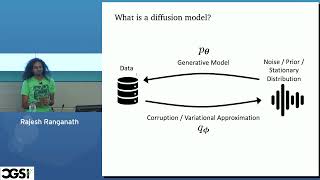
Digging into the Foundations of Generative AI for Healthcare
Explore foundations of generative AI in healthcare, focusing on automated learning for multivariate diffusions, denoising score matching, and targeted updates of language models.
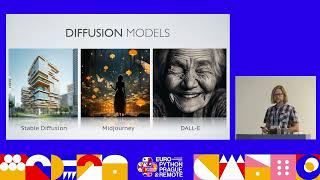
Understanding Neural Network Architectures with Attention and Diffusion
Explore Attention and Diffusion models in neural networks, focusing on their applications in language processing and image synthesis, with simplified diagrams for visual learners.
Studio Acoustic Design and Treatment - Essential Concepts and Implementation
Delve into studio acoustic design fundamentals with expert Gavin Haverstick as he shares practical insights on room treatment, speaker placement, and budget-friendly solutions for optimal sound quality.
Neuroscience and AI - What Artificial Intelligence Teaches Us About the Brain and Vice Versa
Explore the fascinating intersection of neuroscience and AI with Stanford expert Surya Ganguli, examining how modern AI systems inform our understanding of biological intelligence and brain function.

에이닷의 이미지 이해와 생성 기술 발전 - AI 이미지 대화와 모션 프로필 서비스
Discover how A.dot evolved to understand and generate images, featuring insights into AI image dialogue systems and motion profile services using advanced Vision AI technology and LLM integration.
Text-to-Graph with Large Generative Graph Models
Explore cutting-edge research on large generative graph models and their applications in biomedicine and cybersecurity through diffusion-based technology and text-to-graph conversion.
Moving Beyond Screening via Generative Machine Learning Models for Materials Discovery
Explore generative machine learning models for materials discovery, moving beyond screening to generate novel structures and chemistries using advanced algorithms and techniques.
Equilibrium vs Nonequilibrium Carrier Response
Explore equilibrium and nonequilibrium carrier responses in semiconductor physics, examining their characteristics and implications for device behavior.
Flux-1 Dev - Photorealistic Image Generation Tutorial Using LoRA Adapters
Learn to generate photorealistic images using Flux-1 (Dev) model and LoRA adapters. Explore setup, inference steps, guidance, and output variety in this hands-on tutorial using Google Colab.
Democratizing Diffusion Models with Diffusers
Discover how to create and edit photo-realistic images using Diffusers, an open-source Python library that makes advanced image generation accessible through diffusion models.
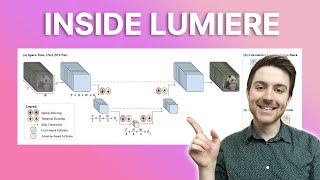
Understanding Lumiere: A Space-Time Diffusion Model for Video Generation
Explore Lumiere's innovative space-time diffusion model for video generation, covering its architecture, solutions to common problems, and practical applications in coherent motion synthesis.

Understanding Diffusion Transformers and the Technology Behind Sora
Dive into the technical foundations behind OpenAI's Sora, exploring diffusion transformers, U-Nets, and latent diffusion models that power this groundbreaking video generation technology.