Allen School Colloquium - GRAIL Research Lab Presentations
Explore cutting-edge research in computer graphics, vision, and robotics. Topics include CAD debugging, virtual try-on, spatial audio, and AR-based robot learning, showcasing innovative solutions to complex challenges.

PixArt-α: Open Source Text-to-Image Model - Installation and Usage Tutorial
Explore PixArt-α, an open-source text-to-image model rivaling Midjourney. Learn installation, usage, and comparison with other models. Discover its superior capabilities in various art styles and prompt following.
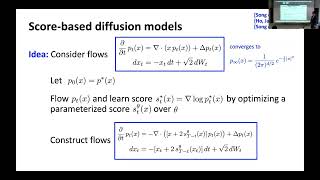
Renormalization Group Flow, Optimal Transport, and Diffusion Models
Explore connections between renormalization group flow, optimal transport, and diffusion models in applied mathematics, with insights from Harvard researcher Jordan Cotler.

Lumiere: Space-Time Diffusion Model for Video Generation
Explore Google's Lumiere, a text-to-video AI model using Space-Time U-Net architecture for coherent motion synthesis. Learn about its innovative approach, applications, and societal impact.

Deep Generative Modeling - MIT 6.S191 Lecture 4
Explore deep generative modeling, including autoencoders, VAEs, GANs, and recent advances. Learn about latent variables, training techniques, and applications in AI-driven content creation and data analysis.
From Entropy to Artistry: Thermodynamics and Generative AI
Explore connections between diffusion models and physics, focusing on non-equilibrium thermodynamics and its applications in image/video generation and climate modeling.

Approximate Caching for Efficiently Serving Text-to-Image Diffusion Models
Innovative caching technique for text-to-image generation, reducing GPU compute, latency, and costs while maintaining quality. Explores real-world applications and performance improvements.

Fine-tuning Flow and Diffusion Generative Models
Explore reward fine-tuning for dynamical generative models through stochastic optimal control, featuring a novel Adjoint Matching algorithm for improved consistency and realism.
Discrete Flow Matching for High-Dimensional Discrete Data Generation
Explore Discrete Flow Matching for generating high-dimensional discrete data. Learn about probability paths, sampling techniques, and improved generative perplexity in AI applications.
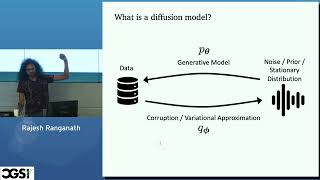
Deep Generative Models in Medicine - CGSI 2023
Explore deep generative models in medicine, covering robustness, interpretability, missing data, language models, and diffusion techniques for improved medical applications and research.
Diffusion Forcing: Next-token Prediction Meets Full-Sequence Diffusion
Explore Diffusion Forcing, a novel training paradigm combining next-token prediction and full-sequence diffusion for enhanced sequence generation and decision-making in AI applications.
Score Matching via Differentiable Physics
Explore score matching via differentiable physics for inverse problems. Learn about combining physics operators with stochastic differential equations to generate plausible trajectories towards given end states.
D-Flow: Differentiating through Flows for Controlled Generation
Explore D-Flow framework for controlled generation in AI models, optimizing source points through flow differentiation. Learn applications in inverse problems and conditional generation.
Mosaic-SDF for 3D Generative Models
Explore Mosaic-SDF, a novel 3D shape representation for generative models. Learn its design principles, preprocessing, and application in flow matching for efficient 3D generation.
Diffusion Models for Sampling Rare Events in Chemistry
Explore advanced diffusion models for generating transition state structures in chemical reactions, accelerating reaction mechanism discovery and network exploration.
MultiDiffusion: Fusing Diffusion Paths for Controlled Image Generation
Explore MultiDiffusion: a framework for controllable image generation using pre-trained diffusion models. Learn about panorama creation, high-resolution outputs, and versatile user controls without retraining.
Generalization in Diffusion Models from Geometry-Adaptive Harmonic Representation
Explore generalization in diffusion models through geometry-adaptive harmonic representation. Analyze denoising DNNs, score functions, and inductive biases to understand high-dimensional density learning and optimal basis adaptation.

Linear Structure of High-Level Concepts in Text-Controlled Generative Models
Explore the linear structure of high-level concepts in text-controlled generative models, focusing on embedding, representation, and semantic encoding for precise model control.
Consistency Trajectory Models: Learning Probability Flow ODE Trajectory of Diffusion
Explore advanced diffusion models with Consistency Trajectory Models, improving sample quality and efficiency in AI-driven image generation. Learn novel sampling techniques and state-of-the-art results.
Reflected Diffusion Models: Principled Data Constraints in Generative Modeling
Explore reflected diffusion models for improved image generation. Learn about reversing stochastic differential equations, addressing numerical errors, and incorporating data constraints in principled ways.
GenPhys: From Physical Processes to Generative Models
Explore how physical processes inspire new generative models, including diffusion and Poisson flow. Learn to translate PDEs into AI algorithms and expand the design space of generative approaches.