Wolfram AI in Medical Imaging: Prostate Cancer Detection
Explore AI-powered prostate cancer detection using Wolfram's platform for medical imaging, featuring deep neural networks and MRI diffusion analysis.
A Review of Machine Learning Techniques for Anomaly Detection - Dr. David Green
Explore machine learning techniques for anomaly detection, covering traditional methods, deep neural networks, and practical applications in various domains.
Nonlinear Approximation by Deep ReLU Networks - Ron DeVore, Texas A&M
Explores deep ReLU networks for nonlinear approximation, covering architecture, error analysis, and manifold approximation. Bridges mathematics, statistics, and computer science in data science applications.
High-Dimensional Learning and Deep Neural Networks
Explorez les réseaux neuronaux profonds et l'apprentissage en haute dimension avec le professeur Mallat. Découvrez les avancées récentes en science des données et leurs applications pratiques.
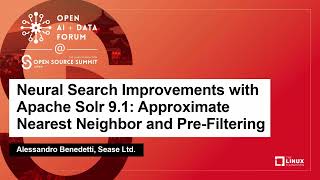
Neural Search Improvements with Apache Solr 9.1 - Approximate Nearest Neighbor and Pre-Filtering
Explore neural search in Apache Solr 9.1, including HNSW graph improvements, pre-filtering capabilities, and Deep Learning integrations for enhanced search relevance and efficiency.
Beyond Test Accuracies for Studying Deep Neural Networks
Explore deep neural networks beyond test accuracies, focusing on model construction, optimization, and inference. Gain insights into generative multitask learning, learning trajectories, and language model consistencies.

Machine Learned Regularisation for Solving Inverse Problems
Machine learned regularization techniques for solving inverse problems, focusing on image reconstruction from tomographic and blurred measurements. Explores data-driven approaches and discusses open mathematical challenges.
Tropical Solutions to Hard Problems in Auction Theory
Explore tropical mathematics' applications in auction theory, neural networks, and statistics through polytopes, algorithms, and semigroup matrices, unveiling powerful problem-solving techniques.
Splines and Imaging - From Compressed Sensing to Deep Neural Networks
Explore splines in imaging, from compressed sensing to deep neural networks. Unser demonstrates spline optimality in inverse problems and their connection to deep learning, offering insights into ReLU architecture and activation optimization.
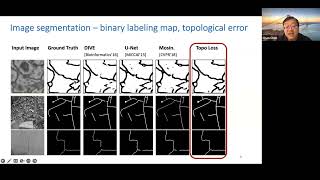
Topological Uncertainty and Representations for Biomedical Image Analysis
Innovative approach to biomedical image analysis using topological structures and uncertainty, enhancing segmentation accuracy and enabling interactive annotation for fine-scale delineation.
Linear Causal Representations from Interventions under General Nonlinear Mixing
Explore causal representation learning from latent interventions in nonlinear settings. Uncover geometric structures, analyze precision matrices, and evaluate a contrastive algorithm for identifying latent variables.
Mathematics for Deep Neural Networks: Advantages of Additional Layers - Lecture 3
Explore the mathematical advantages of deep neural networks over shallow networks, focusing on localization, approximation capabilities, and the Kolmogorov-Arnold theorem.
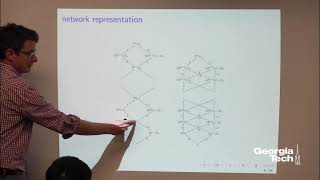
Mathematics for Deep Neural Networks: Statistical Theory for Deep ReLU Networks - Lecture 4
Explore statistical theory for deep ReLU networks, focusing on risk bounds, approximation properties, and sparse connections in neural network architectures.
Mathematics for Deep Neural Networks: Energy Landscape and Open Problems - Lecture 5
Explore the energy landscape of deep neural networks and future challenges in statistical theory, focusing on gradient descent methods and important developments.

Digital Design and Net Zero in Aviation: Optimizing Gas Turbines for Sustainability
Explore digital design and optimization strategies for gas turbines in aviation, focusing on net-zero goals and advanced manufacturing techniques.

Dendrites: Why Biological Neurons Are Deep Neural Networks
Explore how individual neurons function like deep neural networks, examining their complex information processing capabilities and the physiological mechanisms behind their computational complexity.
Machine Learning for Determining Protein Structure and Dynamics from Cryo-EM Images
Explore machine learning techniques for analyzing cryo-EM images to determine protein structure and dynamics, focusing on the cryoDRGN algorithm and its applications in structural biology.
High Accuracy Wavefunctions Using Deep-Learning-Based Variational Monte Carlo
Explore deep learning-based variational Monte Carlo for high-accuracy wavefunctions in computational chemistry, featuring novel architecture and improved methods for ground state energy calculations.
HyperPCM: Robust Task-Conditioned Modeling of Drug-Target Interactions
Explore HyperPCM, a robust method for predicting drug-target interactions using hypernetworks. Learn about its state-of-the-art performance on benchmarks and excellence in zero-shot inference for unseen protein targets.

Getting the Best of Both Worlds - IoT and Edge Using Hierarchical Inference
Explore hierarchical inference strategies for optimizing IoT and edge computing, focusing on machine fault detection and image classification while balancing accuracy with resource constraints.
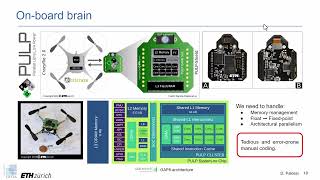
Autonomous Nano-UAVs: An Extreme Edge Computing Case
Exploring autonomous nano-UAVs as extreme edge computing cases, focusing on onboard intelligence, machine learning techniques, and full-stack solutions for navigation and human-robot interaction in resource-constrained environments.