StyleGAN Explained
Comprehensive exploration of StyleGAN architecture, detailing its innovations over traditional GANs. Covers mapping networks, style control, and noise injection for high-quality image generation.

What Are GANs - Generative Adversarial Networks Explained
Explore generative adversarial networks (GANs), their working principles, training phases, and applications in AI and deep learning. Learn how GANs generate realistic data through generator-discriminator competition.
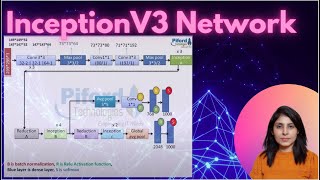
InceptionV3 - Inception Network
Detailed exploration of InceptionV3 architecture, covering its improvements over previous versions, including factorized convolutions, RMSProp optimizer, and label smoothing for enhanced CNN performance.
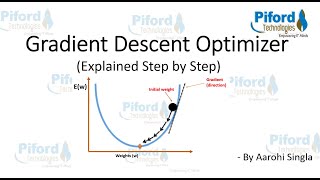
Explained Gradient Descent Optimizer
Comprehensive explanation of gradient descent optimization, covering mathematical foundations, weight updates, and backpropagation for machine learning and deep learning applications.
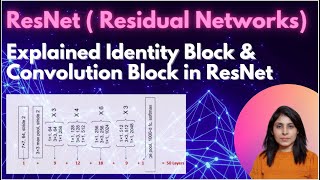
Explained Identity Block and Convolution Block in ResNet - Residual Networks
Practical explanation of identity and convolutional blocks in ResNet, including line-by-line code breakdown and discussion of residual concepts in deep learning architectures.
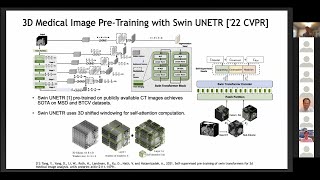
Modern Medical Image Segmentation, AutoML, and Beyond
Explore advanced medical image segmentation techniques, including AutoML and deep learning, for improved disease understanding and clinical diagnosis.
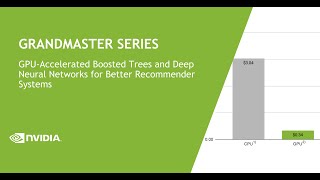
Boosted Trees and Deep Neural Networks for Better Recommender Systems
Explore GPU-accelerated boosted trees and deep neural networks for building winning recommender systems, featuring insights from Kaggle Grandmasters on the ACM RecSys Challenge.

Getting Started with Caffe - Deep Learning Framework Introduction - Class 3
Learn to define, train, and deploy Deep Neural Networks using Caffe framework. Covers data management, network definition, training monitoring, and deployment for classification or feature extraction.
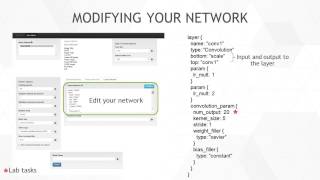
NVIDIA Deep Learning: Getting Started with DIGITS - Class 2
Learn to create, test, and optimize deep neural networks using NVIDIA's DIGITS tool for image classification tasks, with hands-on examples and practical deployment strategies.
Visual AI in Milliwatts - A Grand Challenge and Massive Opportunity
Explore visual AI's potential in low-power devices, discussing challenges, opportunities, and applications in security cameras and beyond. Learn about deep learning, processors, and algorithms driving this technology.
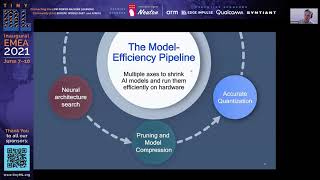
The Model Efficiency Pipeline: Enabling Deep Learning Inference at the Edge
Explore optimizing deep learning for edge devices through model efficiency techniques, including neural architecture search, pruning, quantization, and conditional processing.
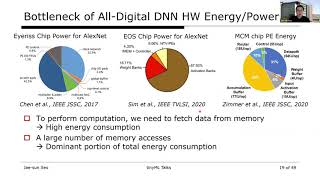
TinyML Talks - SRAM Based In-Memory Computing for Energy-Efficient AI Inference
Explore SRAM-based in-memory computing for energy-efficient AI inference, covering bitcell circuits, architectures, and design optimization for improved performance in low-power processors.
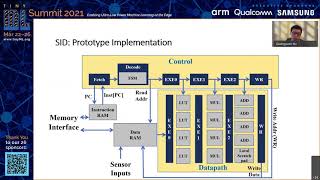
Smartphone Impostor Detection with Behavioral Data Privacy and Minimalist Hardware Support
Innovative smartphone security: Deep Learning for quick impostor detection, preserving user privacy with on-device processing and minimal hardware support.
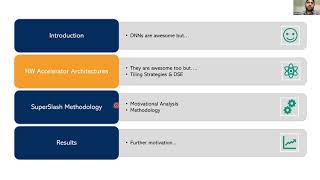
TinyML Talks Pakistan - SuperSlash - Unifying Design Space Exploration and Model Compression
Unifying design space exploration and model compression for efficient deep learning accelerators on resource-constrained devices, optimizing off-chip memory access and model size.

Efficient On-Device Deep Learning: Challenges and Opportunities
Explore efficient on-device deep learning, focusing on affordable AI models for edge devices and maximizing inference performance using heterogeneous computing resources.
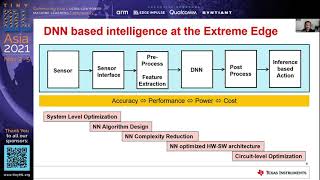
Machine Learning at the Extreme Edge of Always-on Intelligent Sensor Networks
Explore ML optimization techniques for resource-constrained IoT sensor nodes, focusing on system, algorithm, architecture, and circuit levels to achieve significant area-power improvements.

Stable Diffusion DreamBooth Guide - Optimal Classification Images Count Comparison Test
Comprehensive guide on optimizing DreamBooth training in Automatic1111, comparing classification image counts for best results in AI image generation and fine-tuning.
Physics-Guided Deep Learning for Fluid Dynamics - Rose Yu
Explores physics-guided deep learning for fluid dynamics, focusing on accelerating turbulence simulations and incorporating symmetry for generalization in ocean current forecasting.
Quick to Production: Integrating Spark and TensorFlow for Efficient MLOps
Learn to quickly deploy deep learning models using Spark and TensorFlow, simplifying MLOps for data scientists. Explore distributed computing, feature engineering, and leveraging TensorFlow ecosystem libraries for efficient model production.
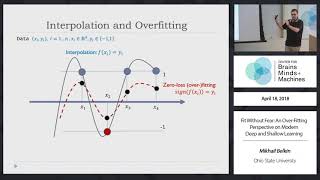
Fit Without Fear - An Over-Fitting Perspective on Modern Deep and Shallow Learning
Explore over-fitting in modern machine learning, challenging conventional wisdom and presenting kernel methods as a competitive alternative to deep learning. Insights on interpolation, generalization, and stochastic gradient descent.
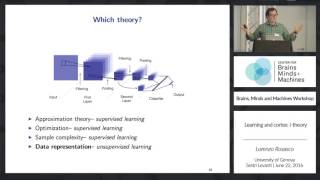
Learning & Cortex - I-Theory
Explore principles of data representation, invariance, and selectivity in deep neural networks, focusing on convolutional architectures and their theoretical foundations.