
User Behavior Hashing for Audience Expansion - Deep Learning Approach
Explore deep learning-based hashing for sequential behavior data, utilizing Spark for large-scale preprocessing and distributed inference on Databricks with Pandas UDF.

Productionizing Machine Learning Pipelines with Databricks and Azure ML
Jumpstart ML projects with Databricks and Azure ML. Learn to build, track, and deploy production-ready pipelines using tools like MLflow, TensorFlow, and PyTorch for efficient, reproducible data science workflows.

Deep Learning for Price Action Prediction Using Databricks and AWS
Explore deep learning techniques to enhance price action prediction using Databricks and AWS. Learn to optimize technical indicators and train models with Amazon SageMaker for improved financial forecasting.

Benchmarks and How-Tos for Convolutional Neural Networks on HorovodRunner-Enabled Apache Spark Clusters
Explore benchmarks and implementation techniques for distributed deep learning using HorovodRunner on Apache Spark clusters, focusing on CNN tasks and scaling efficiency for both GPU and CPU clusters.

Apache Spark NLP for Healthcare - Building Real-World AI Systems
Explore real-world healthcare AI systems using NLP, covering patient risk prediction, diagnosis automation, and revenue optimization. Learn key considerations for building domain-specific models and scalable ML pipelines.

Scaling Up AI Research to Production with PyTorch and MLFlow
Explore PyTorch's latest advancements in AI research and production, including distributed training, model optimization, and deployment using MLFlow, with insights on scaling and efficiency.

Delivery of Deep Transformer NLP Models Using MLflow and AWS SageMaker for Enterprise AI
Learn to deploy deep transformer NLP models using MLflow and AWS SageMaker for enterprise AI, covering the full machine learning lifecycle and CI/CD pipelines for production-quality implementation.

Automated and Explainable Deep Learning for Clinical Language Understanding
Explore advanced deep learning techniques for clinical NLP, including automated model training, explainable AI, and scalable architectures to extract critical healthcare insights from unstructured medical notes.
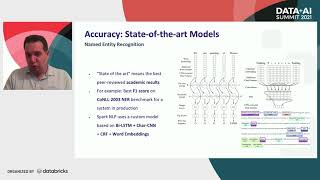
Advanced Natural Language Processing with Apache Spark NLP
Explore advanced NLP tasks using Apache Spark NLP, covering classification, named entity recognition, sentiment analysis, and more through hands-on Python notebooks and deep learning techniques.
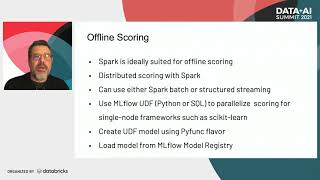
MLflow Model Serving - Methods and Best Practices
Explore MLflow model serving techniques, including batch and real-time scoring, open-source and Databricks-managed options, with emphasis on new production-ready model serving features.

Generalized Pipeline Parallelism for DNN Training - PipeDream System Overview
Efficient multi-accelerator parallelization for DNN training using PipeDream, combining intra-batch parallelism with inter-batch pipelining to improve throughput and overcome challenges in bi-directional training.
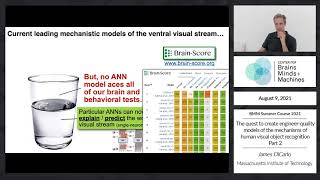
The Quest to Create Engineer-Quality Models of the Mechanisms of Human Visual Object Recognition - Part 2
Explore cutting-edge models of human visual object recognition, their implications for AI, and strategies for future research in neuroscience and machine learning.
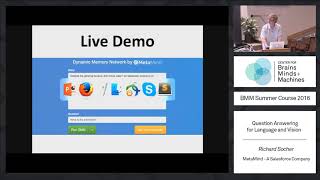
Question Answering for Language and Vision
Explore advanced techniques in question answering for language and vision, including joint models, multitask learning, and neural networks with Richard Socher from MetaMind.
Security and Information Assurance with Deep Learning
Explore deep learning applications in security, focusing on intrusion detection systems and common pitfalls. Learn about complex security data and real-world examples of machine learning challenges.
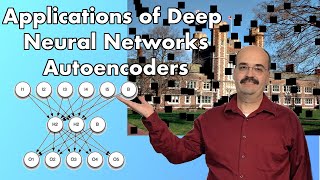
Deep Neural Network Autoencoders in TensorFlow and Keras - Part 1
Learn to create and implement autoencoders in Keras and TensorFlow, including denoising autoencoders, for deep neural network applications in image processing and function approximation.
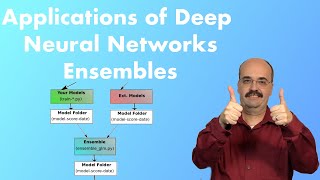
Neural Networks with Ensembles for TensorFlow and Keras
Learn to create and evaluate ensemble models using random forests and deep neural networks with TensorFlow, Keras, and scikit-learn. Explore feature importance and perturbation ranking techniques.
Deep Learning Cross Validation for TensorFlow and Keras
Learn to implement cross-validation techniques for deep learning models using TensorFlow and Keras, enhancing model evaluation and performance in regression and classification tasks.
Early Stopping and Encoding a Feature Vector for Deep Neural Networks
Learn to implement early stopping, encode feature vectors, and use validation sets in Keras neural networks for improved deep learning model performance and efficiency.
Introduction to TensorFlow and Keras with Anaconda Python
Learn to build neural networks using TensorFlow and Keras for classification and regression tasks. Covers key concepts, data handling, model creation, training, and evaluation.
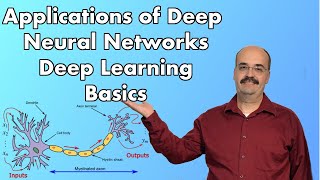
Deep Neural Network Basics for Keras and TensorFlow
Explore deep neural network fundamentals including activation functions, bias neurons, and output calculation for Keras and TensorFlow implementation.
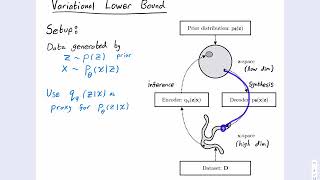
Variational Autoencoders
Explore generative models, autoencoders, and variational techniques in deep learning. Learn about architecture, optimization, and practical applications of variational autoencoders.