Building Knowledge Graphs
Explore the power of knowledge graphs in data management, their applications, and strategies for successful implementation in semantic search, recommendation systems, and data fabric.
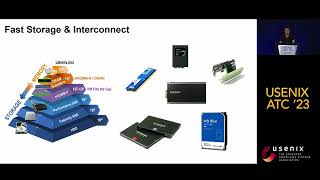
P2CACHE: Exploring Tiered Memory for In-Kernel File Systems Caching
Explores P2CACHE, a novel in-kernel caching mechanism leveraging persistent memory and DRAM to enhance legacy file systems' performance, durability, and crash consistency without extensive modifications.

End-to-End LLM Project: Langchain with Pinecone Vector Database
Learn to build an end-to-end LLM project using Langchain and Pinecone vector database. Covers data processing, vector creation, database operations, and similarity search implementation.
Standardizing CPUID Data for the Open-Source x86 Ecosystem
Proposal to standardize CPUID information for x86 architecture, addressing challenges in feature identification and data redundancy across open-source projects. Aims to improve accuracy and efficiency in CPU feature detection.
Delivery and Debugging MariaDB Docker Official Images - Challenges and Solutions
Explore container-specific challenges, CI/CD benefits, and debugging strategies for MariaDB Docker images. Learn to avoid pitfalls and enhance database performance in containerized environments.
Bring Your App into the AI-Age with Weaviate and Docker - DockerCon 2023
Explore integrating AI capabilities into your applications using Weaviate and Docker. Learn about vector databases, LLMs, and overcoming hallucination through Retrieval Augmented Generation for AI-powered features.
Building LangChain-Based Database-Backed GenAI Applications with Docker - DockerCon 2023
Learn to develop GenAI applications using LangChain and databases within Docker. Explore new technologies for quick setup and gain insights from industry experts on leveraging large language models in your projects.
IoTivity and the Open Connectivity Foundation - Addressing the IoT Challenge
Explore IoTivity and OCF's approach to secure IoT device communication, addressing challenges in local networks and cloud connectivity while prioritizing security and privacy.
Graphs and Sensors: The Internet of Connected Things
Explore how graph databases enhance IoT data analysis, enabling real-time insights and better decision-making in industries like oil and gas and transportation.
Running a Cloud-Native SQL Database on Mesos
Explore deploying CockroachDB, a scalable and consistent database, on Mesos for cloud-native applications. Learn about the DC/OS SDK and its benefits for stateful services deployment.
Building Your First Stateful DC/OS Service
Learn to build robust stateful applications on DC/OS using the SDK. Explore storage provisioning, scaling, client discovery, operator management, and failure resilience for distributed systems like Apache Kafka and Cassandra.
Robust Applications in Mesos Using External Storage
Explore container storage options for robust Mesos applications, comparing local and external storage impacts on deployment, operations, and failure tolerance in production environments.
QEMU Storage Daemon and libblkio: Exploring New Frontiers for the QEMU Block Layer
Explore QEMU-Storage-Daemon and libblkio for enhanced storage flexibility, security, and performance in virtualization. Learn about new possibilities for local and remote storage integration.
Right-Sizing and Auto-Scaling of MySQL Containers in Kubernetes
Optimizing MySQL container resources in Kubernetes using statistical analysis and algorithms for dynamic sizing and scaling, improving performance and efficiency while reducing costs.
Introduction to Vitess: Features, Functionality, and VSchema Design
Learn about Vitess architecture, sharding metadata, and key features. Explore use cases, design strategies, and practical solutions for scaling and managing distributed databases.
Exploring High Availability in Kubernetes with Vitess
Learn how Vitess enhances high availability in Kubernetes, featuring failure handling, data recovery, and integration with monitoring tools. Includes a live demo on disaster preparedness and recovery.
Creating an IoT Data Layer for Collecting, Storing, and Analyzing Data
Learn to build an IoT data layer for collecting, storing, and analyzing data across edge and cloud environments using Linux and open-source tools. Explore distributed architectures, time series data, and real-time analytics.
Benchmarking Cloud Native Databases on Kubernetes - Performance and Tradeoffs
Explore performance tradeoffs of running databases on Kubernetes, comparing various storage options through benchmarks. Learn to make informed decisions and conduct your own tests.
NoSQL Is Not NoVulnerable - Exploring Security Risks in NoSQL Databases
Explores vulnerabilities in NoSQL databases, comparing threats to traditional SQL systems and demonstrating new attacks exploiting complex data types like JSON to bypass application-level access controls.
Programming Distributed Systems
Exploring innovative programming language designs to simplify distributed systems development, enhancing performance and correctness while reducing common errors in large-scale applications.
When is an ADT Not an ADT? - Modeling Data Types in Programming
Explore data representation in programming, comparing OOP and FP approaches. Learn about tradeoffs and design choices for clear, efficient code in a simple programming language example.