Physics-Informed Machine Learning: Curating Training Data - Part 2
Explore physics-informed data curation for machine learning, covering data augmentation, coordinate systems, simulation vs. experiments, and strategies for handling expensive, biased, and rare data in AI/ML applications.
Learning from Aggregate Responses
Explore aggregate learning techniques for privacy-protected data, including loss construction, bagging schemes, and iterative boosting algorithms to improve model accuracy while maintaining data privacy.

Learning from Dynamics in Linear Dynamical Systems
Explore efficient algorithms for learning linear dynamical systems, bridging gaps in understanding and revealing connections between machine learning tools and non-stationary settings.
Generative AI vs AGI - Strengths and Weaknesses of Large Language Models
Explore AI frontiers with Dr. Ben Goertzel, comparing LLMs to human intelligence and AGI. Learn about integrating LLMs with advanced tools for enhanced analytics and reasoning, and gain insights into AI's future potential and limitations.
Network Configurations for High-Performance Streaming Connectivity in Kubernetes
Optimize Kubernetes networking for high-performance streaming. Explore network setups, Container Network Interface, and proxy solutions to enhance data connectivity and reduce latency in K8s environments.
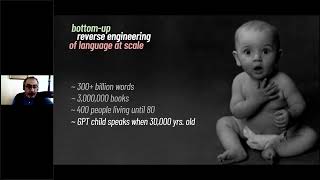
Towards Explainable and Language-Agnostic LLMs
Innovative approach to creating explainable, language-agnostic LLMs by integrating symbolic representations with empirical power, addressing limitations in true language understanding and AI interpretability.
Longest Common Subsequence Using Dynamic Programming - Design and Analysis of Algorithms
Explore dynamic programming to solve the Longest Common Subsequence problem efficiently. Learn step-by-step implementation and optimization techniques for this fundamental algorithm.
Enterprise MLOps: Insights from a Lead ML Engineer
Insights into enterprise MLOps from a lead engineer, covering infrastructure, model development, and anti-money laundering applications in the banking sector.
Bloomberg's Journey to a Multi-Cluster Workflow Orchestration Platform
Explore Bloomberg's evolution in cloud-native workflow orchestration, addressing challenges of rapid growth and discussing solutions for efficient multi-cluster resource deployment and management.
Scaling Batch, Big Data, and AI Workloads Beyond the Kubernetes Scheduler
Explore solutions for scaling AI, big data, and batch workloads on Kubernetes. Compare projects like Koordinator, Kueue, MCAD, Volcano, and YuniKorn to optimize cluster utilization and overcome scheduling challenges.
A Decade of High-Volume Data and APIs - The Evolution of SIG-Apps
Explore the evolution of Kubernetes workload support and APIs over a decade, highlighting SIG Apps' achievements, milestones, and future directions in cloud native computing.
Efficient Integration of Kubeflow Tools - ISS Data Case Study on Anomaly Detection
Explore Kubeflow's integrated tools for ML workflows through an ISS anomaly detection case study, showcasing Dask, Katib, PyTorch Operator, and KServe in a unified KFP pipeline.
Argo for ML: Achieving Scalability and User Experience in Machine Learning Platforms
Explore how Argo Workflows enables scalable ML platforms across industries. Learn from experts about balancing high-scale operations with user-friendly interfaces for efficient ML team workflows.
Using EEG and Machine Learning to Perform Lie Detection - YOW! 2017
Explore EEG-based lie detection using Azure Machine Learning. Learn about data collection, model building, and limitations in this innovative experiment combining neuroscience and AI.
Flyte - Production-Grade Data and Machine Learning Orchestration
Explore Flyte, an open-source platform for scalable, repeatable, and maintainable data and machine learning orchestration, addressing key challenges in MLOps and data processing.
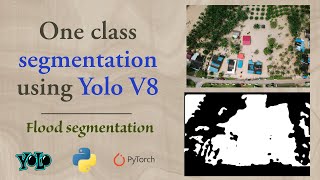
Flood Detection with YOLO V8 Segmentation - One-Class Image Segmentation
Learn to detect floods using Yolo V8 image segmentation. Covers dataset preparation, model training, and testing on new images to generate segmentation masks highlighting flooded areas.
Exploring Armada: Multi-Kubernetes Cluster Batch Job Meta-Scheduler
Explore Armada, a multi-Kubernetes-cluster batch job meta-scheduler, with Carlos Santana. Learn its features, benefits, and best practices for optimizing cloud-native computing workflows.

Google's RAG Experiment - NotebookLM Overview and Demo
Explore Google's NotebookLM, an AI-powered tool for document analysis and interaction. Learn about its features, interface, and capabilities through demonstrations and blog post insights.
The Challenges of Training Infinitely Large Neural Networks
Explore challenges in training infinitely large neural networks, including feature learning incorporation and scaling kernel machines to large datasets, with Professor Mikhail Belkin.
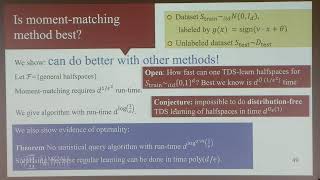
Testing Assumptions of Learning Algorithms
Explore how property testing can mitigate reliance on distributional assumptions and no distribution shift in supervised learning algorithms, ensuring more reliable theoretical guarantees.
Coresets and Their Applications to Design Sublinear Algorithms
Explore coresets and their role in designing efficient sublinear algorithms, enhancing computational performance for large-scale data analysis and machine learning tasks.