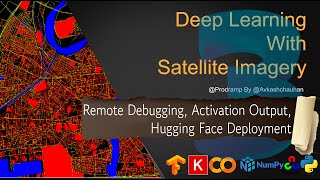
Advance Deep Learning Workshop for Satellite Imagery - Model Export & Production
Hands-on workshop on advanced deep learning techniques for satellite imagery, covering remote debugging, model deployment, activation heatmaps, and custom predictions using TensorFlow and Keras.
Probabilistic Deep Learning in TensorFlow - The Why and How - ODSC Europe 2019
Explore probabilistic deep learning in TensorFlow, focusing on Bayesian techniques, uncertainty modeling, and practical applications using TensorFlow Probability for more robust and interpretable neural networks.

Oral History - Russell Impagliazzo in Conversation with Dick Karp
Explore key developments in theoretical computer science through an engaging conversation between Russell Impagliazzo and Dick Karp, covering topics from NP-completeness to computational biology.
Power of Active Sampling for Unsupervised Learning
Explore active sampling techniques for unsupervised learning, focusing on matrix completion, graphical models, and clustering. Learn about statistical tradeoffs and computational complexity.
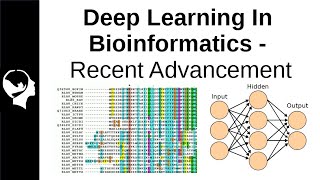
Deep Learning in Bioinformatics - Recent Advancement
Explore recent advancements in deep learning for bioinformatics, covering BTINET, autoencoders, and deep belief networks. Gain insights into cutting-edge applications in genomics, drug discovery, and disease prediction.
Continuous Algorithms - Sampling and Optimization in High Dimension
Explore high-dimensional sampling and optimization techniques, including cutting plane methods, interior-point algorithms, and Riemannian Hamiltonian Monte Carlo, with insights on complexity and open problems.
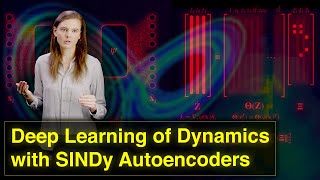
Deep Learning of Dynamics and Coordinates with SINDy Autoencoders
Discover effective coordinate systems and models simultaneously using SINDy autoencoders, a novel approach for analyzing high-dimensional data in dynamical systems.

Support Vector Machines in Python from Start to Finish
Comprehensive guide to implementing Support Vector Machines in Python, covering data preparation, model building, and optimization techniques for machine learning practitioners.
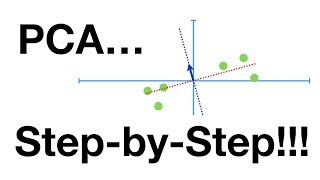
Principal Component Analysis - PCA, Step-by-Step
Step-by-step guide to Principal Component Analysis (PCA), explaining its importance in data analysis and machine learning. Covers 2D and 3D data examples, PC calculation, and interpretation of results.

Principal Component Analysis - PCA Clearly Explained - 2015
Clear explanation of Principal Component Analysis, covering dimensions, variance, loading scores, and key concepts for interpreting PCA plots in RNA-seq data analysis.

SQL Server Reporting Services - Data Analysis Tutorial
Comprehensive tutorial on SQL Server Reporting Services, covering data analysis, report creation, visualization, and administration. Learn to design, deploy, and manage interactive reports for various platforms.
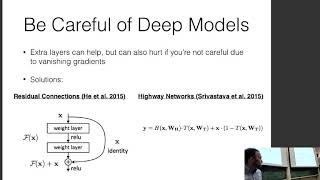
Neural Nets for NLP - Debugging Neural Nets
Practical strategies for identifying and resolving issues in neural networks for NLP, covering training and test-time problems, model architecture, and data analysis.
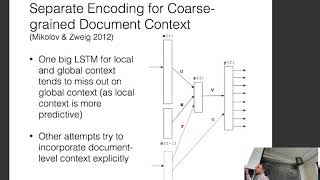
CMU Neural Nets for NLP 2018 - Document-Level Models
Explore document-level NLP models, covering language modeling, topic modeling, coreference resolution, and discourse parsing. Learn advanced techniques for analyzing and processing longer texts.
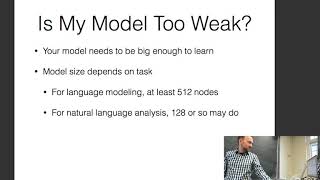
Neural Nets for NLP - Debugging Neural Nets for NLP
Practical strategies for debugging and optimizing neural networks in NLP, covering issues like training, overfitting, initialization, and evaluation metrics.
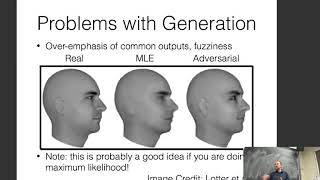
Neural Nets for NLP 2017 - Adversarial Learning
Explore adversarial learning in NLP, covering generative adversarial networks, feature vs. output adversaries, discrete outputs, and applications to language tasks.
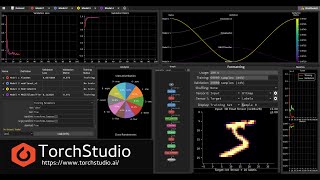
TorchStudio - Deep Learning Toolkit
Hands-on guide to TorchStudio: Access PyTorch datasets, train models, and compare results. Ideal for beginners and experienced users in the PyTorch ecosystem.
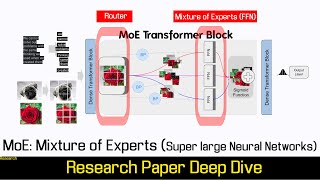
Research Paper Deep Dive - The Sparsely-Gated Mixture of Experts
Explore the Sparsely-Gated Mixture-of-Experts model, its architecture, and data processing for text and images. Learn about conditional computation and resource-efficient large-scale AI training.
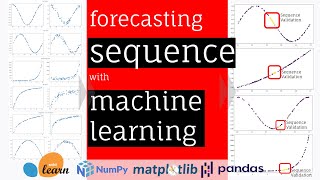
Forecast Any Mathematical Number Sequence with Regression - Machine Learning
Learn to generate and forecast mathematical number sequences using Python, pandas, numpy, and scikit-learn. Visualize data with matplotlib and apply regression models to predict future numbers in various function-based series.
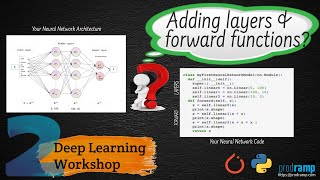
Adding Layers and Forward Functions to Your Neural Network in PyTorch
Learn to create neural networks in PyTorch: design layers, implement forward functions, and adapt models for various data types. Hands-on examples cover basic to complex architectures for structured and unstructured data.
Everything You Need to Know About Tensors in Deep Learning With PyTorch
Comprehensive guide to PyTorch tensors: creation, operations, data types, and GPU usage. Hands-on examples cover essential concepts for deep learning beginners.
Topic Modeling Workshop for Beginners in Python
Learn topic modeling in Python using Gensim, spaCy, and NLTK. Covers data preparation, exploratory analysis, tokenization, LDA modeling, and evaluation techniques for beginners.