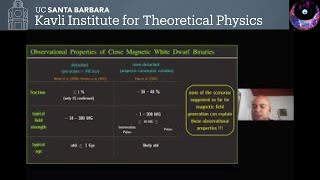
Formation and Evolution of Close Magnetic White Dwarf Binaries - Diogo Belloni
Explore the formation and evolution of close magnetic white dwarf binaries, their impact on astrophysics, and implications for stellar remnants and galactic populations.
Atmospheric Radiation - Using Machine Learning for the Unknowable and Uncomputable - Robert Pincus
Exploring machine learning applications in atmospheric radiation to tackle unknowable and uncomputable aspects, enhancing climate modeling and understanding of Earth's energy balance.
Skillful El Nino Prediction Beyond Predictability Barriers - Henk Dijkstra
Explores advanced techniques for predicting El Niño events beyond traditional limitations, discussing innovative approaches to enhance climate forecasting accuracy and extend prediction timeframes.
Relating Coastal Sea Level to Its Drivers in the Interior - Abigail Bodner
Explore the connection between coastal sea levels and interior drivers using advanced data analysis and machine learning techniques to enhance climate change understanding and prediction.
Objective Discovery of Dominant Dynamical Regimes - Bryan Kaiser - Climate-C21
Discover dominant dynamical regimes in climate systems using machine learning and big data. Explore objective methods to advance theoretical understanding and inform future climate predictions at regional scales.
Revealing the Impact of Global Heating on the Meridional Overturning Circulation
Explore the effects of global heating on ocean circulation using transparent machine learning techniques. Gain insights into climate system dynamics and future regional impacts.
Deep Unsupervised Learning for Climate Informatics - Claire Monteleoni
Exploring deep unsupervised learning techniques for climate data analysis, focusing on innovative approaches to extract insights from complex Earth system observations and modeling data.
Exploring Physical and Machine Learning Approaches for Stochastic Modeling and Ensemble Prediction of Weather and Climate
Explores innovative approaches combining physical principles and machine learning for stochastic modeling and ensemble prediction in weather and climate systems, addressing challenges in multi-scale processes and future projections.
Data-Driven Subgrid-Scale Modeling - Stability, Extrapolation, & Interpretation
Explores data-driven subgrid-scale modeling in climate science, focusing on stability, extrapolation, and interpretation. Discusses advancements in theoretical understanding and the potential of machine learning to address complex climate processes.
Learning from Billions of Galaxies - Can Our Understanding of Galaxy Formation Keep Up With the Upcoming Data Revolution?
Exploring the challenges and opportunities in understanding galaxy formation as we enter a new era of astronomical data, with insights from billions of observed galaxies.
On the Origins of High-Energy Neutrinos
Explore the origins of high-energy neutrinos with Ali Kheirandish, covering interdisciplinary developments in neutrino physics and their impact on astrophysics, cosmology, and particle physics.
Status of Neutrino Oscillation Experiments - Andre deGouvea
Comprehensive overview of current neutrino oscillation experiments, exploring recent findings, challenges, and future directions in this cutting-edge field of particle physics research.
Status of the DUNE Experiment - Leigh Whitehead
Comprehensive overview of the DUNE experiment's current status, exploring its goals, technology, and potential for groundbreaking neutrino physics discoveries.
Short-Baseline Review - Accelerators - Ornella Palamara
Explore short-baseline neutrino experiments and their role in advancing our understanding of neutrino physics, with insights from Fermilab expert Ornella Palamara.
Results from the NOvA Experiment - Zoya Vallari
Explore the latest findings from the NOvA neutrino experiment, presented by Zoya Vallari from Caltech. Gain insights into cutting-edge neutrino physics research and its implications for our understanding of the universe.
Do We Need to Go Beyond Cold Dark Matter?
Exploring the necessity of expanding beyond Cold Dark Matter theory in cosmology, examining current evidence and potential alternatives for a more comprehensive understanding of the universe.
Application of Constrained Simulations in Understanding Galaxy-Halo Connection
Explore constrained simulations to understand galaxy-halo connections, enhancing our knowledge of cosmic structure formation and the relationship between dark matter and visible galaxies.
Spin Alignments and Large-Scale Structure Reconstructions Using Neural Nets by Punyakoti Veena
Explore neural networks for spin alignments and large-scale structure reconstructions in cosmology, advancing our understanding of the Universe's structure and evolution.
The Distribution of Cold Gas in the Local Universe
Explore the distribution of cold gas in the local universe, examining its role in cosmic structure formation and galaxy evolution through advanced cosmological surveys and data analysis techniques.
Cosmology and Cosmography with Galaxy Peculiar Velocity Surveys
Explore galaxy peculiar velocity surveys and their impact on cosmology and cosmography. Learn about cutting-edge techniques for mapping large-scale structures and understanding the Universe's evolution.
Stacking Galaxy Clusters by Uri Keshet
Explore galaxy cluster stacking techniques and their applications in cosmological research, focusing on advanced data analysis methods for large-scale structure studies.