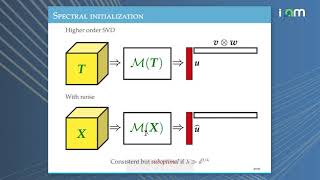
Low Rank Tensor Methods in High Dimensional Data Analysis
Explore advanced tensor methods for analyzing high-dimensional data, focusing on recent developments, challenges, and applications in various scientific fields.
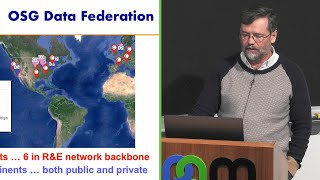
Global Cyberinfrastructure for LIGO, Virgo, Kagra, IceCube, and Others
Explore global cyberinfrastructure supporting multi-messenger astrophysics experiments, including data management, compute clusters, and modular software stacks for collaborative research.
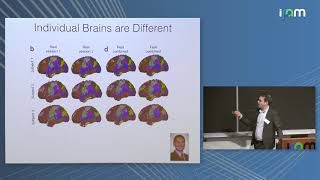
Sensing Psychosis: Toward Robust Computational Phenotypes in Severe Mental Illness
Exploring computational approaches to quantify behavior in severe mental illnesses, aiming to develop personalized psychiatric care through unobtrusive behavioral phenotyping strategies.

Machine Learning and Neural Networks: K-Nearest Neighbors - Day 9
Explore K-Nearest Neighbors algorithm for machine learning and neural networks, covering its principles, implementation, and applications in classification and regression tasks.
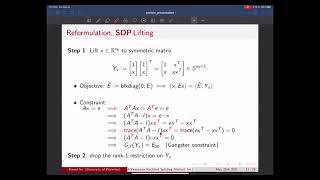
A Peaceman-Rachford Splitting Method for the Protein Side-Chain Positioning Problem
Explore protein side-chain positioning through doubly nonnegative relaxation and Peaceman-Rachford splitting method, with insights on facial reduction and numerical experiments for optimal solutions.
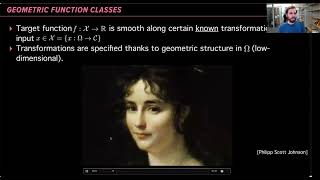
On the Role of Data Structure in High-Dimensional Learning
Explores high-dimensional learning challenges, focusing on geometric function classes, optimization aspects, and computational hardness. Discusses algorithmic approaches and implications for deep learning.
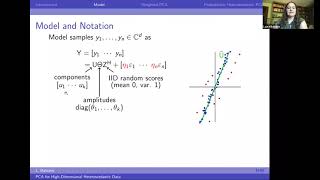
PCA for High-Dimensional Heteroscedastic Data
Explore optimal weighting for PCA in high-dimensional heteroscedastic data, improving recovery of underlying components and addressing challenges in modern applications with heterogeneous datasets.
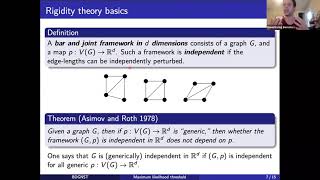
Rigidity Theory for Gaussian Graphical Models - The Maximum Likelihood Threshold of a Graph
Explore rigidity theory's application to Gaussian graphical models, focusing on maximum likelihood thresholds and their implications for data analysis in genomics and other fields.
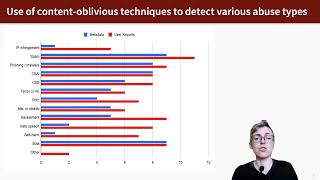
Content-Oblivious Trust and Safety Techniques - Survey Results from Online Service Providers
Survey results on trust and safety techniques used by online service providers, highlighting the prevalence of content-oblivious methods and implications for policy debates on anti-abuse measures and end-to-end encryption.

Disinformation: The State of Informational Trust and Integrity - Panel Discussion
Panel discussion on disinformation tactics, actors, and impacts. Experts analyze campaigns, offer tips to spot false information, and explore the security community's role in preserving data integrity.

Nifty Network Discovery Techniques - 2019
Explore advanced techniques for network reconnaissance and mapping with HD Moore, uncovering hidden assets and vulnerabilities in complex environments.
Hunting Twitter Bots at Scale - 2018
Explore techniques to identify and track automated Twitter accounts using data collection, attribute analysis, and machine learning classifiers for large-scale bot detection.
Nonlinear Data Analysis for Teachers - Professional Development
Explore nonlinear data analysis techniques for real-world applications, including residual assessment, inverse function linearization, and implementation of CCSS Mathematical Practices with web resources.

Mathematical and Computational Challenges in Quantum Computing - IPAM UCLA
Explore mathematical and computational challenges in quantum computing through workshops and collaborations, focusing on empowering mathematics to impact quantum information science and vice versa.
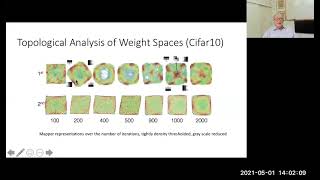
Gunnar Carlsson: Topological Deep Learning
Explore topological data analysis in deep learning, reducing data needs and enhancing transparency. Focuses on image and video analysis, network architectures, and applications in various fields.
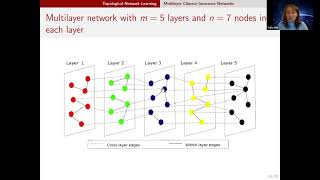
Yulia Gel - Topological Clustering of Multilayer Networks
Explore topological clustering of multilayer networks, focusing on higher-order interactions and local neighborhood shapes. Learn applications in climate-insurance and COVID-19 data analysis.
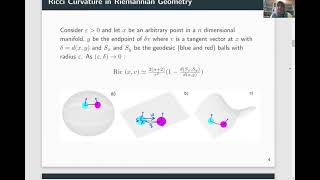
How Optimal Transport Can Help Us to Determine Curvature of Complex Networks
Explore Ollivier Ricci curvature in complex networks, its applications in network analysis, and implementation in chemical reaction networks using optimal transport theory.
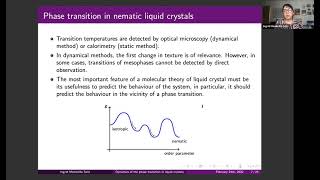
Liquid Crystals Dynamics - What Persistent Homology Reveals
Explore liquid crystal phase transitions through persistent homology, revealing thermodynamic features and structural changes in nanocomposites using advanced data analysis techniques.
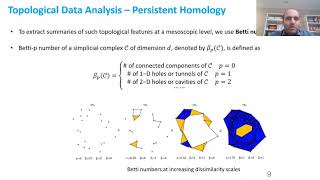
Cuneyt Akçora - TDA on Networks – Applications and Scalability Issues
Explore Topological Data Analysis on networks, focusing on applications in blockchain for ransomware detection, price prediction, and anomaly detection. Learn about persistent homology and TDAMapper algorithms.
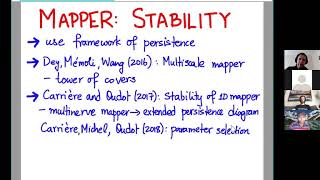
Bala Krishnamoorthy - Steinhaus Filtration and Stable Paths in the Mapper
Explore Steinhaus filtration and stable paths in Mapper, a topological data analysis tool. Learn applications in recommendation systems and explainable machine learning for data-driven insights.
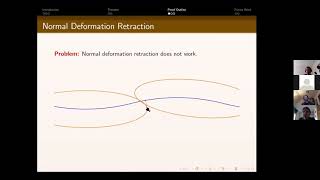
Sampling Smooth Manifolds Using Ellipsoids
Explore sampling smooth manifolds using ellipsoids, a novel approach requiring lower sample density than traditional ball-based methods, with potential applications in data science and topology.