
Best Stocks to Buy Now - Python for Finance - Part 6
Learn to automate stock market predictions using Python, focusing on regression analysis to identify high-momentum stocks and forecast potential returns across the entire market.

Stock Market Prediction Using Regression Analysis - Python for Finance
Learn stock market prediction using Python, covering regression analysis, forecasting, and ARIMA models to guide investment decisions based on past performance.

Low Risk Investments - Python for Finance 4
Learn Python techniques for analyzing low-risk investments, including portfolio creation, risk assessment, ROI analysis, and stock sector diversification using data science libraries.

Python for Finance: Downloading and Analyzing Stock Data
Learn to analyze stock market data using Python, covering Numpy, Pandas, data cleaning, and calculating financial metrics for thousands of stocks.
Linear Regressions with StatsModels - Data Science Tutorial
Learn to create linear regressions using StatsModels, exploring datasets and examples with NumPy, Pandas, Matplotlib, and Seaborn. Analyze professor ratings and tipping strategies through practical applications.

Art of the Possible: Showcasing Data Science Solutions for a Better World
Showcasing data science solutions for social good: challenges, approaches, and impact. Explores ethical AI, civic engagement, and inclusive design for systemic change in humanitarian and environmental sectors.

Stabilizing the Unstable Output of Persistent Homology Computations
Explore stabilizing techniques for persistent homology computations, focusing on generating cycles and their applications in topological data analysis.

Statistical Shape Analysis Using the Persistent Homology Transform
Explore statistical shape analysis using persistent homology transform, covering classical methods, TDA approaches, and recent advancements in multidimensional scaling and alignment.
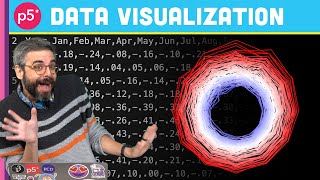
Visualizing Climate Data
Create a climate spiral visualization using p5.js to illustrate temperature changes over time. Learn data handling, polar coordinates, and animation techniques to effectively represent climate data.
Excel 2021 VBA Expert Tutorial
Master Excel 2021 VBA programming: automate tasks, create custom tools, and enhance productivity. Learn debugging techniques, error handling, and advanced features for efficient code development.
David Uminsky - LatMath 2022 - IPAM's Latinx in the Mathematical Sciences Conference
Explore mathematical applications in data science, including topological analysis and Fourier transforms, with insights on research initiatives and educational approaches.
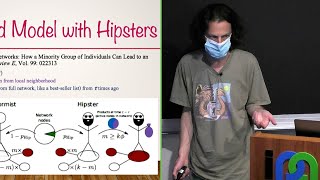
Opinion Models and Social Influence on Networks - IPAM at UCLA
Explore opinion dynamics on networks, including threshold models, voter models, and bounded-confidence models. Discover how network structure influences social contagions and opinion polarization.
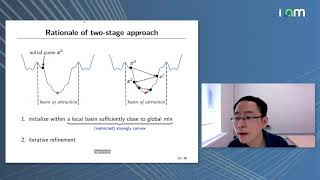
The Effectiveness of Nonconvex Tensor Completion - Fast Convergence and Uncertainty Quantification
Explores nonconvex optimization for tensor completion, proposing a two-stage algorithm with guaranteed success, linear convergence, and statistical accuracy. Discusses distribution characterization and confidence interval construction.
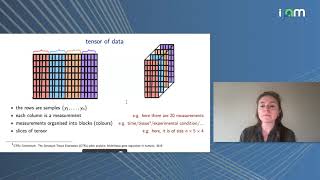
Principal Components along Quiver Representations
Explore principal components in quiver representations, a generalization of multi-indexed data tensors, and their applications in optimization and data analysis.
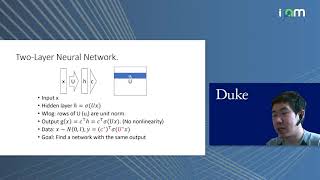
Beyond Lazy Training for Over-parameterized Tensor Decomposition
Explore tensor decomposition in over-parameterized settings, analyzing gradient descent variants and their performance beyond lazy training regimes for improved optimization in neural networks.
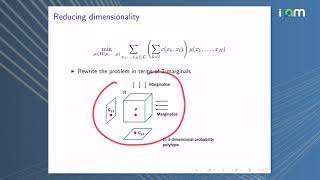
Strictly-Correlated Electron Functional and Multimarginal Optimal Transport
Explore convex optimization methods for multi-marginal transport problems in density functional theory, including relaxation techniques and rounding schemes for energy bounds.
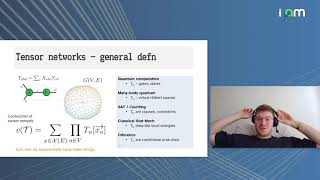
Hyper-Optimized Tensor Network Contraction - Simplifications, Applications and Approximations
Explore tensor network contraction optimization through hyper-graph partitioning, simplifications, and approximations, with applications in quantum circuit simulation and beyond.
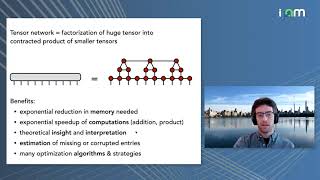
Tensor Networks for Machine Learning and Applications
Explore tensor networks in machine learning, their benefits, and applications. Learn about model functions, optimization algorithms, and potential insights for matching architectures to data types.
Low Rank Tensor Completion
Explore low-rank tensor completion methods for recovering tensors from partial observations, including matrix composition, multilinear ranks, and approaches for initialization and recovery.
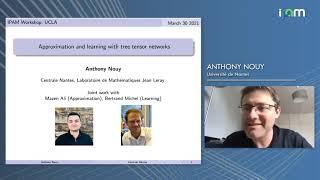
Approximation and Learning with Tree Tensor Networks
Explore tree tensor networks for high-dimensional function approximation, covering theoretical aspects, approximation classes, and learning strategies in statistical settings.
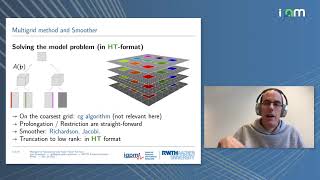
Multigrid in Hierarchical Low Rank Tensor Formats
Explore hierarchical low rank tensor formats and multigrid methods for solving high-dimensional systems, with focus on convergence analysis and practical applications in scientific computing.