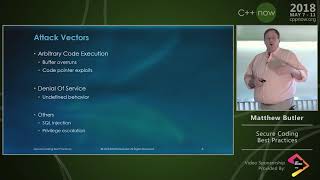
Secure Coding Best Practices
Explore secure coding practices in C++ to protect systems from vulnerabilities. Learn to identify attack surfaces, balance security with performance, and integrate security measures from the design phase.
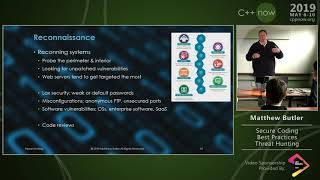
Secure Coding Best Practices - Threat Hunting
Explore threat modeling and secure coding practices in C++, focusing on identifying attack surfaces, analyzing vulnerabilities, and implementing effective defense strategies for robust software design.
If You Can't Open It, You Don't Own It
Exploring hardware vulnerabilities and their impact on C++ systems, this talk delves into side-channel attacks, physical penetrations, and supply chain risks, offering insights for securing modern C++ designs.
Safety and Security - The Future of C++
Explore C++'s future through safety and security lens, examining its role as critical infrastructure and the ethical responsibilities of developers to address its challenges.

Coding for Safety, Security, and Sustainability in C++ - Panel Discussion
Expert panel explores C++'s future, addressing safety, security, and sustainability challenges. Discusses language evolution, competition, and community needs for improved software development.
Carbon Language Successor Strategy - From C++ Interop to Memory Safety
Explore Carbon Language's successor strategy, C++ interoperability, and memory safety features. Learn about its unique approach, implementation challenges, and potential impact on large-scale C++ codebases.
Privacy-Preserving Methods - Building Secure Projects
Explore privacy-preserving techniques for secure data handling and machine learning, including anonymization and pseudonymization methods to protect user information while maintaining data utility.
Charla: Detección automatizada de archivos maliciosos en el repositorio PyPI
Detección automatizada de malware en PyPI: vectores de ataque, sistema de detección integrado, tipos de chequeos implementados y cómo combatir amenazas en el repositorio.
Using Python to Detect Vulnerabilities in Binaries
Explore Python-based CVE Binary Tool for detecting software vulnerabilities. Learn its functionality, usage, and contribute to enhancing cybersecurity for all.
Practical Privacy-Preserving Machine Learning in Python
Explore privacy-preserving machine learning techniques in Python, including federated learning and encrypted data algorithms, to build accurate models while protecting user privacy.
Deploying Python at Scale with Dask
Explore scaling Python with Dask on distributed systems, focusing on deployment challenges and solutions for cluster resource managers like Kubernetes, Yarn, and cloud platforms.
Secure Software Supply Chains for Python
Explore Python software supply chain security, including common attacks, protective measures, and tools. Learn about ecosystem improvements for enhanced security in third-party package integration.
Unexpected Execution - Wild Ways Code Execution Can Occur in Python
Explore unconventional code execution methods in Python, from yaml to str.format. Learn about real vulnerabilities, absurd exploits, and prevention techniques using Facebook's open-source Pysa analyzer.
Cuándo Usar Extensiones Nativas en Rust - Rendimiento Accesible y Seguro
Explora el uso de extensiones nativas en Rust para mejorar el rendimiento de Python, ofreciendo seguridad y accesibilidad. Aprende cuándo implementarlas basado en la experiencia del proyecto Pants.
Bad Actors vs Our Community - Detecting Software Supply Chain Attacks
Explore techniques used by bad actors in software supply chain attacks and learn about a large-scale vetting system for detecting malware in Python packages.
Python for Threat Intelligence
Explore threat intelligence using Python: automate tasks, analyze data, and build tools for security incident prevention. Learn from real-world examples and development practices.
Open Source, Python Based Tools for Data Privacy
Explore open-source Python tools for integrating data privacy into software development, improving trustworthiness and efficiency in handling personal data across various infrastructures.
Securing the Open Source Software Supply Chain
Explore tools and best practices for securing the open-source software supply chain, addressing vulnerabilities, and enhancing trust in the ecosystem. Learn about recent developments and future improvements.
Securing Code with the Python Type System
Explore how Python's type system can enhance code security, from simple annotations to advanced tools, preventing vulnerabilities and enabling incremental improvements in project safety.
Oh No! My Regex Is Causing a Denial of Service! What Can I Do About It?
Explore regex performance issues, including ReDoS, with practical examples. Learn to detect problematic expressions, improve performance, and defend against malicious inputs using static analysis techniques.
Software Security and Slippery Slopes - How to Elevate an Entire Ecosystem at Scale
Explore strategies for enhancing software security in large open-source ecosystems, focusing on Python. Learn about community collaboration, automation, and practical approaches to implement security improvements at scale.