ABY3 - A Mixed Protocol Framework for Machine Learning
Explore privacy-preserving machine learning with ABY3, a framework addressing data collection concerns through encrypted computations and secure multi-party protocols.
Ret2spec- Speculative Execution Using Return Stack Buffers
Explore speculative execution security risks, focusing on return stack buffer vulnerabilities and potential countermeasures in modern CPUs.
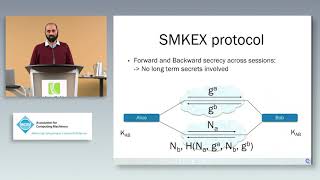
Secure Opportunistic Multipath Key Exchange
Explore a novel key exchange protocol offering opportunistic encryption benefits and protection against active attackers, without relying on trusted third parties or pre-established secrets.
Advanced Cryptography: Promise and Challenges
Explore advanced cryptography beyond communication security, including zero knowledge and secure multi-party computation. Learn about its potential, performance, and current usability challenges.
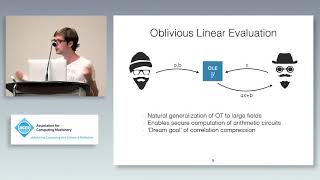
Compressing Vector OLE
Explore secure two-party protocols for vector oblivious linear evaluation, its applications, and improvements in pseudorandom correlations and sparse vector-OLE generation.

Fast Multiparty Threshold ECDSA with Fast Trustless Setup
Explore efficient multiparty ECDSA signatures with fast, trustless setup. Learn about threshold schemes, communication optimization, and implementation details for secure digital signatures.

Fast Secure Multiparty ECDSA
Explore secure distributed ECDSA signing, its challenges, and innovative solutions for threshold signing in cryptography and blockchain applications.
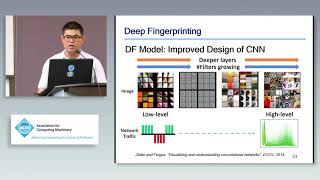
Deep Fingerprinting: Undermining Website Fingerprinting Defenses with Deep Learning
Explore advanced website fingerprinting attacks using deep learning, challenging existing defenses and analyzing their effectiveness against Tor and other protective measures.
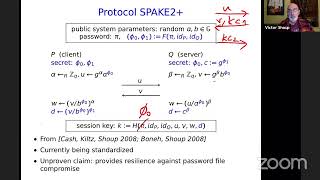
Oblivious Structures, Key-Exchange and Group Messaging
Explore oblivious structures, key-exchange protocols, and secure group messaging techniques. Gain insights into cryptographic concepts and their practical applications in communication systems.

Authenticated Encryption
Explore authenticated encryption, including combiners, fast decryption, and sponge-type security. Learn about plaintext release and engage in Q&A sessions.

Post Quantum Crypto 2
Explore pseudorandom quantum states, efficient correlations, and bullet proofs in this advanced cryptography discussion on post-quantum security.

Practical Decryption Exfiltration: Breaking PDF Encryption
Explore techniques for breaking PDF encryption, including content overlay, form exfiltration, and malleability gadgets. Learn about attacker models, encryption gaps, and potential mitigations.

Cryptographic Primitives
Explore cryptographic primitives including witness maps, efficient reductive signatures, constraint PRFs, and chameleon hash functions. Dive into applications, state-of-the-art techniques, and advanced concepts.

Welcome - Functional Encryption and Identity Based Encryption
Explore functional encryption and identity-based encryption concepts, including attribute-based encryption, adaptive security, and verifiability in cryptographic systems.
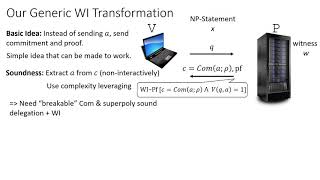
Witness Indistinguishability for Any Single-Round Argument with Applications to Access Control
Explore witness indistinguishability in single-round arguments and its applications to access control, presented by Brakerski and Kalai at PKC 2020.
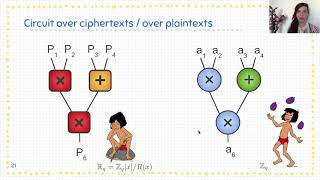
Boosting Verifiable Computation on Encrypted Data
Explore verifiable computation on encrypted data, covering homomorphic encryption, SNARKs, and polynomial commitments for secure and private delegation of computation.
Generic Authenticated Key Exchange in the Quantum Random Oracle Model
Explores authenticated key exchange in quantum settings, addressing limitations of prior work and proposing a new security model for 2-move protocols in the Quantum Random Oracle Model.
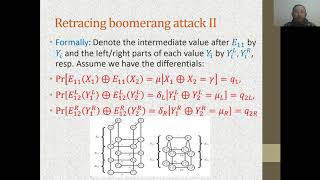
The Retracing Boomerang Attack
Explore advanced cryptanalysis techniques, focusing on the Retracing Boomerang Attack and its variants. Learn about block ciphers, differential attacks, and applications to AES.

Multi-Party Computation 1
Explore multi-party computation fundamentals, adaptive security, and practical applications in this comprehensive overview of secure collaborative data analysis techniques.

Quantum Cryptography 1 - Continued
Explore multiparty quantum computations, one-way functions, and obfuscation in this advanced continuation of quantum cryptography concepts.
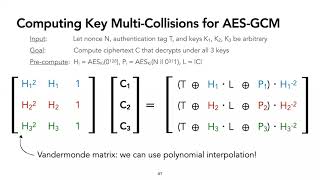
Partitioning Oracle Attacks
Explore partitioning oracle attacks in cryptography, focusing on authenticated encryption, key multi-collisions, and vulnerabilities in protocols like Shadowsocks and OPAQUE.