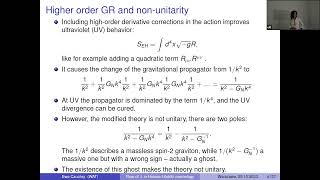
Energy Flow of λ in Hořava-Lifshitz Cosmology
Explore Hořava-Lifshitz cosmology, focusing on λ parameter's energy flow. Analyze two formulations using diverse datasets to bound cosmological parameters and compare with Einstein gravity.
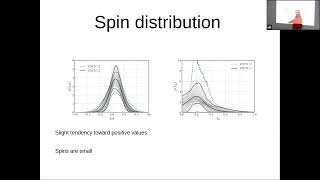
Where Do Merging Binary Black Holes Come From?
Explore the origins of merging binary black holes, examining LVK detections, formation models, and their comparison to observational data.
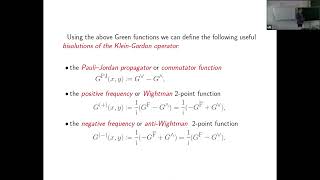
Feynman Propagator on Curved Spacetimes - Definitions and Examples
Explore the Feynman propagator in Quantum Field Theory, examining its definitions and applications across various spacetime models, including stationary, FLRW, and de Sitter.
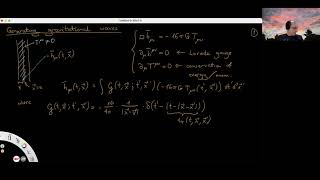
Gravitational Wave Sources, Detectors, and Schwarzschild Metric - Lecture 14
Explore gravitational wave sources, detectors, and the Schwarzschild metric in this advanced physics lecture, covering quadrupole formula and total power calculations.
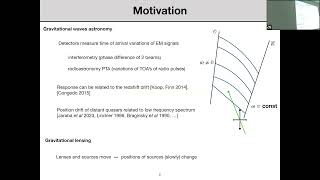
Redshift Drift, Position Drift and Caustics in General Relativity
Explore redshift and position drifts in general relativity, examining their formulas, physical consequences, and applications in gravitational lensing, astrometry, and cosmology.
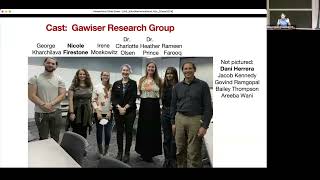
What We Think We Know About Lyman Alpha Emitting Galaxies - Lecture
Explore high-redshift Lyman Alpha Emitting galaxies, examining common assumptions and their validity. Discover ongoing research methods to test these hypotheses about LAEs.
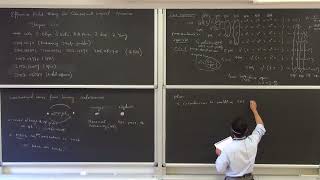
Effective Field Theory for Gravitational Inspiral Dynamics
Explore advanced concepts in gravitational wave physics, focusing on effective field theory applications to binary inspiral dynamics and post-Newtonian expansions.
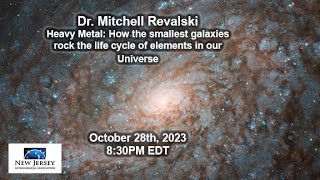
Heavy Metal: How the Smallest Galaxies Impact the Life Cycle of Elements in Our Universe
Explore the role of small galaxies in the cosmic metal cycle, examining their metal content and evolution over billions of years using deep space observations from Hubble and ground-based telescopes.
Dark Matter: What We (Don't) Know - Samhain Agus Science 2022
Explore the mysteries of Dark Matter, its existence, detection methods, and potential production in collider experiments. Gain insights into this enigmatic component of the universe.
Samhain to Space Telescopes - A Journey Through Irish Astronomy
Explore Ireland's astronomical journey from ancient Samhain timekeepers to modern space telescope observations, uncovering the rich history of stargazing on the island.
Why Is the Universe Big?
Explore the profound implications of the universe's size, delving into fundamental physics mysteries that challenge our understanding of spacetime, quantum mechanics, and the nature of reality.
A Novel Proposal for Ultra Light Dark Matter
Explore a groundbreaking proposal for Fuzzy Dark Matter, inspired by Schrodinger's work, and examine potential evidence supporting this ultra-light dark matter scenario.
A Novel Proposal for Ultra Light Dark Matter
Explore a groundbreaking proposal for Fuzzy Dark Matter, inspired by Schrodinger's work, and examine potential evidence supporting this ultra-light dark matter scenario.
PRyMordial - The First Minutes of the Universe Computed in Seconds
Explore the computational simulation of the universe's earliest moments, uncovering insights into cosmic origins and evolution.
Freeze-in: Problems and Opportunities in Dark Matter Production
Explore FIMP dark matter production, challenges in detection, and solutions involving matter-dominated epochs and low reheating temperatures. Discover implications for direct detection and freeze-out transitions.
Monopoles and Baryons from Sphalerons and Instantons
Explore non-perturbative quantum field theory phenomena in particle physics, focusing on sphalerons and instantons, their role in baryon number violation, and implications for cosmology and magnetic monopoles.
Non-Relativistic Gravity: 1/c Expansion of General Relativity
Explore the 1/c expansion of general relativity, Newton-Cartan gravity, and non-relativistic gravity's applications in quantum mechanics and fluid dynamics.
Green Functions for Black Hole Spacetimes - Wave Propagation, Self-Force, Stability, and Quantum Properties
Explore Green functions in black hole spacetimes, examining wave propagation, self-force, stability, and quantum properties. Gain insights into crucial mathematical and physical concepts.
Dark Energy with a Little Help from its Friends - Why It Might Need Somebody
Explore string theory's insights into dark energy, quantum gravity, and coupled dark sectors, with potential observable consequences.
Covariant Loop Quantum Gravity and Cosmology
Explore covariant Loop Quantum Gravity dynamics and its applications to cosmology, including primordial correlations, entanglement entropy, and singularity resolution in the quantum gravitational framework.
Search for Cosmic Strings Through Their Gravitational Wave Signals
Explore gravitational wave signals from cosmic strings and their detection prospects with upcoming experiments and recent pulsar timing array data.