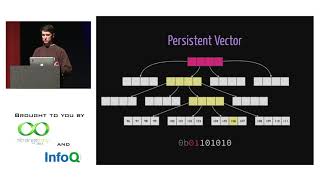
Functional Vectors, Maps, and Sets in Julia
Explore functional data structures in Julia: implementing persistent vectors, hash maps, and sets. Learn optimizations for improved performance in this hands-on coding session.
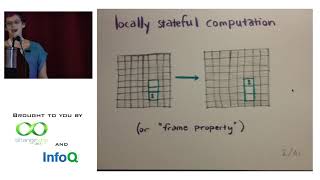
Linear Logic Programming
Explore linear logic programming's unique approach to state change and resource management, with applications in state machines, narratives, and interactive systems using the Celf language.
Xiki - GUI and Text Interfaces are Converging
Xiki: Innovative text-based interface combining shell, code snippets, and GUI elements for efficient control of web browsers, databases, and APIs. Simplifies menu creation and tool interaction.
Bust the Android Fragmentation Myth
Learn techniques to overcome Android fragmentation, including responsive design and progressive enhancement, applicable for developers of all team sizes.

Creative Machines
Exploring the potential for machine creativity, this talk delves into AI-generated art, examining algorithms and techniques used to exhibit creativeness and their implications for the future of artificial intelligence.
Category Theory - An Abstraction for Anything
Explore category theory's foundations, applications in programming, and powerful abstractions. Learn to recognize category-theoretical patterns and apply them to your projects.
A Relational Exploration of the Chomsky Hierarchy
Explore encoding automata and Turing Machines in miniKanren for relational programming. Learn to generate strings and associated data structures, gaining insights into the Chomsky Hierarchy and automata workings.
How Developers Can Treat Ovarian Cancer
Explore how developers leverage genomics and bioinformatics to create an evidence-based engine for personalized ovarian cancer treatment, using technologies like Clojure and Neo4J.
CQRS with Erlang
Explore CQRS implementation in Erlang, highlighting its advantages for distributed systems and eventual consistency. Learn how Erlang's features complement CQRS principles.
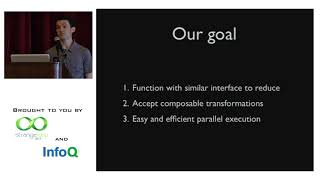
Dissecting Clojure Reducers
Explore Clojure Reducers through live coding, uncovering functional abstractions and performance improvements for parallel solutions. Learn from ground-up implementation and real-world examples.
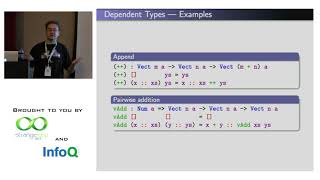
Scala vs Idris - Dependent Types, Now and in the Future
Exploring dependent types in Scala and Idris: current capabilities, limitations, and future possibilities. Demonstrates rich type systems' potential for program verification and static constraint capture in functional programming.
The JavaScript Interpreter, Interpreted
Demystifying JavaScript's core concepts: function objects, prototypes, scope, and 'this'. Gain a clear understanding of the language's interpreter for better vanilla JavaScript programming.
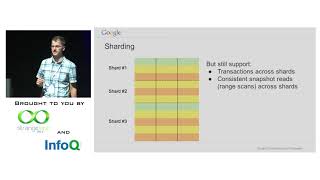
Spanner - Google's Distributed Database
Explore Google's Spanner: a planet-scale distributed database with innovative features like lock-free strong reads and globally consistent snapshots, enabled by GPS and atomic clocks.
Native Speed on the Web - JavaScript and asm.js
Exploring asm.js: Compiling C++ to JavaScript for near-native web performance. Demos, limitations, and future directions of this approach to optimize JavaScript execution while maintaining compatibility.
How to Teach Your Kid to Code with Hopscotch
Explore visual programming for kids using Hopscotch, an iPad app designed to introduce coding concepts without syntax hurdles. Learn techniques and sample projects to start teaching children programming.
Java Puzzlers - Strange Loop Edition
Explore Java's quirks and pitfalls through entertaining puzzles. Learn to identify and avoid common programming traps while sharpening your Java skills with industry experts Bob Lee and Josh Bloch.
Patterns for Scalable Web Services in Go
Explore Go's features and packages for building scalable web services, covering HTTP, JSON, reflection, testing, deployment, logging, and more. Learn battle-ready patterns for production.
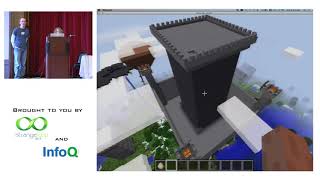
Generation Minecraft - Kids Building Software
Exploring how Minecraft motivates kids to create on computers, featuring live demonstrations by young players and discussing strategies for encouraging digital creativity in children.
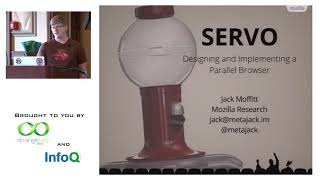
Servo - Designing and Implementing a Parallel Browser
Explore Servo, an experimental browser engine designed for multi-core hardware, focusing on parallelization and security through Rust. Learn about its goals, design, and potential impact on web browsing.
Finding a Way Out
Exploring the future of programming beyond current paradigms, reimagining software creation for improved insight and reduced complexity in modern development.
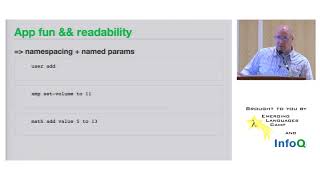
Daimio - A Language for Sharing
Explore Daimio, a new language for secure functionality sharing. Discover architectural possibilities, security techniques, and comparisons to similar systems. Witness practical applications in browser-based projects.