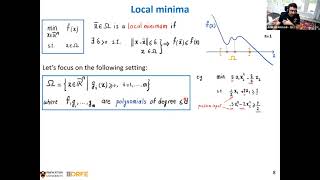
Local Minima, Stable Sets, and Sums of Squares
Explore polynomial optimization complexity, local minima, stable sets, and sum of squares polynomials. Uncover connections between graph theory and algebra in this advanced mathematical presentation.
Essentials of Math Modeling - Basic Programming in MATLAB
Learn essential MATLAB programming concepts for mathematical modeling, including variables, data types, loops, and functions. Practice with real-world problem-solving using the M3 Challenge 2019 submission analysis.

Stochastic Games on Large Graphs in Mean Field and Sparse Regimes
Explore stochastic games on large graphs, focusing on mean field and sparse regimes. Learn about linear-quadratic models, graph-based player interactions, and large-scale asymptotics in dense and sparse scenarios.
Essentials of Math Modeling - Overview of the Math Modeling Process
Comprehensive overview of mathematical modeling process, covering problem definition, assumptions, variables, solution building, analysis, and result reporting. Includes hands-on problem-solving sessions.
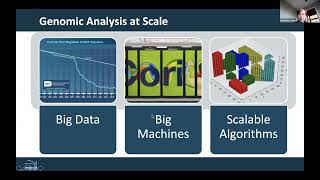
Genomic Analysis at Scale - Mapping Irregular Computations to Advanced Architectures
Explore genomic data analysis at scale, covering parallel algorithms, architectures, and programming models for efficient processing of large-scale genomic datasets on advanced computing systems.
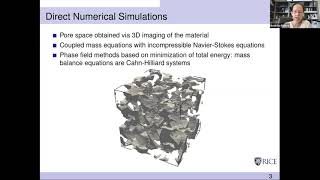
Bound-Preserving Numerical Solutions of Variable Density Two-Phase Flows
Explore efficient numerical methods for solving phase-field models in pore-scale flows, focusing on bound-preserving solutions and applications in energy and environmental sciences.
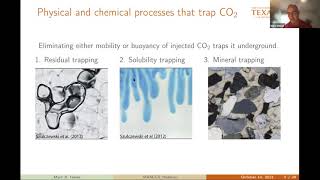
Solutal Convection in Porous Media
Explore solutal convection in porous media, challenging conventional theories with experimental findings and numerical simulations to understand flux patterns and mixing processes.
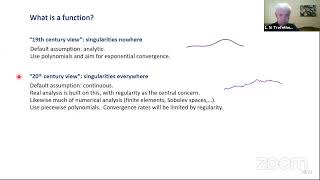
Rational Functions
Explores recent advances in rational approximation theory for numerical computation, focusing on "AAA" and "lightning" algorithms for solving PDEs in complex domains with singularities.

Machine Learning - Dynamical, Statistical, and Economic Perspectives
Explore machine learning's decision-making aspects, focusing on statistical and economic challenges in multiple decision-making, scarcity, and competition through dynamical systems perspectives.
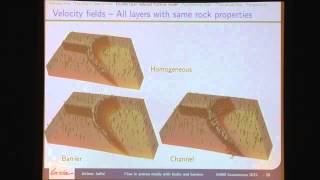
Discrete Reduced Models for Flow in Porous Media
Explore reduced models for porous media flow, focusing on simple models, interfaces, and intersection fractions with practical examples and applications.
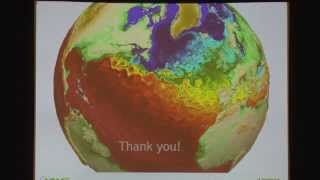
A Multi-Scale Approach to Global Ocean Climate Modeling
Explore multi-scale approaches to global ocean climate modeling, focusing on mimetic methods, Voronoi tessellations, and simulations of ocean systems like the North Atlantic.
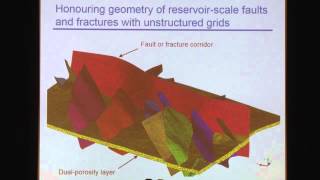
Numerical Simulation of Fractured Reservoirs
Explore advanced techniques for simulating fractured reservoirs, including dual-porosity models, unstructured grids, and probabilistic approaches to enhance flow prediction and reservoir management.
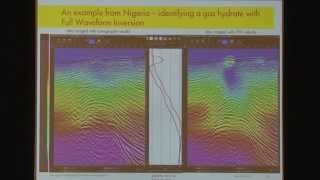
Seismic Inverse Problem
Explore seismic inverse problems, wave propagation, and modern exploration methods. Learn about FWI, wave bath tomography, and extended Born operators for improved subsurface imaging.

Math and Healthcare - Optimizing and Coordinating Healthcare Networks and Markets
Explore optimization models for efficient healthcare resource management and network coordination, featuring insights from MIT's Retsef Levi on industry challenges and opportunities.
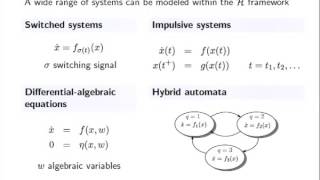
Feedback Control of Hybrid Dynamical Systems
Explore mathematical framework for analyzing and controlling hybrid systems with continuous and impulsive dynamics. Learn tools for stability, invariance, and applications in genetics and power systems.
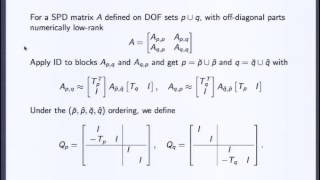
Hierarchical Interpolative Factorization
Explore efficient matrix factorization techniques for differential and integral operators, focusing on interpolative decomposition and its applications in various dimensions and problem types.
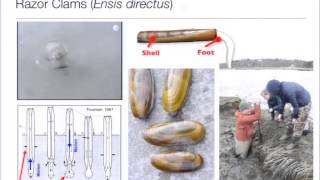
From Razor Clams to Robots - The Mathematics Behind Biologically Inspired Design
Explore biomimicry in engineering through examples of snails, clams, and microorganisms. Learn how mathematical analysis of natural systems leads to innovative robotic designs and optimization techniques.

Molecular Testing for Periprosthetic Joint Infections
Explore multiplex PCR and metagenomic sequencing for detecting pathogens in periprosthetic joint infections, comparing their effectiveness to traditional culture methods.

Microbial Myths III
Debunks common microbiology misconceptions, covering topics from household cleaning to personal hygiene and health beliefs. Provides scientific explanations to dispel widespread myths about germs, infections, and everyday practices.

Ideals and Varieties of the Pinhole Camera
Explore the mathematics behind pinhole cameras, from historical context to modern applications in reconstruction and invariant theory, with insights into projective geometry and cubic surfaces.
Sharp Inequalities in Probability and Harmonic Analysis
Explore sharp inequalities in probability and harmonic analysis, covering motivations, history, proofs, and applications in stochastic integrals and numerical approximations.