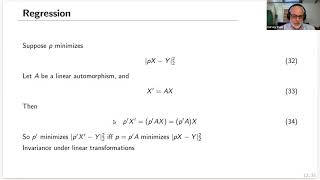
Model Invariants and Functional Regularization
Explore model invariants and functional regularization in quantitative finance. Learn about regression, MLE, Bayesian estimation, and new approaches to improve model robustness and interpretability in data analysis.
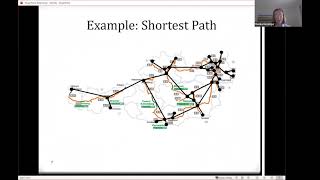
Dynamic Graph Algorithms and Their Implementation
Explore recent advances in dynamic graph algorithms, covering theoretical analysis and empirical evaluations for efficiently handling edge deletions and insertions in evolving graph models.
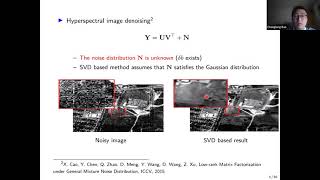
Learning Robust Imaging Models without Paired Data
Explore robust imaging models using Bayesian inference and deep learning without paired data. Learn techniques for image denoising, segmentation, and unpaired degradation modeling in practical applications.
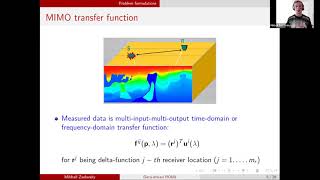
Reduced-Order Modeling and Inversion for Large-Scale Problems of Geophysical Exploration
Explore reduced-order modeling techniques for efficient geophysical exploration, focusing on electromagnetic and seismic methods to solve large-scale forward and inverse problems in real-time.
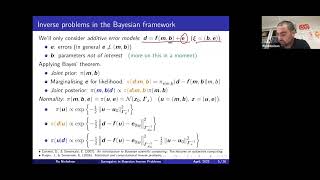
On the Use of Linear Surrogate Models for Bayesian Inverse Problems
Explore efficient Bayesian inverse problem solutions using linear surrogate models. Learn about model discrepancy, Gaussian priors, and applications in high-dimensional PDE discretization problems.

Operational Risk Financialization of Electricity Under Stochasticity
Quantifying and allocating risk in electricity grids with renewable energy sources, using Monte Carlo simulations and advanced optimization techniques to enhance grid reliability and cost-effectiveness.
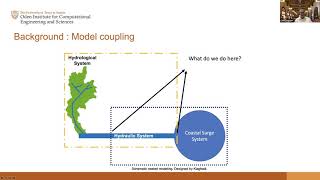
Modeling of Compound Flooding in Coastal Environments
Explore compound flooding modeling, combining storm surge and rainfall simulations. Learn about challenges, recent developments, and applications in coastal environments.
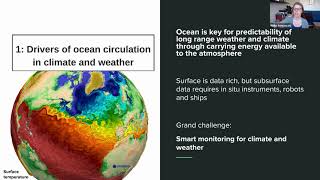
Understanding the Ocean's Response in a Future Climate - A Robust Blueprint for Trustworthy AI for Climate Analysis
Explore AI-driven climate analysis, focusing on ocean circulation changes. Learn transparent ML techniques rooted in oceanographic theory for trustworthy insights into future climate scenarios.
Multiscale Methods for Machine Learning
Multiscale machine learning framework for efficient predictions in enormous output spaces, addressing challenges of limited data and scalability through hierarchical modeling and sparse matrix techniques.
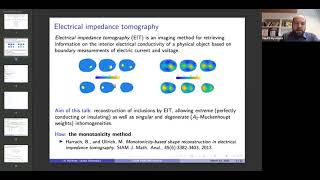
Monotonicity Method for Extreme, Singular and Degenerate Inclusions in Electrical Impedance Tomography
Explores advanced mathematical techniques for electrical impedance tomography, focusing on the monotonicity method's application to extreme, singular, and degenerate inclusions in conductivity reconstruction.
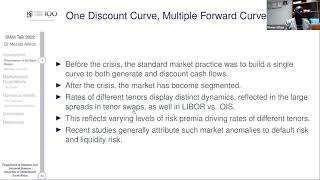
Quantitative Finance - Toward A General Framework for Modelling Roll-Over Risk
Explore quantitative finance and reinforcement learning in this SIAM talk series, featuring discussions on roll-over risk modeling and continuous-time episodic RL with linear-convex models.
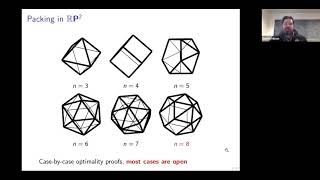
Packing Points in Projective Spaces
Explore optimal point arrangements in projective spaces, surveying current research and open problems in this fundamental area of metric geometry with applications in digital communication.
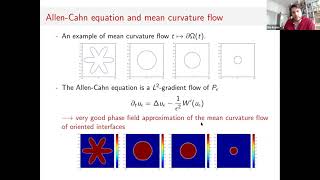
Mean Curvature Flow, Neural Networks, and Applications
Explore mean curvature flow's applications in image processing, data science, and biology. Learn how neural networks can approximate interface evolutions for non-oriented surfaces, with applications to Steiner and Plateau problems.
Modelling, Upscaling and Simulation of Dissolution and Precipitation in a Porous Medium with an Evolving Pore-Scale Geometry
Explore modeling and simulation of dissolution and precipitation in porous media, focusing on evolving pore-scale geometry and its impact on Darcy scale properties. Learn upscaling techniques and numerical approaches.
Essentials of Math Modeling - Good Writing Practices and Challenge Weekend CRAM Session
Learn effective math modeling report writing techniques, explore a case study on the 2022 practice problem, and discover LaTeX for professional document creation in this comprehensive session.
Essentials of Math Modeling - Introduction to Regression and Statistical Ideas
Explore linear regression, data transformations, and statistical concepts in mathematical modeling. Learn MATLAB examples, sensitivity analysis, and problem-solving techniques for real-world applications.
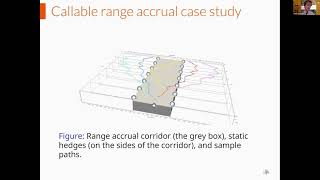
Darwinian Model Risk and Reverse Stress Testing
Explore Darwinian model risk and reverse stress testing in finance. Learn about adverse model selection, valuation losses, and strategies to detect and mitigate long-term risks in trading.
Essentials of Math Modeling - Session 5 - Probabilistic Models
Explore probabilistic models, including Markov chains and Metropolis-Hastings algorithm, with practical exercises and problem-solving sessions using MATLAB for mathematical modeling applications.
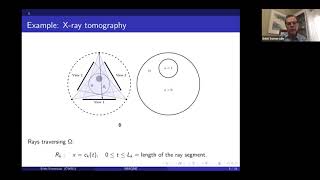
Imaging with Unstructured Adaptive Meshes
Explore adaptive mesh techniques for imaging problems, focusing on finite element methods and mesh adaptation to improve resolution and computational efficiency in PDE solutions.
Essentials of Math Modeling - Model for Disease Spread, Difference, and Differential Eqs
Explore mathematical modeling for disease spread using difference and differential equations. Learn stage-structured models, solution methods, and practical applications through examples and problem-solving sessions.
Essentials of Math Modeling - Intro to Data Analysis Using MATLAB and Excel
Learn data analysis techniques using MATLAB and Excel, covering SI models, plotting, data importing, and problem-solving with real-world examples from mathematical modeling challenges.