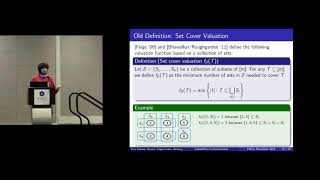
Settling the Communication Complexity of Combinatorial Auctions with Two Subadditive Buyers
Explores communication complexity in combinatorial auctions with two subadditive buyers, introducing truncated set cover valuations and examining protocols for this scenario.
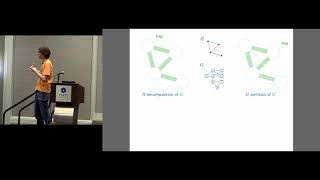
Planar Graphs Have Bounded Queue-Number
Explore the theory of planar graphs and their bounded queue-number property, including history, extensions, and applications in graph theory.
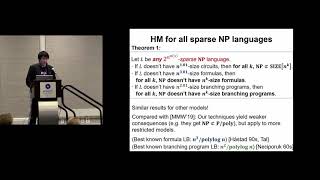
Hardness Magnification for All Sparse NP Languages
Explore hardness magnification in computational complexity, focusing on sparse NP languages and the Minimum Circuit Size Problem, with insights on algorithms and open challenges.
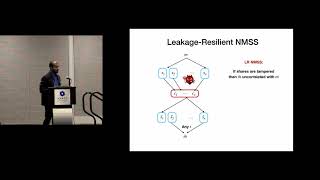
Leakage Resilient Secret Sharing Against Colluding Parties
Explore leakage-resilient secret sharing techniques against colluding parties, discussing bounded collusion protocols, communication complexity, and non-malleable secret sharing.
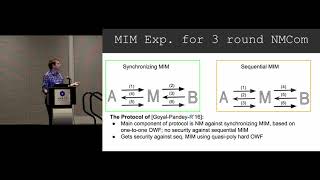
Non-Malleable Commitments Using Goldreich-Levin List Decoding
Explore non-malleable commitments using Goldreich-Levin list decoding. Learn about semantic security, commitment schemes, and applications in cryptography.
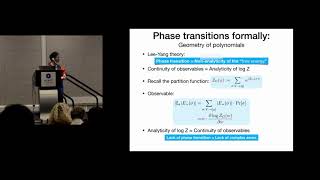
A Deterministic Algorithm for Counting Colorings with 2Δ Colors
Explore a deterministic algorithm for counting colorings, delving into phase transitions, partition functions, and entropy conditions in graph theory.
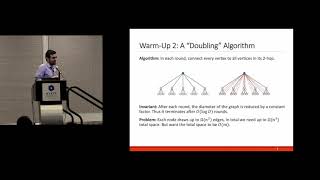
Near Optimal Massively Parallel Graph Connectivity
Explore efficient parallel algorithms for graph connectivity, focusing on near-optimal solutions and innovative techniques for large-scale graph processing.
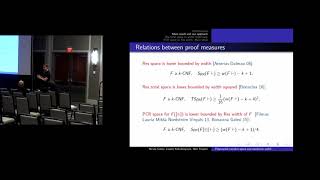
Polynomial Calculus Space and Resolution Width
Explore proof complexity, resolution systems, and space complexity in polynomial calculus, featuring combinatorial characterizations and discussions on total spaces and tight bounds.
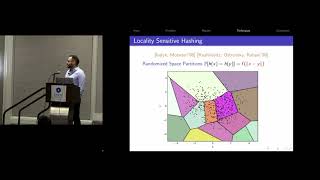
Multi-Resolution Hashing for Fast Pairwise Summations
Explore fast pairwise summations using multi-resolution hashing techniques, covering applications, key ideas, and innovative approaches to improve computational efficiency.
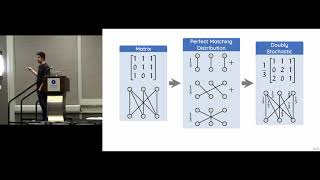
A Tight Analysis of Bethe Approximation for Permanent
Explore the Bethe approximation for permanent, analyzing its accuracy and limitations through various approximation factors and distributions on perfect matchings and trees.
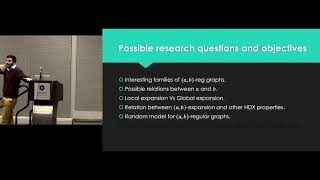
Expander Graphs - Both Local and Global
Explore expander graphs, their local and global properties, construction methods, and applications in this concise IEEE talk by experts in the field.
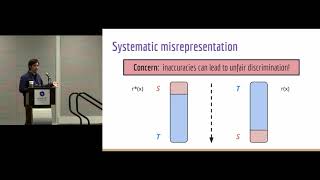
Learning from Outcomes - Evidence-Consistent Rankings
Explore evidence-consistent rankings in machine learning, focusing on fairness, misrepresentation, and multi-accuracy. Gain insights into domination compatibility and self-reference in ranking systems.
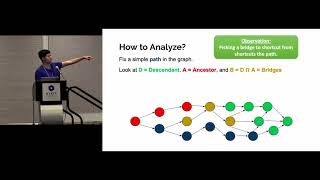
Parallel Reachability in Almost Linear Work and Square Root Depth
Explore efficient parallel algorithms for graph reachability, focusing on distributed computing and improved runtime complexity in large-scale networks.
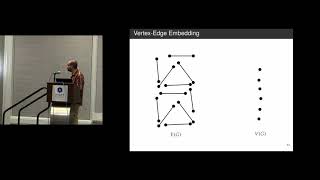
Inapproximability of Clustering in Lp Metrics
Explores computational complexity of clustering in Lp metrics, discussing approximation algorithms, hardness of approximation, and key concepts like Johnson Coverage Hypothesis.
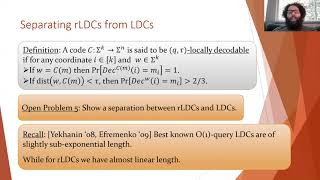
Relaxed Locally Decodable Codes
Explore advanced concepts in coding theory, including relaxed locally decodable codes, constant query regime, and list-decoding regime, with insights on lower bound techniques.
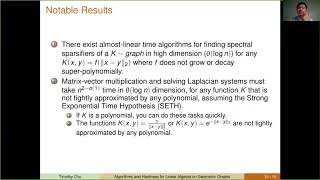
Algorithms and Hardness for Linear Algebra on Geometric Graphs
Explore algorithms and hardness for linear algebra on geometric graphs, focusing on K and K-graphs, sparsifiers, matrix-vector multiplication, and Hamming nearest neighbor problems.
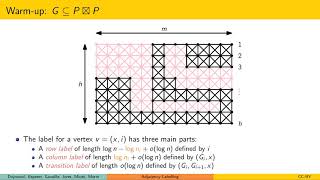
Adjacency Labelling for Planar Graphs - and Beyond
Explore adjacency labelling for planar graphs, covering universal graphs, labeling schemes, and the Strong Graph Product. Learn about binary search trees and their applications in graph theory.
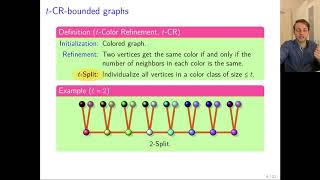
Isomorphism Testing for Graphs Excluding Small Minors
Explore graph isomorphism algorithms for graphs excluding small minors, covering decompositions, t-CR-bounded graphs, and quasipolynomial-time solutions in this advanced theoretical computer science talk.
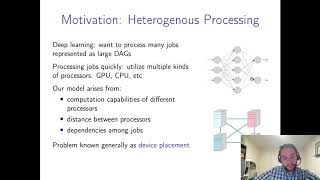
Scheduling Precedence-Constrained Jobs on Related Machines with Communication Delay
Explore efficient job scheduling on related machines, considering precedence constraints and communication delays. Learn about duplication strategies and algorithmic approaches for optimizing makespan.

A Tight Lower Bound on Adaptively Secure Full-Information Coin Flip
Explore secure full-information coin flipping protocols, adaptive adversaries, and biasing techniques. Analyze expected outcomes, protocol jumps, and robust vs. non-robust approaches.
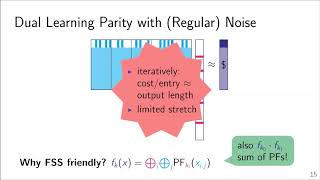
Correlated Pseudorandom Functions from Variable-Density LPN
Explore correlated pseudorandom functions and variable-density LPN, delving into weak PRFs, secure multi-party computation, and pseudorandom correlation generators for enhanced cryptographic security.