
From Papers to Programs - Courts, Corporations, Clinics and the Battle over Computerized Psychological Testing
Explore the evolution and controversies surrounding computerized psychological testing, examining its impact on courts, corporations, and clinics in this thought-provoking presentation.

One Label, One Billion Faces - Usage and Consistency of Racial Categories in Computer Vision
Explores racial categorization in computer vision, examining usage, consistency, and implications for fairness in AI systems. Highlights challenges and potential biases in facial recognition technology.

Impossible Explanations? Beyond Explainable AI in the GDPR from a COVID-19 Use Case Scenario
Exploring AI explainability challenges in GDPR compliance using COVID-19 scenarios, emphasizing justifiability over technical explanations in legal and ethical contexts.

A Pilot Study in Surveying Clinical Judgments to Evaluate Radiology Report Generation
Explore a pilot study on evaluating AI-generated radiology reports through clinical judgments, examining methodologies, results, and implications for healthcare technology.
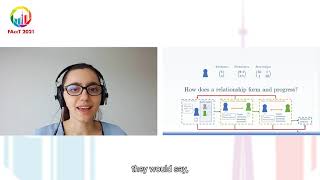
An Agent-Based Model to Evaluate Interventions on Online Dating Platforms to Decrease Racial Homogamy
Explore an agent-based model evaluating interventions on dating platforms to reduce racial homogamy, examining societal impacts and potential solutions.

High Dimensional Model Explanations - An Axiomatic Approach
Explore axiomatic approaches to high-dimensional model explanations, covering value functions, design principles, and characterization results, with a case study on movie reviews.
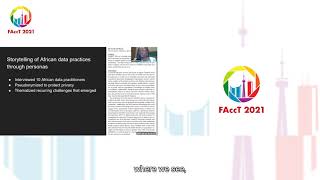
Narratives and Counternarratives on Data Sharing in Africa
Explore narratives and counternarratives on data sharing in Africa, examining challenges, power dynamics, trust issues, and open data implications for the continent's digital landscape.
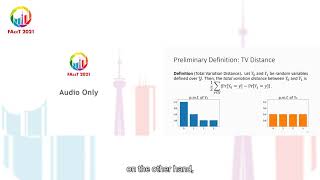
Avoiding Disparity Amplification under Different Worldviews
Explore strategies to prevent amplification of disparities in machine learning systems while considering diverse worldviews, with a focus on fairness and utility in decision-making processes.

The Sanction of Authority - Promoting Public Trust in AI
Explore strategies for building public trust in AI through institutional authority, documentation practices, and ethical considerations in this insightful conference presentation.

Standardized Tests and Affirmative Action - The Role of Bias and Variance
Explore the impact of bias and variance in standardized tests on affirmative action policies, examining their role in shaping educational opportunities and social equity.

Mitigating Bias in Set Selection with Noisy Protected Attributes
Explore techniques for fair subset selection in machine learning when protected attributes are noisy or missing, addressing bias mitigation challenges in real-world applications.
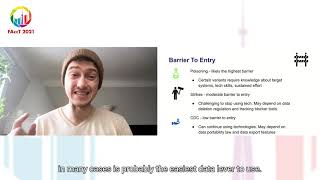
Data Leverage: A Framework for Empowering the Public in its Relationship with Technology Companies
Explore a framework for empowering the public's relationship with tech companies through data leverage, examining concepts like data levers, laundering, and conscious contribution.

Leveraging Administrative Data for Bias Audits - Assessing Disparate Coverage with Mobility Data for COVID-19 Policy
Explore how administrative data can be used to audit bias in mobility data for COVID-19 policies, addressing disparate coverage and its implications for decision-making.

Better Together? How Externalities of Size Complicate Notions of Solidarity and Actuarial Fairness
Explore how group size affects solidarity and actuarial fairness in insurance, challenging traditional notions and revealing complex implications for policy and social justice.
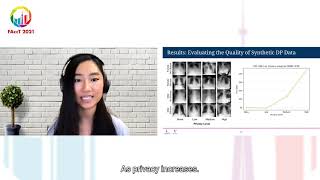
Can You Fake It Until You Make It? - Impacts of Differentially Private Synthetic Data on Downstream Classification Fairness
Explore the effects of differentially private synthetic data on classification fairness, examining its potential and limitations in machine learning applications.
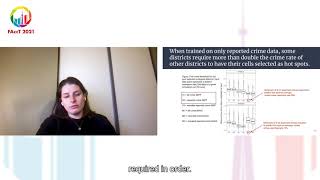
The Effect of Differential Victim Crime Reporting on Predictive Policing Systems
Explore how differential victim crime reporting impacts predictive policing systems, analyzing models, synthetic data, and hotspot prediction to improve fairness in law enforcement.

Agreement Testing Theorems on Layered Set Systems
Explore agreement testing theorems on layered set systems, their applications in CSPs, and recent advancements in this field of theoretical computer science.

Sublinear Algorithms for Gap Edit Distance
Explore sublinear algorithms for efficiently computing gap edit distance, including dynamic programming, approximation techniques, and key theoretical results.

Derandomization from Algebraic Hardness - Treading the Borders
Explore derandomization techniques in algebraic complexity, focusing on hitting set construction and generator design for improved bootstrapping in computational theory.
Efficient Construction of Rigid Matrices Using an NP Oracle
Explore matrix rigidity, its applications in communication complexity and circuit lower bounds, and innovative algorithmic approaches for constructing rigid matrices.

Hardness of Coding Problems
Explore SETH hardness in coding problems, focusing on linear codes, nearest codeword problem, and minimum distance problem. Learn about reductions and key concepts in computational complexity.