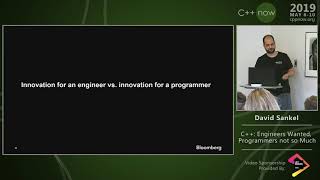
C++ - Engineers Wanted, Programmers Not so Much
Explore the shift from programming to engineering in C++, focusing on system-level thinking, business value, and mature software development practices for large-scale projects.
CMake - One Tool To Build Them All
Explore CMake's vital role in C++ development, its history, and key features for building, testing, and deploying software across platforms with Bill Hoffman, CMake's creator.

The C++ Rvalue Lifetime Disaster
Explores rvalue reference lifetime issues in C++, discussing const& binding and temporary lifetime extension problems, with proposed solutions for safer memory management in generic code.

A Crash Course in Unicode for C++ Developers
Comprehensive introduction to Unicode concepts and processing for C++ developers, covering encodings, normalization, and text algorithms to handle user text correctly.
How to - Colony
Dive deep into the mechanics of the colony container, exploring its implementation details, performance optimizations, and potential applications in C++ programming.

When Should You Give Two Things the Same Name
Explore when and why to give entities the same name in C++, examining overloading, polymorphism, and naming conventions to improve code design and maintainability.
C++11/14 at Scale - What Have We Learned?
Comprehensive analysis of C++11/14 features in large-scale production, examining benefits, drawbacks, and lessons learned over 8 years of use at Bloomberg. Insights on teachability and practical implications.

Code Analysis
Explore C++ static analyzers, Core Guidelines enforcement, and "Simplify C++" trends. Discuss various code checks, from catching dangling pointers to enforcing style guidelines, and consider gamifying static analysis.
Converting a State Machine to a C++ 20 Coroutine
Explore converting state machines to C++20 coroutines, leveraging async operations and co_await. Learn to simplify complex code using modern C++ features for more readable and maintainable asynchronous programming.
Better C++ Ranges
Explore advanced C++ range concepts, including efficient stacking, self-contained adaptors, internal iteration, and optimized text formatting, enhancing code expressiveness and performance.
Surveying the C++ Community
Explore C++ community trends, usage statistics, and insights from the Meeting C++ continuous survey, comparing data with other annual surveys and revealing key findings about the ecosystem.
Interactive C++ in a Jupyter Notebook Using Modules for Incremental Compilation
Explore interactive C++ in Jupyter notebooks using modules for incremental compilation, addressing limitations of existing tools and enabling a more robust computational chain for experimentation.

Practical TMP - A C++17 Compile Time Register Machine
Explore a practical compile-time register machine in C++17, covering design aspects, real-world applications, and performance considerations for advanced template metaprogramming.
Weak Interfaces - Weak Defences - The Bane of Implicit Conversion in Function Calls
Explore strategies to enhance function interfaces and prevent parameter mix-ups through type safety, refactoring, and code analysis tools. Gain insights on improving C++ code quality and maintainability.
Executors - The Art of Generating Composable APIs
Explore composable APIs for software resilience in high-performance computing, focusing on HPX's implementation of task replay and replication to mitigate silent data corruptions in multi-processor systems.

Parallelism on Ranges - Should We?
Explore parallelizing C++ ranges, discussing implementation challenges, algorithmic fusion, and potential benefits using HPX library examples. Insights on combining composability with performance in modern C++.
The Worst Best Practices
Explore controversial C++ best practices, self-publishing experiences, and handling criticism in modern programming. Gain insights from Jason Turner's journey writing a book on C++ best practices.
Using Concepts - C++ Design in a Concept World - Part 1 of 2
Explore C++20 concepts: definition, usage, writing, and design impact. Learn to apply standard library concepts, create custom ones, and understand their role in modern C++ development.
Using Concepts - C++ Design in a Concept World - Part 2 of 2
Explore advanced C++ concept design, implementation, and application in real projects. Learn to write, use, and design with concepts for improved code clarity and functionality.
Hop - A Language to Design Function-Overload-Sets
Explore a template library for creating complex function overload sets in C++, covering variadic functions, default arguments, and advanced overloading techniques.
What is an ABI and Why is Breaking it a Problem?
Explore the concept of Application Binary Interface (ABI), its importance in C++ development, and the implications of breaking it, with examples and historical context.