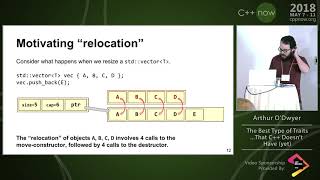
The Best Type Traits that C++ Doesn't Have
Explore advanced C++ type traits for efficient memory operations, comparisons, and optimizations. Gain insights into relocatable objects, equality comparisons, and tombstone traits for improved performance.
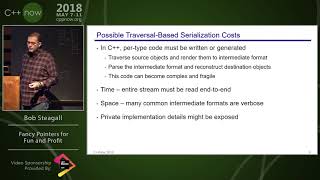
Fancy Pointers for Fun and Profit
Explore fancy pointers in C++, their implementation, and applications in shared memory databases, private heaps, and object persistence. Learn addressing models and storage strategies for synthetic pointers.
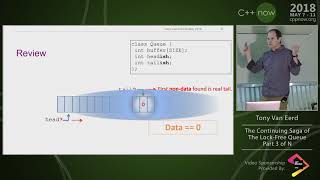
The Continuing Saga of the Lock-free Queue - Part 3 of N
Explore advanced lock-free programming techniques for multi-producer, multi-consumer queues. Learn to critically evaluate when lock-free solutions are appropriate and how to approach their implementation.
Boost.TMP - Your DSL for Metaprogramming
Explore advanced C++ metaprogramming techniques using Boost.TMP, focusing on composition, SFINAE strategies, and efficient type traits for faster and more readable metaprograms.
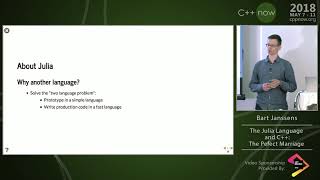
The Julia Language and C++ - The Perfect Marriage
Explore Julia's integration with C++, showcasing its high performance, dynamic dispatch, and seamless interfacing capabilities through Cxx.jl and CxxWrap.jl, with interactive examples and benchmarks.
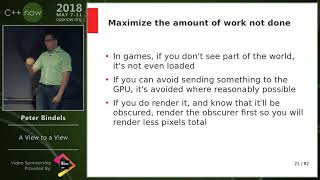
A View to a View
Exploring C++17 views: benefits, pitfalls, and implementation strategies for improved performance and cleaner abstractions in software design.
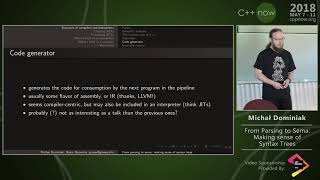
From Parsing to Sema - Making Sense of Syntax Trees
Explore the journey from parsing to semantic analysis in compiler design, covering approaches, challenges, and insights for effectively processing syntax trees in language analysis tools.

Os Matters
Explore how binary size metrics in code reviews can effectively counter complexity in large C++ applications, providing insights into VMware's development practices.
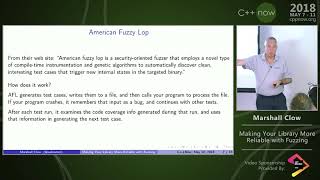
Making Your Library More Reliable with Fuzzing
Explore advanced fuzzing techniques to enhance library reliability, with insights on tools, guided fuzzing, and real-world examples from libc++ and Boost.Algorithm.
My Little -this Deduction - Friendship is Uniform
Explore C++ language enhancements: uniform call syntax, recursive lambdas, and simplified method templates. Learn how these features improve code clarity, reduce boilerplate, and enhance language uniformity.

Modern C++ in Embedded Systems
Explore modern C++ in embedded systems, covering decision-making, tool support, language features, and practical applications for bare-metal and small-OS projects.
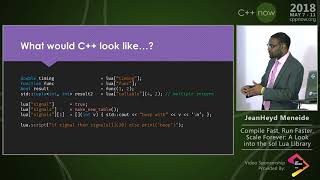
Compile Fast, Run Faster, Scale Forever - A Look into the sol2 Lua Library
Explore sol2, a C++ wrapper for Lua API, offering intuitive abstractions, performance optimization, and scalability. Learn API extension, wrapping techniques, and compile-time strategies.
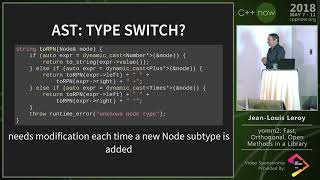
YOMM2 - Fast, Orthogonal, Open Methods in a Library
Explore fast, orthogonal open methods in C++ with yomm2 library. Learn to add virtual functions, solve dispatch problems, and enhance polymorphic behavior without modifying existing class hierarchies.
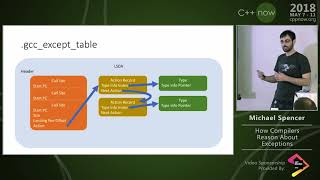
How Compilers Reason About Exceptions
Explore how modern compilers implement exceptions, their impact on optimization, and the true costs associated with their use in C++. Gain insights into exception handling mechanisms and performance considerations.

What Belongs in the C++ Standard Library
Panel discussion exploring criteria for including features in the C++ Standard Library, debating potential additions and their impact on the language's evolution and usability.
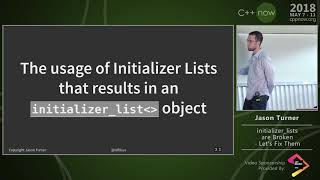
Initializer Lists Are Broken, Let's Fix Them
Explores flaws in C++11's initializer_list, demonstrating issues with dangling references and inefficiencies. Discusses potential solutions and seeks consensus on addressing these problems in the C++ standard.
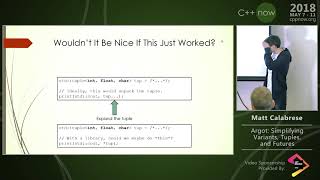
Argot - Simplifying Variants, Tuples, and Futures
Explore Argot, a library simplifying complex operations with tuples, variants, and futures in C++. Learn powerful techniques to enhance code readability and efficiency in handling these abstractions.
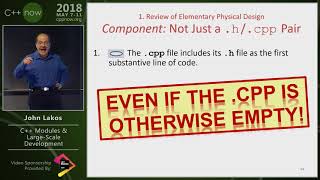
C++ Modules and Large-Scale Development
Explore C++ modules, their goals, and impact on large-scale development. Learn about efficiency, architecture requirements, and migration paths for codebases of all sizes.

Runtime Polymorphism - Back to the Basics
Explores alternative designs for runtime polymorphism in C++, introducing a policy-based approach that offers flexibility in storage and dispatch mechanisms, challenging traditional inheritance-based methods.
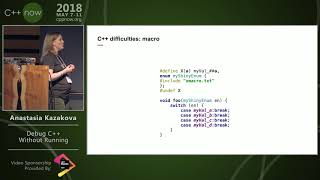
Debug C++ Without Running
Explore advanced C++ debugging techniques without running code, focusing on macros, templates, and preprocessor challenges. Learn IDE-based solutions for improved code understanding and efficiency.
Secure Coding Best Practices
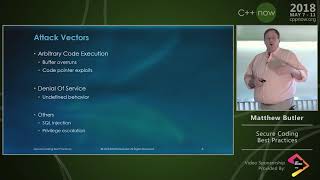
Explore secure coding practices in C++ to protect systems from vulnerabilities. Learn to identify attack surfaces, balance security with performance, and integrate security measures from the design phase.