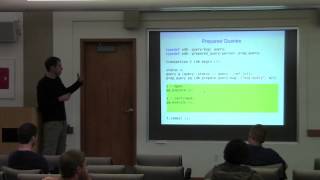
ODB, an ORM for C++
Explore ODB, an open-source ORM system for C++. Learn about C++11 support, database schema evolution, polymorphism, and multi-database capabilities for efficient object persistence in relational databases.
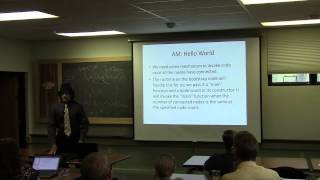
Boost.Asio and Boost.Serialization - Design Patterns for Object Transmission
Explore C++ network programming using Boost.Asio and Boost.Serialization for efficient object transmission, covering complex data structures, serialization techniques, and asynchronous communication patterns.
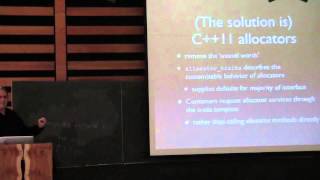
Allocators in C++11
Explore custom allocators in C++11, their motivation, implementation challenges, and impact on container design. Learn to write simple allocators and understand the new 'allocator_traits' model.
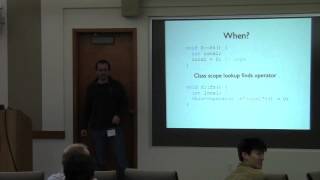
Overloading the Member Access Operator
Explores innovative approach to overloading the dot operator in C++, discussing implementation, use cases, and challenges through an experimental Clang compiler feature.
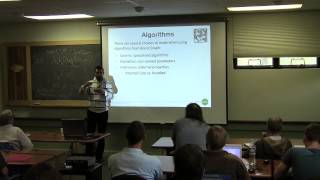
Boost.Graph for Beginners
Learn to use Boost.Graph library's algorithms for graph operations, with examples of input/output parameters and function calls to simplify implementation in C++ projects.

Multi-Threading with C++11 and Boost
Explore C++11 and Boost for multi-threading through practical examples, including thread-safe queues, parallel tasks, and task interruption. Learn about threads, mutexes, and condition variables.
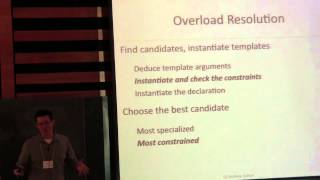
Concepts Lite - Constraining Templates with Predicates
Introduction to template constraints in C++14, improving template declarations and error handling. Learn to use constraints with algorithms, data structures, and class templates for better code organization and readability.
Standardizing the Data Distribution Service API for Modern C++
Explore modern C++ standardization for DDS API, covering data-centric publish-subscribe architecture, exception safety, and forward compatibility in distributed real-time systems.
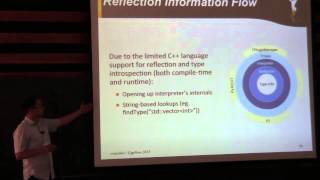
Interactive, Introspected C++ at CERN
Explore CERN's interactive C++ interpreter Cling, built on LLVM/Clang. Learn about its role in ROOT Framework, challenges in implementation, and impact on data analysis and C++ learning.
Debugging and Profiling C++ Template Metaprograms
Explore advanced C++ template metaprogramming techniques, debugging tools, and profiling methods to optimize compilation time and enhance code efficiency.
Threads and Shared Variables in C++0x
Explores C++0x's introduction of threads and shared variable semantics, focusing on the memory model, atomic operations, and challenges in designing meaningful multithreaded programs with sequential consistency.
Distributed Parametric Optimization with the Geneva Library
Explore Geneva, an open-source library for distributed optimization algorithms, leveraging Boost libraries to solve large-scale parametric problems on multi-core systems, clusters, and cloud environments.
Toward Native XML Processing Using Multi-paradigm Design in C++
Explore advanced C++ techniques for native XML processing, leveraging multi-paradigm design to bridge the gap between object-oriented and XML programming paradigms.
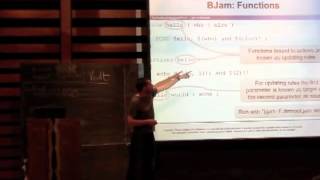
A Complete Overview on Boost.Jam and Boost.Build
Comprehensive guide to Boost.Jam and Boost.Build, covering language constructs, project setup, and advanced concepts for efficient C++ project management and customization.
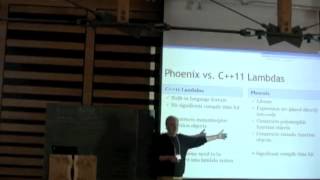
Phoenix V3 - An Overview
Overview of Phoenix V3, a next-gen library for creating unnamed, inlined polymorphic function objects. Combines Boost.Bind and Boost.Lambda functionality, focusing on functional programming in C++ and its applications.
C++0x Progress and Status
Comprehensive update on C++0x ratification progress, new features, and controversies since BoostCon 2010. Insights from an experienced C++ Standards Committee member on the language's evolution.
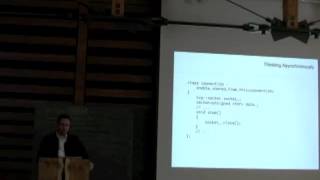
Thinking Asynchronously - Designing Applications with Boost.Asio
Explore asynchronous design principles using Boost.Asio, covering alternative approaches, common pitfalls, and techniques for managing complexity and optimizing performance in C++ applications.
Getting Jiggy with Proto - Hands-on Tutorial on C++ EDSL Design
Hands-on tutorial exploring C++ Embedded Domain Specific Languages using Boost.Proto, demonstrating elegant and efficient code design for small to medium-sized problems.
Automatic Hybrid MPI+OpenMP Code Generation
Explore hybrid MPI+OpenMP parallelization techniques and tools for multi-core processors, including BSP++, a C++ library for parallel programming, and BSPGen, an automatic code generation framework.
The Proposed Boost B-tree Library
Explore B-trees and a proposed library for disk-resident associative containers, covering implementation, performance, and relation to C++ standard library containers.
Intel's C++ STM Compiler and Transactional Language Constructs for C++
Explore Intel's C++ STM compiler and transactional language constructs, focusing on type-safety, optimization, and complex operations in parallel programming using transactional memory.