Autopsy Update
Comprehensive update on Autopsy digital forensics tool, covering new features like Web Domain interfaces, scoring, and Solr 8 upgrade. Explores improvements in UI, artifact pipelines, and integration with other forensic tools.
Incident Recorder
Demonstration of an open-source automation tool for Security Incident recorders, designed to track and document incidents efficiently for forensic and legal purposes.
Forensic Acquisition of Websites, Webpages and Online Services with Open Source Tools
Explore open-source tools for forensically acquiring online evidence, including websites, social media, and cloud services. Learn techniques for preserving digital content with verifiable processes and blockchain timestamps.
ARTHIR - ATT&CK Remote Threat Hunting Incident Response Windows Tool
Modular framework for remote threat hunting and incident response on Windows systems, mapping capabilities to MITRE ATT&CK Framework. Improves on Kansa with expanded functionality and community collaboration.
Windows Event Log Trick-Shots in Rust
Discover advanced techniques for processing Windows event logs using Rust, including fast large-scale searching, recovering records from empty pages, and leveraging open-source tools for forensic analysis.

Leaving No Stone Unturned
Explore memory forensics techniques for digital investigations, covering attack methodologies and analysis steps. Learn to uncover hidden evidence in volatile memory samples for more comprehensive case insights.
A Golden Ticket to the Cloud
Explore cloud security threats, including the Golden SAML attack, and learn detection strategies using open-source tools to protect against unauthorized access in cloud environments.
Velociraptor - Dig Deeper
Explore Velociraptor's powerful VQL for efficient DFIR hunting at scale. Learn to perform on-endpoint analysis, create custom detections, and implement real-time monitoring rules for rapid incident response.
Chrome Wasn't Built in a Day
Explore Chromebook forensics challenges, acquisition methods, cloud data analysis, and comparative data recovery techniques in this updated talk on digital investigation advancements since 2018.
Two Faces to the Same Linux - GUI Environments
Explore Linux desktop forensics in GNOME and KDE environments, comparing user activity artifacts and investigation techniques for digital forensics professionals.
Log Parser as a Forensic Tool
Explore Log Parser as a forensic tool for incident response, combining MS and open-source tools to collect and analyze system data, logs, and registry information efficiently.
Decrypting TLS Traffic on the Fly
Decrypt TLS traffic on-the-fly with friTap, an open-source framework for intercepting encryption keys. Learn about its applications in network forensics and protocol research across major operating systems.
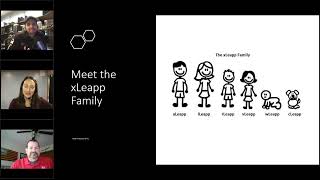
Meet the xLeapp Family
Explore the xLeapp family of digital forensics tools with FBI and academic experts, covering new developments, project extensions, and practical applications in mobile app analysis.
WG21-SG14 - The Story So Far
Explore C++ standardization efforts for low-latency, real-time systems in games, finance, and simulations. Learn about performance optimization, exception costs, and emerging container solutions.
Using the Groovy Ecosystem for Rapid Development on the JVM
Explore Groovy's versatility for JVM development, covering Spock, Geb, Ratpack, and Gradle. Learn how this flexible language enhances productivity and integrates with other JVM tools through code demos.
Finding Bugs with Clang at Compile and Run Time
Explore Clang's static analysis and sanitizers for detecting C/C++ bugs at compile-time and run-time. Learn to write custom code checkers and apply these techniques to improve software quality.
How to Evolve Your Way Out of a Paper Bag
Explore evolutionary algorithms and machine learning through the quirky lens of escaping a paper bag. Gain practical insights into genetic algorithms and cellular automata with simple, visual examples.
Waltzing with Branches
Explore risk management in version control, examining branching strategies, their pros and cons, and alternative practices for ensuring stability and productivity in software development.
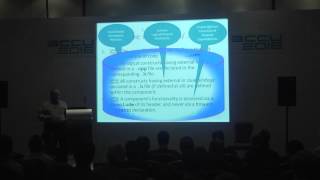
Proper Inheritance
Explore essential software behavior documentation, balancing defined and undefined behaviors in contracts, especially for inheritance-related classes, to enhance development, testing, and performance.
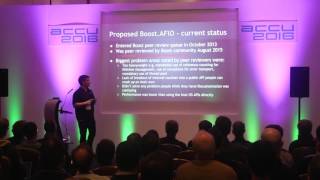
Distributed Mutual Exclusion Using Proposed Boost.AFIO
Explore distributed mutual exclusion using file systems, from fundamentals to high-performance implementation. Learn about Boost.AFIO's portable asynchronous model and compare scalability across different systems and techniques.
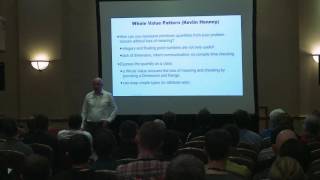
Using Units, Quantities, and Dimensions in C++14
Explore C++14's zero-cost abstraction for safer physical property computations, incorporating dimensions into the type system. Learn to use units libraries for improved code clarity and accuracy.