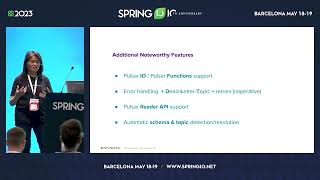
Let's Spring Forth and Stream with Apache Pulsar
Explore building production-ready applications with Spring and Apache Pulsar, leveraging auto-configuration, templates, and listeners for efficient distributed messaging and data streaming in cloud-native environments.
Why Spring Belongs in Your Data Stream - From Edge to Multi Cloud
Explore building data streaming apps at scale using Spring, from edge to multi-cloud. Learn to integrate Spring with Kafka, MQTT, and other technologies for real-time processing in IoT and cloud environments.
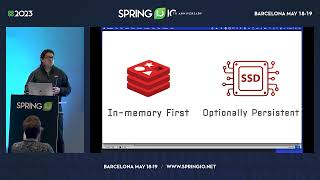
Vector Similarity Search in Spring with Redis Stack
Implementación de búsqueda de similitud vectorial en aplicaciones Spring usando Redis Stack. Aprenda sobre embeddings, bases de datos vectoriales, vectorización de datos y métricas de similitud.
Autopsy Module Competition Videos
Explore winning Autopsy modules: SpeechToText, AD1_Extractor, and FAMA. Discover innovative forensic tools enhancing digital investigations and evidence analysis capabilities.
Investigating Windows Subsystem for Linux - WSL Endpoints
Explore forensic artifacts and investigation techniques for compromised Windows Subsystem for Linux (WSL) endpoints, covering attacker techniques and architectural changes relevant to digital forensics professionals.
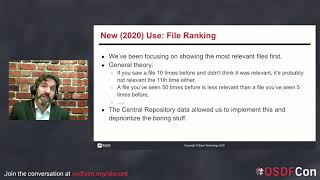
Using Past Data to Determine Relevance in Autopsy
Explore Autopsy's File Discovery UI and Central Repository for efficient digital forensics. Learn how past data analysis enhances file prioritization and streamlines investigations.
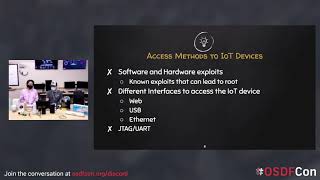
Linux Forensics for IoT - Hello World
Exploring Linux forensics techniques for IoT devices, from smart homes to security systems. Showcases research on applying digital investigation methods to various IoT platforms running Linux operating systems.
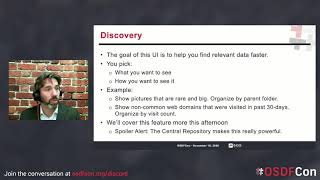
Autopsy's Year in Review - OSDFCon
Comprehensive overview of Autopsy's latest features, including new interfaces and analysis modules, highlighting advancements in digital forensics and incident response capabilities.
Open Source Mobile Forensics Using Python
Learn to process and analyze mobile device extractions using open-source Python tools iLEAPP and ALEAPP. Gain insights into artifact parsing, data analysis, and resources for creating custom parsers.
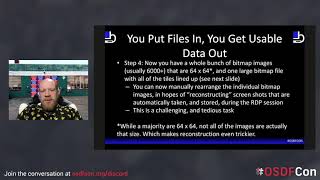
Putting Together the RDPiece
Explore RDP Bitmap Cache forensics for ransomware investigations. Learn to extract, analyze, and reconstruct crucial evidence often overlooked in digital forensics and incident response.
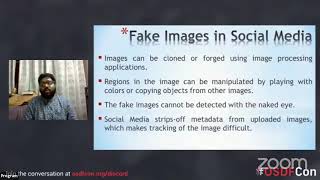
Detection and Tracking of Forged Digital Images on Social Media using Forensically
Explore open-source tools for detecting forged digital images on social media, focusing on Forensically and JPEGMARK. Learn techniques for clone detection, error analysis, and extracting hidden data.
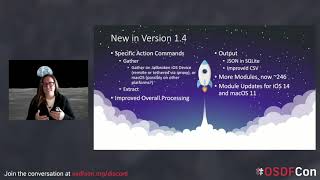
Go for Launch - Getting Started with Practical APOLLO Analysis
Practical guide to using APOLLO Python script for extracting and analyzing data from macOS and iOS devices, focusing on user activity, device status, application usage, and suspicious events.
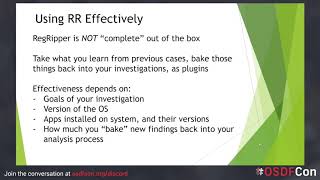
Effectively Using RegRipper 3.0
Explore efficient techniques for utilizing RegRipper 3.0 in digital forensics and incident response, presented by experienced DFIR professional Harlan Carvey at OSDFCon 2020.
Targeted Automation for Malware Analysis
Explore targeted automation techniques for efficient malware analysis using open-source tools, enhancing threat intelligence and collaboration within organizations.
Identify Malware on Compromised Files and URLs Using the PolySwarm Autopsy Plugin
Discover efficient malware detection using PolySwarm's Autopsy plugin. Learn to identify threats with hash lookups and file scans, leveraging 50+ specialized engines for enhanced cybersecurity.
Supporting Digital Forensics Practitioners with Academic Research and Degree Programs
Explore the impact of digital forensics research by students on the field, and learn about academic programs supporting practitioners in this insightful review.
RecuperaBit - Present and Future of NTFS Reconstruction
Explore NTFS reconstruction techniques for data recovery and digital forensics, focusing on RecuperaBit's algorithms, future improvements, and user interface enhancements.
Computer Autopsies - Use Free Forensic Software
Explore computer forensics using Autopsy software, covering evidence collection, analysis, and custom plugin development. Learn practical skills for solving real-world digital investigation cases.
Where Have UAL Been?
Explore Microsoft's User Access Logs on Windows Servers, including authentication details, record retention, and parsing tools. Learn how these logs can be utilized in digital forensics and incident response.
Autopsy Scoring - Finding the Relevant Data with Analysis Results
Explore Autopsy's scoring features to quickly identify relevant data in digital forensics investigations, combining analysis results for efficient case prioritization.
I Know What Your AD Did Last Summer - Talks About Active Directory
Explore Active Directory security, lateral movement, and privilege escalation techniques. Learn forensic approaches for investigating AD incidents using open-source tools, with insights for both red and blue teams.