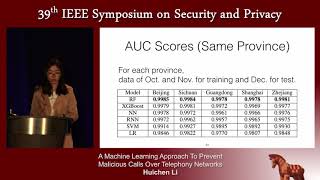
A Machine Learning Approach to Prevent Malicious Calls Over Telephony Networks
Innovative machine learning solution to combat telephony spam and scams, using user-tagged call logs to design effective features for predicting and blocking malicious calls with high accuracy.
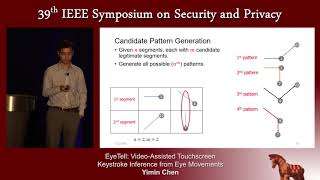
EyeTell - Video-Assisted Touchscreen Keystroke Inference from Eye Movements
Explore a novel video-assisted attack that infers touchscreen keystrokes by analyzing eye movements, posing potential security risks for mobile device users.
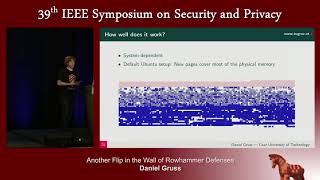
Another Flip in the Wall of Rowhammer Defenses
Unveiling novel Rowhammer attack techniques that bypass existing defenses, including one-location hammering, opcode flipping, and memory waylaying, demonstrating vulnerabilities in DRAM security.
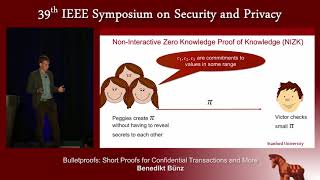
Bulletproofs - Short Proofs for Confidential Transactions and More
Efficient zero-knowledge protocol for range proofs and arithmetic circuits, with logarithmic-sized proofs and no trusted setup. Ideal for confidential transactions in cryptocurrencies.
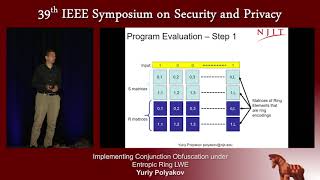
Implementing Conjunction Obfuscation under Entropic Ring LWE
Explore secure program obfuscation implementation for conjunction programs, addressing practicality challenges and achieving significant performance improvements in obfuscation and evaluation runtimes.
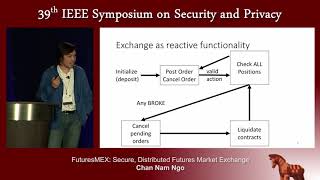
FuturesMEX - Secure, Distributed Futures Market Exchange
Explore a secure, distributed futures market exchange protocol with key operations, security properties, and economic viability considerations for low-frequency trading environments.
How the BIOS Assures Its Handling of Inputs
Explore BIOS input handling, firmware interfaces, and analysis techniques for formal validation and vulnerability detection, including static, dynamic, and symbolic execution approaches.
The Year of LangSec Bugs
Explores major software vulnerabilities of 2016 through the lens of Language-theoretic Security, highlighting preventable bugs and advocating for improved input handling approaches.
Writing Parsers Like It Is 2017
Explore safe parsing techniques using Rust and parser combinators to address memory violations in low-level programming, with practical examples and implementation strategies.
Eliminating Input-Based Attacks by Deriving Automated Encoders and Decoders from Context-Free Grammars
Learn to derive automated encoders and decoders from context-free grammars to eliminate input-based attacks, enhancing security in complex language communication systems.
Taming the Length Field in Binary Data - Calc-Regular Languages
Explores calc-regular languages as an extension of regular languages to handle length fields in binary data serialization, improving security and parsing efficiency for length-prefix formats.
From Trash to Treasure - Timing-Sensitive Garbage Collection
Explores timing-sensitive information leaks via garbage collection, demonstrating attacks and proposing a secure automatic memory management design to prevent such vulnerabilities.
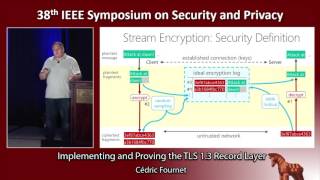
Implementing and Proving the TLS 1.3 Record Layer
Explore the implementation and security proofs of TLS 1.3's record layer, focusing on authenticated encryption, cryptographic algorithms, and formal verification using F* language.
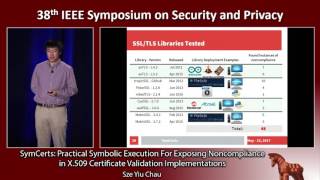
SymCerts - Practical Symbolic Execution for Exposing Noncompliance in X.509 Certificate Validation
Explore practical symbolic execution techniques to uncover noncompliance in X.509 certificate validation implementations, enhancing security in SSL/TLS protocols and IoT systems.
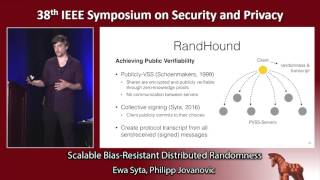
Scalable Bias-Resistant Distributed Randomness
Explore scalable protocols for generating unbiased public randomness in distributed systems, focusing on RandHound and RandHerd's innovative approaches to ensure integrity and efficiency.
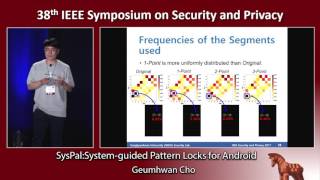
SysPal - System-Guided Pattern Locks for Android
Innovative Android lock scheme mandating random points in pattern selection. Enhances security without compromising usability, as demonstrated through large-scale studies and real-world testing.
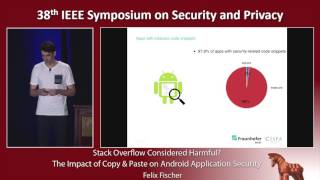
Stack Overflow Considered Harmful - The Impact of Copy & Paste on Android Application Security
Explores the security implications of developers copying code from Stack Overflow into Android apps, revealing alarming rates of insecure snippet usage in popular applications.
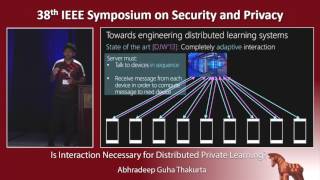
Is Interaction Necessary for Distributed Private Learning?
Explores the necessity of interaction in locally differentially-private algorithms for convex optimization, presenting new algorithms and lower bounds on noninteractive approaches.
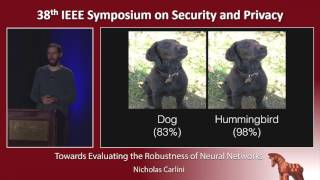
Towards Evaluating the Robustness of Neural Networks
Explores new attack algorithms to assess and challenge the robustness of neural networks against adversarial examples, highlighting vulnerabilities in defensive distillation techniques.
Mitigating LangSec Problems With Capabilities
Explore how capability-based systems like Sandstorm mitigate language-based security vulnerabilities through robust isolation and authorization mechanisms, enhancing web application security.
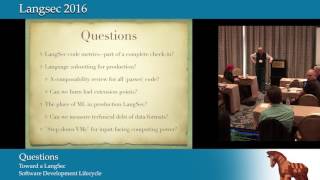
Toward a LangSec Software Development Lifecycle
Explore the integration of Language-theoretic Security principles into software development lifecycles, enhancing security and reliability in system design and implementation.