Quench Dynamics of an Optical Lattice - Local and Global Aspects
Explores non-equilibrium many-body physics in optical lattices, focusing on quench dynamics and universal aspects at the intersection of statistical, AMO, condensed matter, and high-energy physics.
Dynamical Mean-Field Theory in Non-Equilibrium Many-Body Statistical Physics - Giulio Biroli
Explores dynamical mean-field theory in non-equilibrium many-body systems, focusing on aging, glassy dynamics, and high-dimensional chaos. Discusses universal aspects and novel phases of matter far from equilibrium.
Adiabatic Flows and Many-Body Dark States in a Non-Integrable Ising Model - Anatoli Polkovnikov
Explores adiabatic flows and many-body dark states in non-integrable Ising models, discussing novel aspects of non-equilibrium many-body physics and their implications for quantum simulators.
Exact Spectral Form Factors in Interacting Lattice Systems - Tomaz Prosen
Explores exact spectral form factors in interacting lattice systems, discussing non-equilibrium many-body physics and universal aspects of quantum systems far from equilibrium at the interface of various physics fields.
Influence Matrix Approach to Ergodic and Non-Ergodic Quantum Dynamics - Dmitry Abanin
Explores influence matrix approach for understanding ergodic and non-ergodic quantum dynamics, focusing on universal aspects of many-body systems far from equilibrium in statistical physics, AMO, and condensed matter.
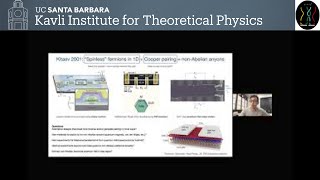
Majorana Zero Modes Discussion - Chair- Jason Alicea
Discussion on recent developments in Majorana zero modes, covering experimental platforms, theoretical methods, and potential applications in quantum computing. Explores advancements in realizing and detecting these elusive particles.
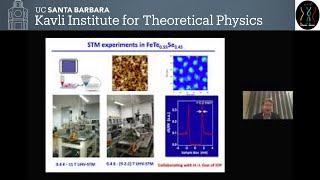
Iron-Based Superconductors as a New Majorana Playground - Hong Ding
Exploring iron-based superconductors as potential hosts for Majorana zero modes, discussing recent developments and implications for quantum computing and condensed matter physics.
Practical Integrability - David Weiss
Explores universal aspects of non-equilibrium many-body physics, focusing on novel phases and universality classes beyond equilibrium paradigms. Bridges statistical, AMO, condensed matter, and high-energy physics.
Nonreciprocity as a Generic Route to Traveling and Oscillatory States - Zhihong You
Explores nonreciprocity in many-body physics, focusing on traveling and oscillatory states. Discusses universal aspects of non-equilibrium systems across various fields of physics.
Qubit-Efficient Simulation with Quantum Tensor Networks - Drew Potter
Explores qubit-efficient simulation using quantum tensor networks, discussing recent advances in integrable models across mathematical physics, condensed-matter physics, and string theory.
Probing Topological Phases with Rydberg Atom Arrays - Giulia Semeghini
Explore topological phases using Rydberg atom arrays in this advanced physics talk by Giulia Semeghini. Discover recent developments in quantum systems and their applications in condensed-matter physics.
Spacetime Mutual Information - Xiaoliang Qi (Stanford)
Explore spacetime mutual information with Stanford's Xiaoliang Qi in this advanced physics talk. Delve into integrable models, quantum systems, and theoretical physics concepts at the forefront of research.
Exploring Entangled Quantum Matter with Programmable Atom Arrays - Mikhael Lukin
Cutting-edge exploration of entangled quantum matter using programmable atom arrays, presented by Harvard's Mikhael Lukin. Discusses recent advances in quantum systems and their applications in physics and technology.
Signatures of Long-Lived Quasiparticles in Nonlinear Response
Explore long-lived quasiparticles in nonlinear response and quantum gas microscopy. Discover recent advances in integrable models across mathematical physics, condensed-matter physics, and string theory.
Probing Quantum Many Body Dynamics with Tweezer Arrays - Manuel Endres
Explore quantum many-body dynamics using tweezer arrays in this advanced physics talk. Discover recent advances in integrable models and their applications in various fields of physics.
Anyon Condensation and the Color Code - Ben Brown (IBM)
Explores anyon condensation in quantum error correction, focusing on the color code and its applications in fault-tolerant quantum computing. Discusses recent advances and implications for NISQ systems.
Floquet Codes and Symmetries of Topological Order - Zhengan Wang
Explores Floquet codes and symmetries in topological order, discussing recent advances in integrable models from mathematical physics, condensed-matter physics, and string theory perspectives.
Learning Global Charges from Local Measurements - Romain Vasseur
Explores techniques for extracting global charge information from localized quantum measurements, discussing recent advances in integrable models and their applications in physics and string theory.
Enhancing Associative Memory Recall & Storage Capacity Using Confocal Cavity QED - Ben Lev
Explore advancements in associative memory recall and storage capacity through confocal cavity quantum electrodynamics, presented by Stanford researcher Ben Lev at the KITP conference on quantum systems.
NLTS Hamiltonians from Good Quantum Codes - Chinmay Nirkhe
Explore NLTS Hamiltonians derived from quantum codes in this talk by Chinmay Nirkhe. Discover recent advances in integrable models, quantum systems, and their applications in mathematical and condensed-matter physics.
Recent Developments in Asymptotically Good Quantum LDPC Codes
Explores recent advancements in quantum LDPC codes, focusing on asymptotically good properties. Discusses theoretical developments and potential applications in quantum error correction and fault-tolerant quantum computing.