Infinite Limits and Scaling Laws of Neural Networks
Explore infinite parameter limits of deep neural networks, scaling laws, and their impact on performance. Gain insights into representation learning and computational resource optimization for neural network training.
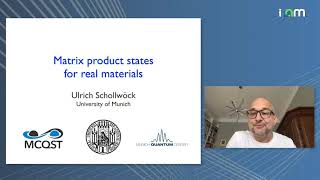
Matrix Product States for Real Materials
Explore recent advances in combining MPS algorithms with DMFT and DFT to study strongly correlated materials, focusing on applications to transition metal and rare earth oxides.
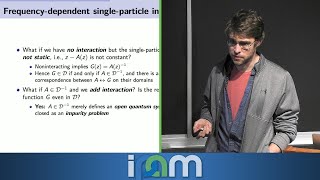
Many-Body Perturbation Theory and Green's Function Methods - IPAM at UCLA
Explore Green's functions and many-body perturbation theory in quantum physics, covering Feynman diagrams, self-energy, and applications like GW method and DMFT. Gain insights into mathematical structures and open problems.
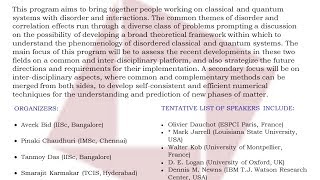
Spontaneous Disorder Near the Mott Transition on Frustrated Lattices
Explore spontaneous disorder in frustrated lattices near Mott transitions. Examine pyrochlore models, effective theories, and experimental realizations in molybdates. Analyze phase diagrams, magnetization, and transport properties.
Dynamical Mean-Field Theory in Non-Equilibrium Many-Body Statistical Physics - Giulio Biroli
Explores dynamical mean-field theory in non-equilibrium many-body systems, focusing on aging, glassy dynamics, and high-dimensional chaos. Discusses universal aspects and novel phases of matter far from equilibrium.

Twisted Transition Metal Dicalcogenides - Tests of Quantum Embedding and Theories
Explore quantum embedding theories and their application to twisted transition metal dicalcogenides, focusing on the Hubbard model and its relevance to experimental observations in materials science.

Computational Quantum Many-Body Physics: A Few Highlights
Explore computational approaches in quantum many-body physics, focusing on key highlights and advancements in the field.

CECAM-MARVEL Classics: Molecular and Materials Modelling with Antoine Georges and Gabriel Kotliar
Explore pioneering methods in computational physics and chemistry with Antoine Georges and Gabriel Kotliar. Learn about quantum excitations, locality, and efficient impurity solvers in this in-depth presentation.
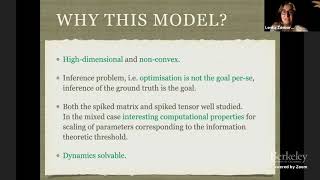
Insights on Gradient-Based Algorithms in High-Dimensional Learning
Explore gradient-based algorithms in high-dimensional learning, covering statistical physics solutions for performance analysis in nonconvex settings like spiked mixed matrix-tensor model, perceptron, and phase retrieval.
Hidden Covalent Insulator and Spin Excitations in SrRu2O6
Explore theoretical study of SrRu2O6, combining DFT and DMFT to investigate its antiferromagnetic properties, spin excitations, and the nature of its paramagnetic state.
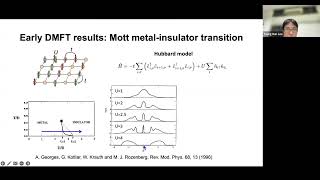
An Efficient and Accurate Approach to Strongly Correlated Materials
Explore an enhanced method for simulating strongly correlated materials using ghost-rotationally-invariant slave-boson (g-RISB) approach, improving accuracy in describing material properties with realistic parameters.
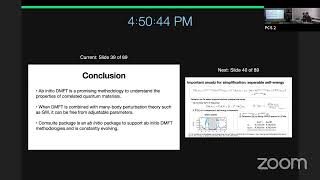
Ab Initio DMFT Methodologies for Correlated Quantum Materials
Explore ab initio DMFT methodologies for understanding correlated quantum materials, their novel physics, and potential applications in quantum information science.
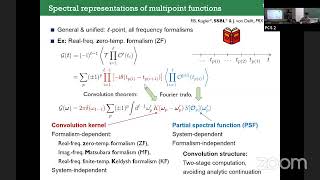
DMFT+NRG: From Models to Real Materials, From Local to Nonlocal Correlations
Explore advanced numerical methods for studying strongly correlated systems using DMFT+NRG, covering recent breakthroughs in first-principles calculations and nonlocal electronic correlations.