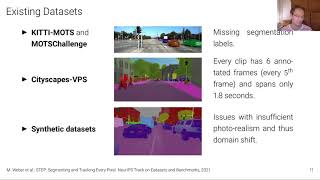
Segmenting and Tracking Every Pixel
Explore video panoptic segmentation with STEP datasets, focusing on real-world challenges in pixel-precise segmentation and tracking. Learn about new evaluation metrics and baseline methods.
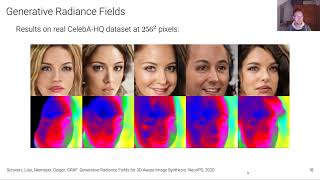
Generative Neural Scene Representations for 3D-Aware Image Synthesis
Explore 3D-aware image synthesis using generative neural scene representations, covering GRAF, GIRAFFE, and CAMPARI models for advanced computer vision applications.
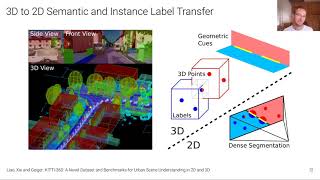
KITTI-360 - A Novel Dataset and Benchmarks for Urban Scene Understanding in 2D and 3D
Comprehensive dataset and benchmarks for urban scene understanding, combining computer vision, graphics, and robotics to advance autonomous driving technology.
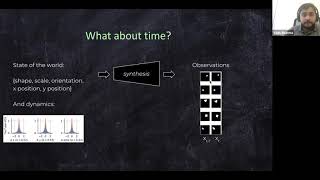
Towards Nonlinear Disentanglement in Natural Data with Temporal Sparse Coding
Explore unsupervised disentanglement of factors in natural videos using SlowVAE. Learn about temporal sparse coding, identifiability proof, and performance on benchmark datasets including new natural dynamics benchmarks.
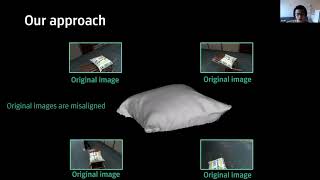
Appearance Acquisition for Digital 3D Content Creation
Explore advanced techniques for digital 3D content creation, including texture recovery, mesh reconstruction, and volumetric representation, using machine learning and computer vision approaches.
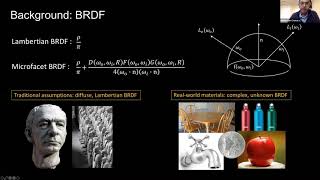
Physically-Motivated Learning of Shape, Material and Lighting in Complex Scenes
Explores physically-motivated learning for shape, material, and lighting recovery in complex scenes using differentiable rendering layers and parsimonious representations, enabling augmented reality applications with single or few images.
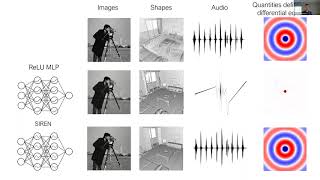
Implicit Neural Scene Representations
Explore implicit neural representations for complex signals, enabling 3D reconstruction from single images and fast inference through gradient-based meta-learning, with applications in scene understanding and semantic segmentation.
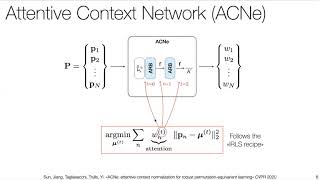
Andrea Tagliasacchi: Structured Representations for 3D Computer Vision
Explore structured 3D representations for computer vision, covering scene analysis, digital humans, and hybrid geometry models. Gain insights into advanced techniques for 3D understanding and reconstruction.
Unmasking the Inductive Biases of Unsupervised Object Representations for Video Sequences
Explore unsupervised object-centric learning approaches for video sequences, comparing perceptual abilities in detection, segmentation, and tracking using a benchmark dataset of procedurally generated videos.
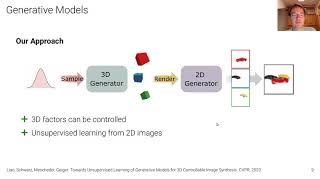
Towards Unsupervised Learning of Generative Models for 3D Controllable Image Synthesis
Explores unsupervised learning for 3D-controllable image synthesis, disentangling latent factors like viewpoint and object pose from raw images to create novel, consistent scenes.
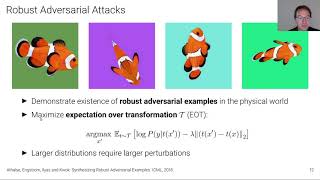
Attacking Optical Flow
Explores adversarial patch attacks on optical flow networks, revealing vulnerabilities in deep learning-based motion estimation crucial for autonomous driving safety.
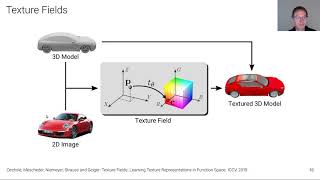
Learning 3D Reconstruction in Function Space
Explore neural implicit 3D representations for geometry and texture reconstruction, discussing their advantages, limitations, and applications in computer vision and graphics.
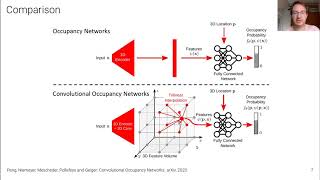
Implicit Neural Representations: From Objects to 3D Scenes
Explore advanced 3D reconstruction techniques using neural representations, from single objects to large-scale scenes. Learn about convolutional occupancy networks, object appearance modeling, and material estimation.
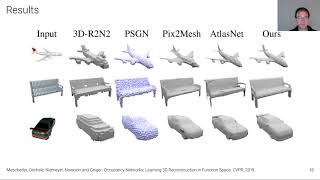
Learning 3D Reconstruction in Function Space - Long Version
Explore neural implicit 3D representations for geometry, texture, and motion reconstruction. Learn innovative techniques for modeling complex 3D shapes using continuous function spaces and 2D supervision.
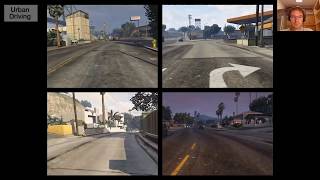
Label Efficient Visual Abstractions for Autonomous Driving
Explore efficient visual abstractions for autonomous driving, analyzing segmentation-based modalities and their impact on driving performance in CARLA simulator. Gain insights on label-efficient approaches.
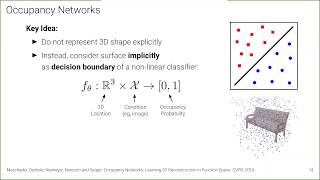
Learning 3D Reconstruction in Function Space
Explore neural implicit models for 3D reconstruction, covering occupancy networks, texture fields, and differentiable rendering. Gain insights into cutting-edge techniques and recent advancements in the field.
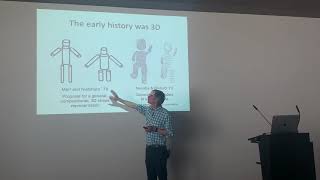
Estimating Human Motion: Past, Present, and Future
Explore the evolution of human motion estimation techniques, from early computer vision approaches to modern 3D body modeling, with insights on challenges and future directions.
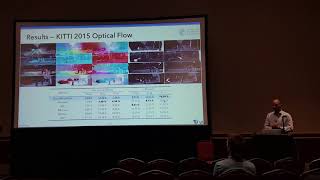
Stefan Roth: Robust Scene Analysis
Explore robust scene analysis techniques, focusing on optical flow estimation, motion segmentation, and uncertainty in computer vision tasks. Learn about challenges, objectives, and innovative approaches.
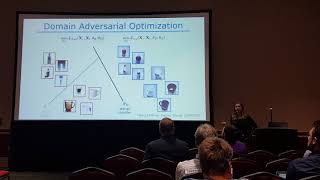
Making Our Models Robust to Changing Visual Environments
Explore techniques for making machine learning models robust to changing visual environments, covering domain adaptation, adversarial optimization, and continuous learning strategies.
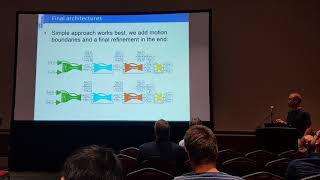
ROB 2018 - Eddy Ilg- Occlusions, Motion and Depth Boundaries with a Generic Network
Explore cutting-edge techniques in computer vision, focusing on occlusions, motion, and depth boundaries using a generic network architecture for improved multiview stereo results.
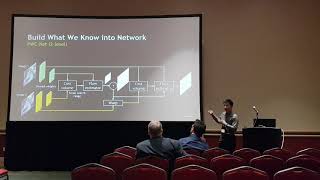
Deqing Sun- PWC Net- CNNs for Optical Flow Using Pyramid, Warping, and Cost Volume
Explore PWC-Net, a CNN-based optical flow algorithm using pyramid processing, warping, and cost volume. Learn its principles, advantages, and limitations for robust motion estimation.