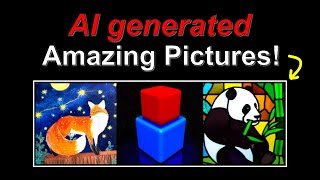
GLIDE- Towards Photorealistic Image Generation and Editing with Text-Guided Diffusion Models
Explore GLIDE, a text-guided diffusion model for photorealistic image generation and editing. Learn about diffusion models, conditional generation, and guided diffusion techniques for high-quality image synthesis.

Hugging Face Datasets - Adding Images
Learn to add images to Hugging Face datasets using Python, covering tar file creation, dataset builder scripts, and best practices for efficient image handling in machine learning projects.
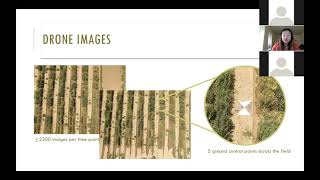
Drone Phenotyping and Machine Learning Enable Discovery
Explore drone phenotyping and machine learning techniques for studying daily floral opening in lettuce, including image processing, statistical analysis, and genetic mapping.
Transfer Learning with TensorFlow - Live Coding and Explanation
Comprehensive live coding session on transfer learning with TensorFlow, covering model reuse, data processing, CNN architectures, and performance optimization techniques for efficient deep learning.

Convolutional Neural Networks with TensorFlow 2022
Comprehensive live-coding tutorial on Convolutional Neural Networks using TensorFlow, covering data preparation, model architecture, optimization techniques, and practical applications in image recognition and object detection.
Learning How to Learn Efficiently - Nando de Freitas, DeepMind
Explore efficient learning techniques for neural networks to solve multiple tasks with limited data, focusing on developing adaptable "prior" networks for rapid task-specific learning.

Making Machines That See - Geometry, Uncertainty and Deep Learning
Explore computer vision advancements, from 3D object reconstruction to real-time deep learning systems incorporating geometry and uncertainty, with applications in robotics and mobile technology.

A Function Space View of Overparameterized Neural Networks - Rebecca Willet, University of Chicago
Explore function spaces of overparameterized neural networks, focusing on weight-bounded networks and their approximation capabilities. Insights from Radon transform analysis reveal novel perspectives on learning with ReLU networks.

ConvNets in Practice
Explore practical applications of ConvNets in object detection, face recognition, and semantic segmentation. Learn about network architectures, performance comparisons, and real-world implementations in robotics and image processing.

Graph Convolutional Networks - GCNs
Explore Graph Convolutional Networks (GCNs), their connection to CNNs, and implementation using PyTorch and DGL. Learn about tensors on vertices and edges, residual gated GCNs, and domain sparsity.

Self-Supervised Learning in Computer Vision
Explore advanced self-supervised learning techniques in computer vision, including PIRL, SwAV, AVID+CMA, and Barlow Twins, to enhance your understanding of representation learning and model training.

Unsupervised Learning - Autoencoding the Targets
Explore unsupervised learning and generative models, covering topics like latent space interpolation, style transfer, super resolution, and autoencoders. Gain insights into advanced machine learning concepts and techniques.
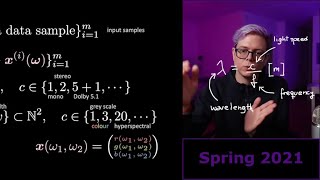
Natural Signals Properties and the Convolution
Explore natural signal properties, convolutional neural networks, and their applications in image processing. Learn about stationarity, locality, sparsity, and parameter sharing in neural network architectures.
Self-Supervised Learning in Computer Vision
Explore self-supervised learning in computer vision, covering pretext tasks, clustering, and contrastive learning. Gain insights into PIRL framework and its evaluation across various applications.

CNN Applications, RNN, and Attention
Explore CNN applications in digit recognition, object detection, and semantic segmentation. Dive into RNNs, addressing their challenges with attention mechanisms, GRUs, LSTMs, and Seq2Seq models.
Convolutional Neural Networks
Explore convolutional neural networks, from basic concepts to modern implementations. Learn about kernels, biological inspirations, CNN evolution, and their advantages in image processing and feature extraction.
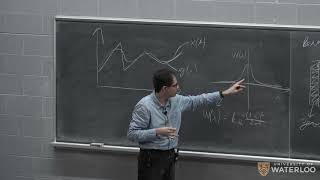
Convolutional Neural Networks
Explore convolutional neural networks, from basic concepts to advanced architectures, including edge detection, pooling, and feature maps for image recognition tasks.
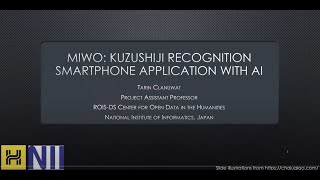
Kuzushiji Recognition Smartphone Application with AI
Explore AI-powered kuzushiji recognition with the miwo app, revolutionizing the study of premodern Japanese documents through innovative technology and user-friendly mobile application.

Visual and Spatial Digital Humanities Research for Japanese Culture
Explore visual and spatial digital humanities research for Japanese culture, focusing on innovative projects using computer vision, machine learning, and geographic information science to analyze historical data.

ComfyUI - Node Based Stable Diffusion UI
Explore ComfyUI, a node-based interface for Stable Diffusion, offering modular AI image generation with advanced techniques like ControlNET, T2I, and Lora for unparalleled creative control.
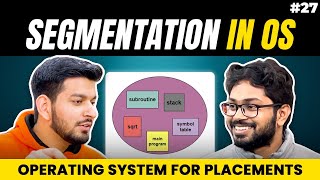
What Is Segmentation - Non-Contiguous Memory Allocation
Explore segmentation in operating systems, including address translation, advantages, and disadvantages. Learn about non-contiguous memory allocation and its implications for system performance.