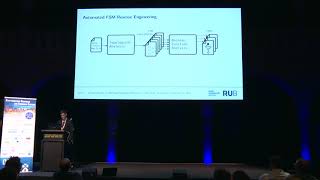
On the Difficulty of FSM Based Hardware Obfuscation
Explores challenges in finite state machine-based hardware obfuscation, analyzing vulnerabilities and proposing potential countermeasures for enhanced security in digital circuit design.

CHES 2018 Rump Session
Cryptographic hardware and embedded systems experts present cutting-edge research and innovations in a rapid-fire format, covering diverse topics in security and cryptography.

The 9 Lives of Bleichenbacher's CAT - New Cache Attacks on TLS Implementations
Explore new cache attacks on TLS implementations, focusing on Bleichenbacher's CAT and its evolution in modern cryptography.
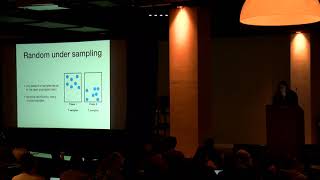
The Curse of Class Imbalance and Conflicting Metrics with Machine Learning for Side-channel Evaluation
Explore machine learning challenges in side-channel analysis, focusing on class imbalance and conflicting metrics. Learn strategies to address these issues in cryptographic hardware evaluation.
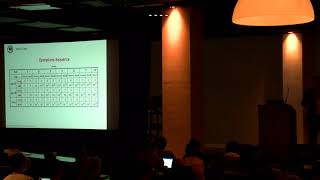
Deep Learning to Evaluate Secure RSA Implementations
Explore deep learning techniques for evaluating secure RSA implementations, focusing on cryptographic hardware and embedded systems security.
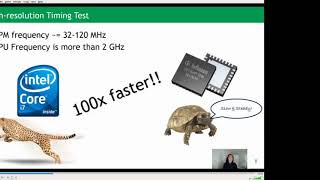
Workshop on Attacks in Crypto 2020 Sessions I and II
Explore cutting-edge cryptographic attacks: lattice, side-channel, timing, and cache attacks on TPMs, PRNGs, and Bluetooth. Learn from experts about vulnerabilities in real-world systems.

TAILCHECK - A Lightweight Heap Overflow Detection Mechanism with Page Protection and Tagged Pointers
Innovative heap overflow detection technique using page protection and pointer tagging, offering low-cost security for C/C++ programs with minimal performance impact.

Core Slicing - Closing the Gap Between Leaky Confidential VMs and Bare-Metal Cloud
Explores core slicing, a novel approach to enhance cloud security by enabling multiple untrusted guest OSes to run on shared bare-metal hardware, addressing vulnerabilities in confidential VMs.

Confidential Computing within an AI Accelerator
Explore IPU Trusted Extensions for secure AI workloads, offering confidentiality and integrity with low overhead. Learn about hardware isolation, encryption, and multi-party training capabilities in Graphcore's AI accelerators.
A Friendly Introduction to Rust for C++ Developers
Friendly introduction to Rust for C++ developers, highlighting key features, similarities, and differences. Includes code comparisons and insights on memory safety, performance, and low-level control.
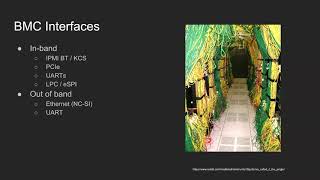
Service Processor Privilege Isolation and Getting Caught with Your Pants Down
Explore service processor vulnerabilities in servers, focusing on BMC security flaws and hardware-based attack methods for gaining persistent control of management systems.

The Delightful User Experience of Security
Exploring how computer security can enhance usability, create user-friendly models, and maintain a positive experience while addressing new challenges in software development.

The Kernel Report
Comprehensive overview of Linux kernel development, covering recent updates, challenges, and future directions. Explores hardware vulnerabilities, stable kernels, testing initiatives, and mobile Linux progress.

Does Making the Kernel Harder Make Making the Kernel Harder?
Exploring the impact of Linux Kernel Hardening Project on vulnerability reduction, exploit difficulty, and development challenges. Analyzes subtle security benefits and associated costs.
Betrusted - Better Security Through Physical Partitioning
Explore Betrusted, a device designed for secure applications using open-source hardware and security-first principles. Learn about its physical partitioning approach to enhance digital security and user focus.
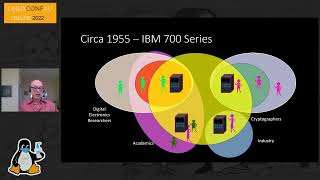
The Security Community Expressed As Too Many Venn Diagrams
Explore the complex relationships within the Open Source security community, its impact on various disciplines, and future predictions for the broader Open Source ecosystem.

PMFault - Voltage Fault Injection on Server Platforms Through the PMBus
Explore voltage fault injection attacks on server platforms via PMBus, revealing vulnerabilities in power management systems and discussing potential security implications for data centers.
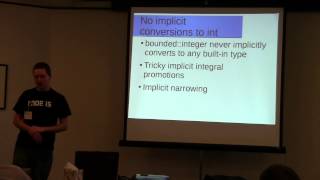
Removing Undefined Behavior from Integer Operations - The Bounded-Integer Library
Learn to eliminate undefined behavior in integer operations using the bounded::integer library, exploring its features, syntax, and practical applications in C++ programming.

Undefined Behavior in C++ - What Is It, and Why Do You Care?
Explore the concept of undefined behavior in C++, its implications, and why it matters for developers. Learn about common pitfalls and compiler optimizations.
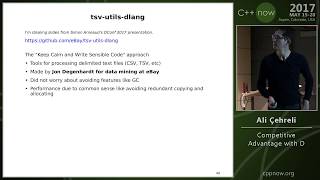
Competitive Advantage with D
Explore D programming language's competitive advantages, focusing on compile-time features, safety, and productivity. Learn how D simplifies systems programming and enhances software engineering.

Rust - Hack Without Fear
Explore Rust's ownership concept, memory safety, and parallelism advantages. Learn how Rust combines low-level control with high-level programming, ensuring thread safety and efficient abstractions.