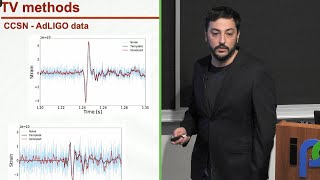
Variational Models and Algorithms for GW Denoising and Reconstruction
Explore variational models and algorithms for gravitational wave denoising and reconstruction, including applications to simulated and real detector data, signal classification, and glitch detection.
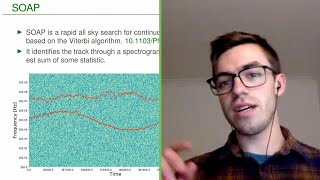
Rapidly Searching for Continuous Gravitational Waves
Explore challenges and solutions in detecting continuous gravitational waves from neutron stars, focusing on SOAP's rapid search method using neural networks for signal identification and parameter estimation.

Machine Learning in Low-Latency Electromagnetic Counterpart Inference
Explore machine learning applications in electromagnetic counterpart inference from gravitational waves, focusing on low-latency data products for efficient follow-up of gravitational wave candidates.
Physically Inspired Machine Learning for Excited States - IPAM at UCLA
Explore machine learning applications in photochemistry, focusing on excited state predictions and light-matter interactions. Discover innovative techniques for overcoming data limitations and enabling accurate photodynamics simulations.
High Accuracy Wavefunctions Using Deep-Learning-Based Variational Monte Carlo
Explore deep learning-based variational Monte Carlo for high-accuracy wavefunctions in computational chemistry, featuring novel architecture and improved methods for ground state energy calculations.
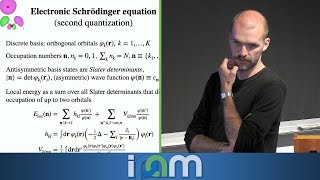
Neural-Network Wave Functions for Quantum Chemistry - IPAM at UCLA
Explore neural-network wave functions in quantum chemistry, covering variational quantum Monte Carlo, antisymmetric ansatzes, and applications to electronic and exciton-phonon Hamiltonians for improved accuracy in molecular modeling.
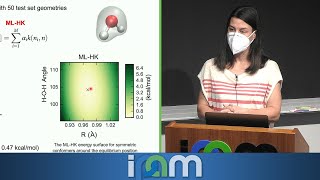
Molecular Electron Densities via Machine Learning - IPAM at UCLA
Explore machine learning techniques for predicting molecular electron densities and energies, with applications in quantum mechanics and molecular dynamics simulations.
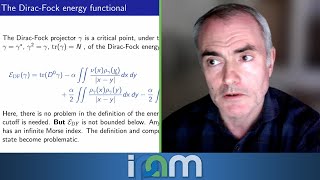
The Ground State of the Dirac-Fock Energy for Molecules and Crystals - IPAM at UCLA
Explore ground state definition for Dirac-Fock energy in molecules and crystals, including existence results and computational algorithms. Insights for theoretical and numerical investigations.
Connectome-Based Modeling of Real World Clinical Outcomes in Addictions
Exploring connectome-based modeling to predict addiction outcomes, focusing on cocaine and opioid abstinence, network stability, and brain states. Discusses potential clinical applications and theoretical models.
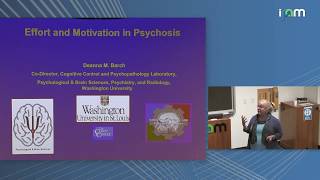
Computational Contributions to Understanding Impaired Motivation and Effort in Psychosis
Exploring computational approaches to understand impaired motivation and effort in psychosis, focusing on reinforcement learning and decision-making to aid treatment development.
Majorana Particle in Condensed Matter Systems by Sankar Das Sarma
Explore Majorana 'particles' in condensed matter systems, covering qubit states, statistics, superconductors, quantum wires, and recent developments in this cutting-edge field of theoretical physics.
Entanglement Entropy, Quantum Field Theory, and Holography by Matthew Headrick
Explore entanglement entropy in quantum systems, focusing on its applications in field theory and holography. Learn about classical and quantum correlations, mutual information, and entropy in spin systems.
Why Do Simple Models Work? Partial Answers from Information Geometry - Lecture 1
Explores information geometry to understand why simple models effectively describe complex systems, focusing on statistical mechanics, renormalization, and model reduction in physics and biology.
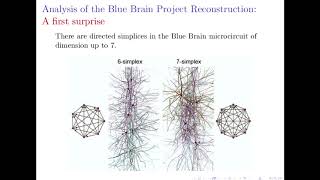
Ran Levi - Bedlewo: Topological Analysis of Neural Networks
Explore topological analysis of neural networks using algebraic topology techniques on biologically accurate digital reconstructions, revealing structural and functional insights into brain connectivity.
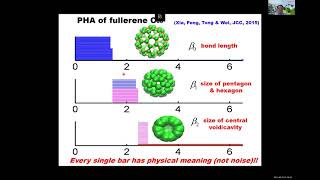
Kelin Xia - Persistent Function Based Machine Learning for Drug Design
Exploring persistent function-based machine learning for drug design, focusing on novel molecular representations and their application in improving predictive models for drug discovery.

Introduction to Quantum Mechanics and Light Polarization
Explore the math of superposition and quantum states, focusing on polarized light and its relation to classical electromagnetic waves. Gain insights into quantum mechanics fundamentals.
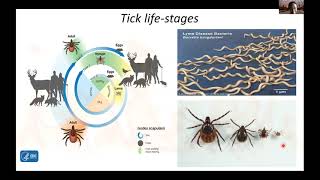
Ticks and Fire - Exploring the Effects of Prescribed Fire on Tick-Borne Disease
Explore the impact of prescribed fire on tick-borne diseases through mathematical modeling, data analysis, and spatial considerations in this seminar on ecological disease management.
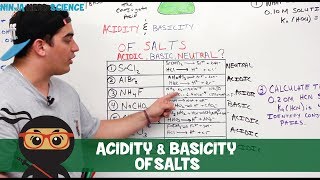
General Chemistry - Acidity & Basicity of Salts
Explore the acidity and basicity of salts through engaging discussions and practice problems, enhancing your understanding of general chemistry concepts.
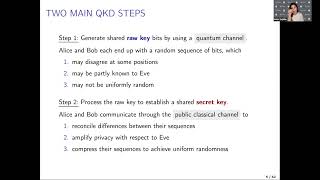
Quantum Independence and Interdependence in Signal Processing
Explore quantum independence and interdependence concepts in signal processing with expert Emina Soljanin, delving into cutting-edge research and applications in the field.
Cosmology - DM Halo - Local Group - Risa Wechsler (Stanford)
Explore cosmology, dark matter halos, and the local group with Stanford researcher Risa Wechsler. Gain insights into cutting-edge astrophysical concepts and their implications for our understanding of the universe.
Modeling Dwarf Galaxy Formation with UniverseMachine - Richie Wang (Stanford)
Explore dwarf galaxy formation using UniverseMachine, a statistical tool for modeling galaxy evolution in cosmological simulations. Learn about abundance matching, multiresolution simulations, and future research directions.