Detection of Objects in Cryo-Electron Micrographs Using Geometric Deep Learning
Explore geometric deep learning techniques for object detection and segmentation in cryo-electron micrographs, focusing on unsupervised methods and graph-based transformers for complex structures.
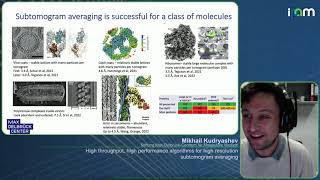
High Throughput, High Performance Algorithms for High Resolution Subtomogram Averaging
Explore high-performance algorithms for subtomogram averaging in cryo-electron microscopy, focusing on tools like TomoBEAR and SUSAN to enhance throughput and resolution in structural biology.
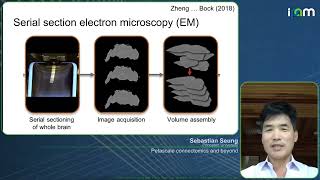
Petascale Connectomics and Beyond - IPAM at UCLA
Explore petascale connectomics, its advancements in brain mapping, and future exascale projects. Learn about automated image analysis techniques and their impact on understanding neural structures and brain function.
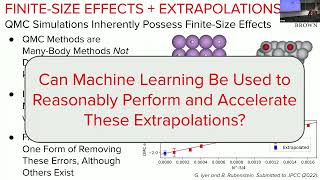
Extending the Reach of Quantum Monte Carlo Methods via Machine Learning
Explore how machine learning enhances quantum Monte Carlo methods for electronic structure modeling, improving force calculations and scaling to larger systems in molecular simulations.
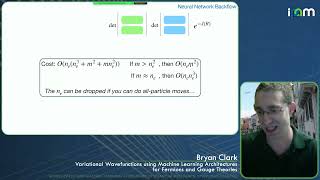
Variational Wavefunctions, Machine Learning Architecture for Fermions and Gauge Theories
Explore machine learning architectures for variational wavefunctions in fermion and gauge theory systems, focusing on preserving symmetries and achieving accurate results in quantum mechanics.
Machine Learning to Improve the Exchange and Correlation Functional in DFT
Explore machine learning approaches to improve exchange and correlation functionals in density functional theory, discussing physically informed methods and their advantages in quantum mechanics.
Compact Representations of Excited States from QMC, as Data for Low-Energy Models
Explore compact wave function representations for excited states in quantum mechanics, focusing on variational Monte Carlo methods and their applications in effective model development.
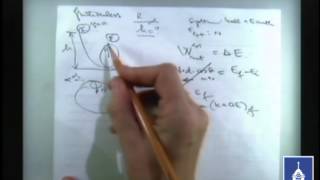
Fundamentals of Energy, Work and Power - Lecture 1
Explore thermodynamics laws, efficiency, and work in systems. Gain insights into renewable energy concepts through interactive discussions and practical examples.
Learning to Untangle Genome Assembly Graphs - IPAM at UCLA
Explore deep learning techniques for untangling genome assembly graphs, improving accuracy and efficiency in DNA sequencing without manual intervention.
Schrödinger Bridges - Classical and Quantum
Explore Schrödinger bridges in classical and quantum contexts, their applications to Markov chains and quantum channels, and their solutions for probability distributions and state evolutions.
Simulation-Based Inference for Gravitational Wave Astronomy - IPAM at UCLA
Explore simulation-based inference techniques for gravitational wave astronomy, covering frequentist vs. Bayesian approaches, summary statistics, and the role of neural networks and inductive bias.
LISA and the Global Analysis of Galactic Binary Gravitational Wave Signals
Explore LISA's role in detecting galactic binary gravitational waves, including data analysis challenges, global fitting techniques, and future prospects for multi-source gravitational wave detection.
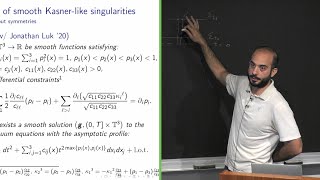
The Mysterious Nature of the Big Bang Singularity - IPAM at UCLA
Explore the enigmatic Big Bang singularity, Einstein's equations, and Kasner solutions in this advanced physics lecture on gravitational theory and cosmological origins.
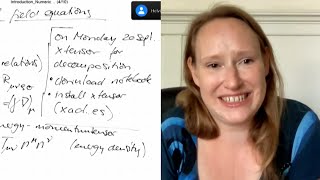
Helvi Witek - Introduction to Numerical Relativity, Part 1 of 2 - IPAM at UCLA
Explore the foundations of numerical relativity, including spacetime decomposition, Einstein's equations, and coordinate choices for stable simulations in gravitational wave astronomy.
Message Passing Neural Networks for Atomistic Systems - Materials - IPAM at UCLA
Explore message passing neural networks for atomistic systems, focusing on thermal transport simulations and diffusion in materials science, with practical examples and convergence tests.
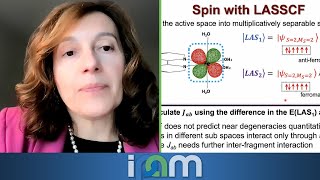
Localized-Wave-Function Methods in Quantum Chemistry and Their Extension to Quantum Computers
Explore localized wave-function methods in quantum chemistry, their applications to large systems, and potential extensions to quantum computing algorithms for improved efficiency and accuracy.
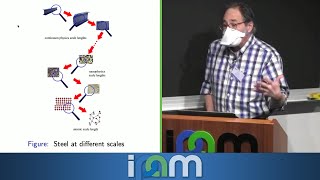
Mesoscale Models and Many-Body Systems - IPAM at UCLA
Explores mesoscale structures in many-body systems, explaining the autonomy of continuum equations and their connection to lower-scale physics, with implications for deep neural networks.
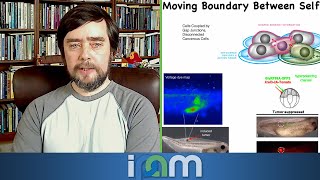
Plasticity Without Genetic Change - Bioelectric Embryos & Synthetic Proto-Organisms
Explore bioelectric embryos and synthetic organisms, delving into morphogenetic control, AI-driven tissue reconfiguration, and collective behaviors challenging traditional biological distinctions.
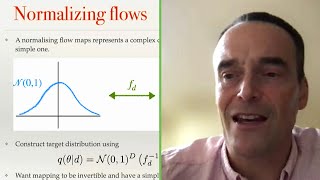
Rapid and Robust Parameter Estimation for Gravitational Wave Observations
Explore rapid parameter estimation techniques for gravitational wave observations, focusing on machine learning approaches like DINGO that use normalizing flows to efficiently analyze data from future detectors.
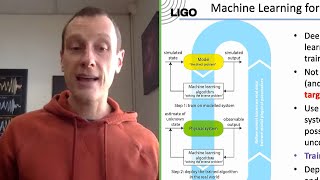
Machine Learning and Gravitational Wave Detectors
Explore machine learning applications in gravitational wave detector science, focusing on noise subtraction and advanced control systems to enhance sensitivity and robustness in astrophysical research.
Computational Challenges in Gravitational Wave Parameter Estimation - IPAM at UCLA
Explore computational challenges in gravitational wave parameter estimation, including novel techniques and future requirements for analyzing compact binary signals in astrophysics.