
History of Neuroscience - Attention Research and Mental Chronometry
Explore Michael I. Posner's groundbreaking research on attention, mental chronometry, and cognitive neuroscience in this insightful interview detailing his influential career and discoveries.

Embracing Complexity: Integrating Data for Predictive Disease Models
Explore how supercomputing and biology integration revolutionizes disease research, breaking linear thinking to uncover complex pathways and innovative treatments.
Exploration of Saturn's Icy Moons as Possible Habitats
Explore Saturn's icy moons as potential habitats and learn about European involvement in the Cassini mission, focusing on ocean worlds like Europa, Enceladus, and Titan.
Physics Matters - New Horizons in Quantum Mechanics by Prof. Vahid Karimipour
Explore new horizons in quantum mechanics, from single atoms to quantum simulation and gravity. Discover how recent developments enhance our understanding and revolutionize technology.
Artificial Intelligence for Accelerating Materials Discovery
Explore how AI accelerates materials discovery through machine learning, high-throughput methods, and autonomous systems. Learn about crystal structure mapping, phase mapping, and future opportunities in materials research.
Basics of Cold Atom Physics by Sourav Dutta
Explore fundamental concepts of cold atom physics, including ultracold atoms, molecules, and ions, quantum optics, and quantum thermodynamics in this comprehensive lecture.
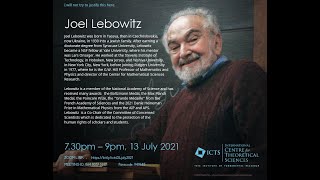
Statistical Mechanical Ensembles and Typical Behavior of Macroscopic Systems by Joel Lebowitz
Explore the foundations of statistical mechanics and its ability to predict macroscopic system behavior with renowned physicist Joel Lebowitz. Gain insights into Gibbs ensembles and their applications.
Topologically Ordered Matter and Why You Should Be Interested
Explore topologically ordered matter in 2D systems, its implications for quantum computing, and potential applications across various physical systems. Gain insights into this exotic yet observable phenomenon.
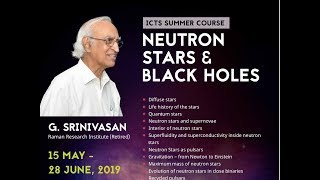
Neutron Stars in Binary Systems by G Srinivasan
Explore neutron stars in binary systems, their formation, evolution, and impact on astrophysics. Gain insights into these fascinating celestial objects and their role in the universe.
Selfie With Blackhole ODRAW Hands on Session by Ananda Hota
Hands-on training for citizen-scientists to create and analyze astronomical images using NASA tools and GMRT data, focusing on galaxies with supermassive black holes and plasma jets.

Quantum Mechanics and Alternate Worlds - Star Trek and the Multiverse Theory
Explore quantum mechanics and multiverse theory through sci-fi examples, examining philosophical implications and scientific concepts like superposition, measurement problem, and universe natural selection.

The Origin of Our Universe from the Multiverse - With Laura Mersini-Houghton
Explore the groundbreaking multiverse theory and its implications for our universe's origins with cosmologist Laura Mersini-Houghton, blending cutting-edge physics with her unique personal journey.
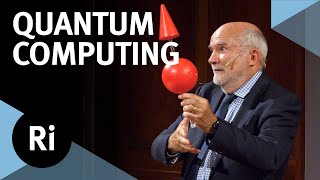
Quantum Computing in the 21st Century – With David Jamieson
Explore quantum technology's potential to revolutionize computing, from Einstein's light quantum to building large-scale devices capable of solving complex problems using single-atom manipulation and quantum mechanics.
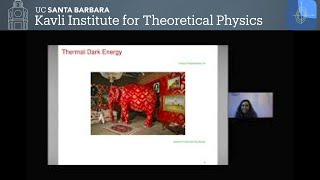
Thermal Dark Energy and Other String Candidates - Susha Parameswaran - EFTBounds
Explores string theory's implications for low-energy physics, focusing on thermal dark energy and other string candidates. Discusses swampland program, Weak Gravity Conjecture, and connections to particle phenomenology.
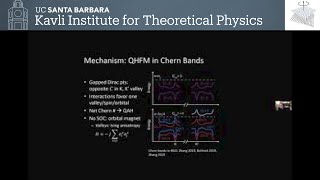
Pomeranchuk Effect and the Entropy of Fluctuating Ferromagnets in Twisted Bilayer
Exploring Pomeranchuk effect and entropy in twisted bilayer graphene's ferromagnets, discussing superconductivity, magnetism, and symmetry breaking in Moiré materials.
How Do Neural Networks Grow Smarter? - With Robin Hiesinger
Exploring neural networks' growth into brains, this talk delves into the interplay between neurobiology and AI, questioning if biological brains are just messy hardware and if nature or artificial intelligence holds the key to smarter systems.
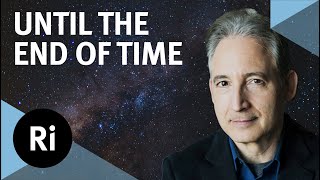
Our Quest to Understand the Cosmos - Brian Greene in Conversation with Jo Marchant
Explore the cosmos from its beginning to its end with physicist Brian Greene, discussing life, consciousness, free will, and the scientific method in this thought-provoking conversation.
What Is Reality? - With Frank Wilczek
Nobel laureate Frank Wilczek explores fundamental concepts shaping our understanding of the universe, including time, space, matter, energy, complexity, and complementarity, offering insights into the nature of reality.
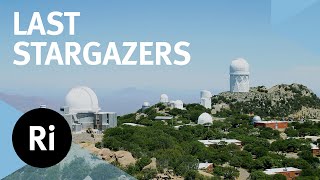
The Last Stargazers - With Emily Levesque
Explore the evolving world of professional astronomy, from remote observatories to cutting-edge technology, and the shift from human to robotic stargazers in this captivating journey through space science.
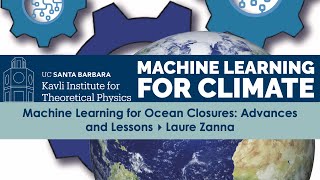
Machine Learning for Ocean Closures - Advances and Lessons - Laure Zanna - Climate-C21
Machine learning techniques for ocean modeling, exploring advances in subgrid closures, turbulent closures, and stochastic parameters to improve climate predictions and understand ocean dynamics.

Correlation Functions from Hydrodynamics Beyond the Boltzmann-Gibbs Paradigm - Benjamin Doyon
Explores correlation functions in hydrodynamics beyond traditional paradigms, focusing on integrable models, hyperbolic scaling, and novel approaches to non-equilibrium many-body physics.