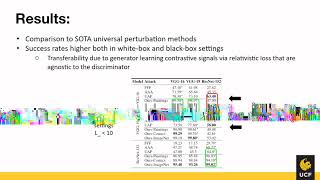
Cross-Domain Transferability of Adversarial Perturbations - CAP6412 Spring 2021
Explore cross-domain transferability of adversarial perturbations, focusing on generative models, discriminator loss, and experimental results in this advanced computer vision lecture.
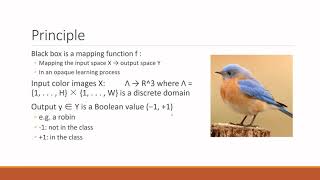
Interpretable Explanations of Black Boxes by Meaningful Perturbation - CAP6412 Spring 2021
Explore principles and methods for explaining black box functions in machine learning, focusing on image saliency, perturbation techniques, and meta-predictors for interpretable AI.
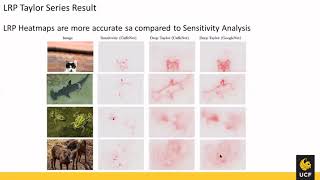
Unmasking Clever Hans Predictors and Assessing Machine Learning - Spring 2021
Unmasking clever predictors: Explore Layer-wise Relevance Propagation and SPRAY techniques to assess machine learning models' decision-making processes and identify potential biases or faults.
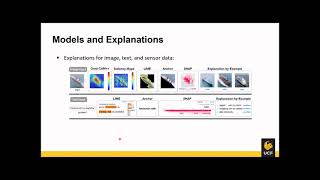
How Can I Explain This to You? An Empirical Study of Deep Neural Net Explanation Methods - Spring 2021
Empirical study comparing deep neural network explanation methods, examining usability, stability, and privacy risks across various visual explanation frameworks.
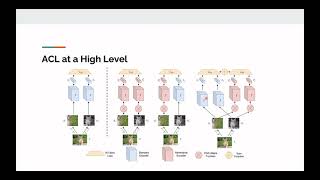
Robust Pre-Training by Adversarial Contrastive Learning - CAP6412 Spring 2021
Explore robust pre-training techniques using adversarial contrastive learning, focusing on unsupervised and semi-supervised methods for improved model resilience and accuracy.
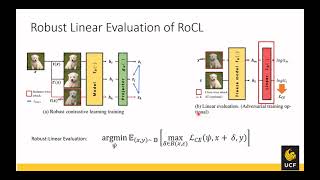
Adversarial Self-Supervised Contrastive Learning
Explore adversarial self-supervised contrastive learning, covering transformers, frameworks, algorithms, evaluations, and experiments in this comprehensive presentation.
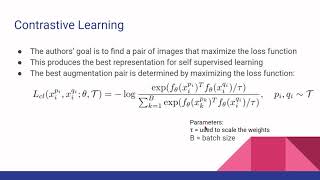
Contrastive Learning with Adversarial Examples - Spring 2021
Explore contrastive learning with adversarial examples, covering unsupervised embedding, self-supervised learning, experiments, and architectural studies in this comprehensive overview.
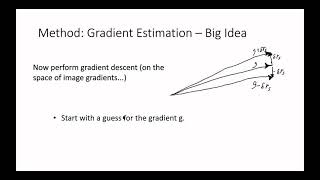
Motion-Excited Sampler: Video Adversarial Attack with Sparked Prior - Spring 2021
Explore video adversarial attacks using the Motion-Excited Sampler technique, covering problem formulation, methodology, gradient estimation, and results analysis.
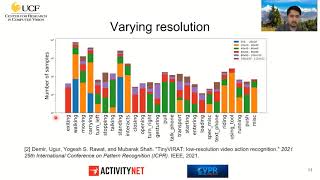
TinyAction Challenge - Action Recognition in Short Videos
Explore cutting-edge research on tiny action recognition, including data analysis, evaluation methods, and experimental results in computer vision and AI.
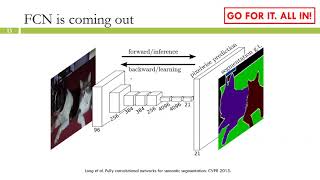
From Saliency to Camouflage Analysis in Computer Vision
Explore visual saliency and camouflage analysis in computer vision, covering FCN-based methods, semantic extraction, and applications. Learn about challenges and future directions in this field.
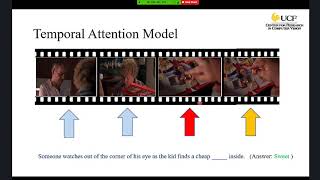
Video Content Understanding Using Text
Explore video content understanding using text, covering challenges, algorithms, and techniques for video representation, scoring, optimization, and inaccuracy detection.
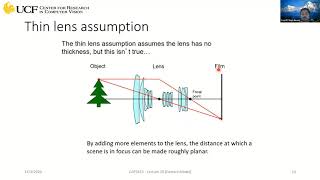
Camera Model and Perspective Projection - Lecture 20
Explore camera models, image formation, lenses, and projection techniques. Learn about 3D relations, pose estimation, and scene understanding in computer vision.
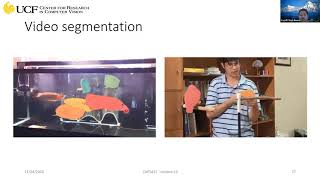
Action Recognition and Video Classification Techniques - Lecture 19
Learn about action recognition in videos, including 3D convolution, video classification, and recurrent neural networks like LSTM, with practical aspects and applications to datasets like UCF101 and VIRAT.
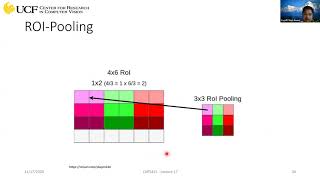
Instance Segmentation - Lecture 17
Explore instance segmentation techniques, including semantic segmentation, ROI pooling, and mask structures, for advanced computer vision applications.
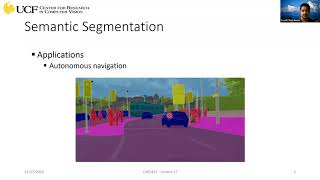
CAP5415 - Semantic Segmentation Part 1 - Lecture 17
Explore semantic segmentation techniques, including pretrained layers, skip connections, and upsampling methods for advanced image analysis and understanding.
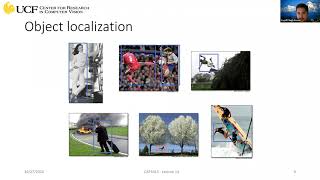
CAP5415 - Object Detection: Sliding Window and Image Pyramids - Lecture 13
Explore object detection techniques including sliding windows, scale-space pyramids, and non-maximum suppression. Learn about challenges and evaluation methods in this comprehensive lecture.
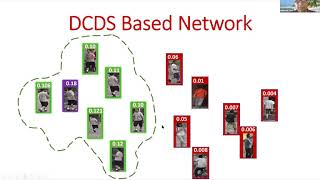
Person Re-Identification and Tracking in Multiple Non-Overlapping Cameras - Keynote
Explore person re-identification and tracking across multiple cameras, covering classification networks, loss functions, and innovative approaches for various camera configurations.
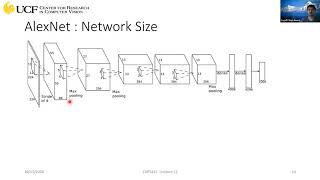
Computer Vision: Classification Techniques - Neural Networks and CNN Architecture - Lecture 12
Explore machine learning frameworks, neural networks, and CNN architecture, focusing on AlexNet and fully convolutional networks. Learn about activation functions and network composition.
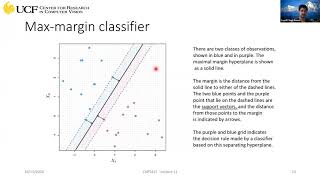
Computer Vision Classification Techniques - Lecture 11
Explore Support Vector Machines (SVM) for classification, covering maximal-margin classifiers, non-separable cases, and nonlinear SVMs. Learn advantages and disadvantages of linear and nonlinear decision surfaces.
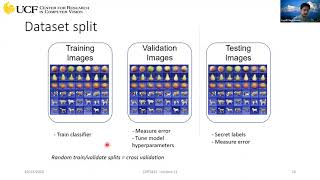
Computer Vision: Classification and Object Recognition - Lecture 11
Explore computer vision classification techniques, including object recognition, image classification, and machine learning frameworks. Learn about nearest neighbor and linear classifiers.
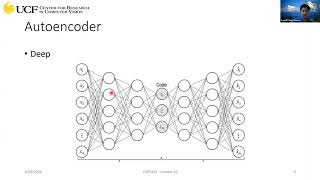
Autoencoder Architecture and Applications - Lecture 10
Explore autoencoders: architecture, comparison, applications in image retrieval, denoising, and anomaly detection. Gain insights into this powerful neural network technique.