Applications of 2x2 Matrices - Wild Linear Algebra A6
Explores 2x2 matrices, focusing on coordinate changes, linear equations, vector operations, and determinants. Covers fundamental concepts and applications in linear algebra.
Arithmetic with Negative Multisets and Integral Polynumbers - Math Foundations 232
Explores advanced arithmetic using negative msets and anti-objects, introducing integral polynumbers and Laurent polynomials in a pure algebraic context, revolutionizing traditional algebra understanding.
Negative Numbers from Antimultisets - Math Foundations 231
Explore negative numbers through antimultisets, drawing parallels with particle physics concepts. Discover a new arithmetic perspective based on elementary principles.
Equality in Computer Science - Sociological and Mathematical Perspectives
Exploring fundamental issues in programming and mathematics related to equality, assignment, and conversion, with insights on how computer science can provide solid foundations for pure mathematics.
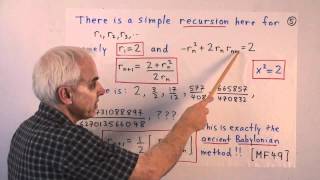
Newton's Method for Finding Zeros - Real Numbers and Limits
Explore Newton's method for finding zeros, focusing on quadratic functions and approximating square roots. Learn about tangent lines, recursion, and practical applications in mathematics.
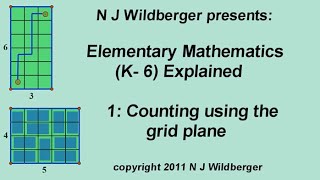
Counting Using the Grid Plane - Elementary Mathematics Explained - Lecture 1
Explore geometry using graph paper, introducing grid points, segments, and rectangles. Learn to measure, count, and tile shapes while practicing arithmetic in a geometric context.
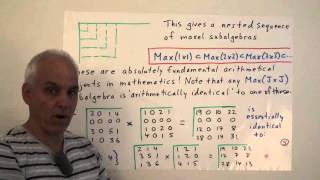
Maxel Algebra II - Data Structures in Mathematics
Exploring maxel algebra as an extension of matrix algebra, focusing on diagonal maxels and their role in projecting and restricting maxels, revealing nested matrix algebra structures.
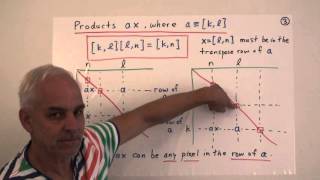
Maxel Theory - New Thinking About Matrices - Data Structures Math Foundations 168
Exploring maxel theory and its impact on linear algebra, focusing on pixel geometry and matrix multiplication for new insights into matrix algebra.
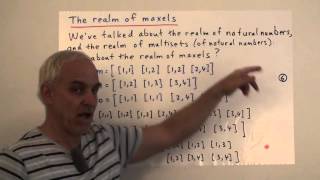
Maxel Theory: New Thinking About Matrices - Math Foundations 166
Explore Maxel theory, a novel approach to matrix theory using pixels. Learn about maxel algebra, multiplicative structure, and applications in linear algebra.

Four Basic Combinatorial Counting Problems in Data Structures - Math Foundations 162
Explores four fundamental combinatorial counting problems for lists, ordered sets, sets, and multisets, providing insights into mathematical data structures and their enumeration.
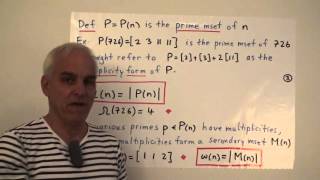
Unique Factorization, Primes and Multisets in Number Theory - Math Foundations 160
Explore elementary number theory through multisets, examining unique factorization, primes, and integral msets. Learn how prime msets connect to fractions and other number theory concepts.
A Socratic Look at Logical Weaknesses in Modern Pure Mathematics
Exploring logical weaknesses in pure mathematics, focusing on continuum, analysis, and set theory. Challenges conventional understanding of limits and introduces computational thinking perspectives.
Computability and Problems with Set Theory - Math History
Explores historical controversies in set theory, Gödel's incompleteness theorems, Zermelo-Fraenkel axioms, and Turing's computability concepts, challenging traditional views on infinite sets in mathematics.
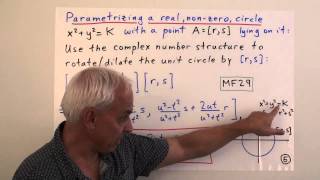
The Projective Line, Circles and the CQQ Theorem - Part 2
Explores advanced geometry concepts including general circles, complex numbers, and the Cyclic Quadrilateral Quadrea theorem, emphasizing projective parametrization and transformations in the complex plane.
Are All True Mathematical Statements Provable? - Famous Math Problems
Explores the philosophical question of mathematical truth and provability, challenging conventional views with explicit examples of likely true but unprovable mathematical statements.
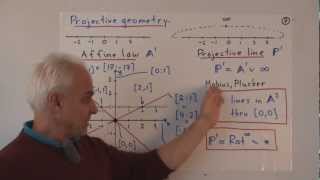
Extended Rational Numbers in Practice - Real Numbers and Limits
Explore extended rational numbers, their applications in mathematics, and connections to projective geometry. Gain insights into graphing polynomials, parametrizing circles, and visualizing infinity in novel ways.

Infinities and Skepticism in Mathematics - Interview with N J Wildberger
Exploration of foundational issues in mathematics, including infinities, skepticism, and modern mathematical challenges. Discusses algorithms, paradoxes, and the future direction of mathematics.
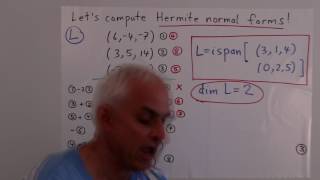
Lattice Relations and Hermite Normal Form - Abstract Algebra Math Foundations 224
Explore lattices and integral linear spans of vexels, including the Hermite normal form algorithm for understanding lattice structure and relations between elements in a spanning set.
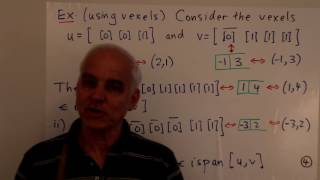
Linear Spaces and Spans II - MathFoundations 220
Introduction to integral linear spaces as abstract algebraic objects, exploring their applications in mathematics, chemistry, and physics. Foundational concepts for linear algebra using vexel language for concrete examples.
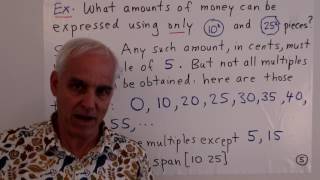
Linear Spaces and Spans I - Abstract Algebra Math Foundations 219
Introduction to linear spaces and spans, generalizing natural numbers with addition to form spans of multisets. Explores fundamental concepts in abstract algebra and linear algebra.
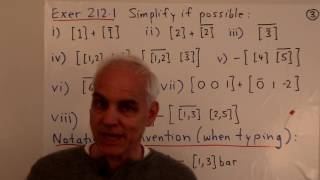
The Anti Operation in Mathematics - Data Structures in Math Foundations 212
Exploring the anti operation in multisets, its symmetry, and applications to vexels and maxels. Expands understanding of mathematical structures and operations.