Statistics for Data Analysis with Exercises - Lecture 1
Comprehensive introduction to statistical methods for data analysis in high-energy physics, covering fundamental concepts and practical applications through exercises and examples.

Causal Data Integration
Techniques for integrating datasets with unobserved confounding variables and summarizing causal DAGs to address data management challenges in causal inference.
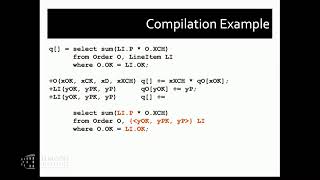
A -Semi-Ring-Based Query Algebra for Incremental View Maintenance and Query Compilation
Algebraic approach to incremental view maintenance using ring structures. Introduces a powerful query calculus with polynomial normal form, enabling efficient delta queries and multi-layered maintenance schemes.
A Stochastic Newton Algorithm for Distributed Convex Optimization
Explore a novel stochastic Newton algorithm for distributed convex optimization, reducing communication rounds while maintaining performance. Gain insights into convergence guarantees and practical applications.
Credal Models for Uncertainty and Logic Treatment
Explore credal models as a generalization of probability theory for handling uncertainty and logic in AI, enhancing reliability and trustworthiness in decision-making processes.
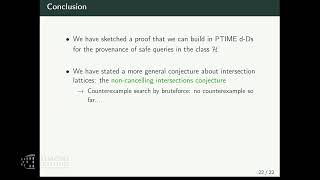
The Intensional-Extensional Problem in Probabilistic Databases
Explores probabilistic query evaluation in databases, discussing safe queries, knowledge compilation methods, and a combinatorial conjecture for solving complex cases efficiently.
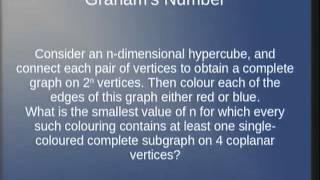
Numbers - From Merely Big to Unimaginable - Lecture 9
Explore the fascinating world of enormous numbers, from prime distribution to complex functions, and delve into advanced mathematical concepts like Ackerman operators and Ramsey Theory.
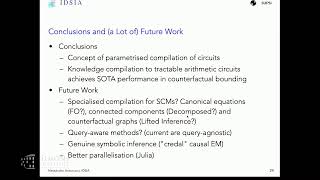
Tractable Bounding of Counterfactual Queries by Knowledge Compilation
Explores bounding partially identifiable queries in causal models using knowledge compilation, offering computational advantages for inference in Bayesian networks with shared structures.
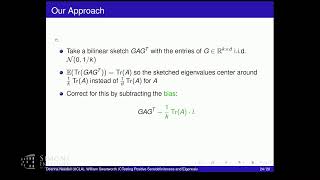
Testing Positive Semidefiniteness and Eigenvalue Approximation
Explore efficient algorithms for testing positive semidefiniteness and approximating eigenvalues in large matrices, with insights from David Woodruff of Carnegie Mellon University.
Sketching and Projecting
Explore sketching and projecting methods for linear systems and linear discriminant analysis, focusing on stochastic gradient approaches to achieve efficient solutions with reduced computational burden.
Variational Bayesian Approximation of Inverse Problems Using Sparse Precision Matrices
Explore Variational Bayes as an efficient alternative to MCMC for solving inverse problems in PDEs, using sparse precision matrices and stochastic optimization for improved computational tractability.
Uncertainty Quantification with Physics-Informed Machine Learning
Exploring uncertainty quantification in physics-informed machine learning, focusing on architecture and learning approaches for scientific applications and complex real-world phenomena.
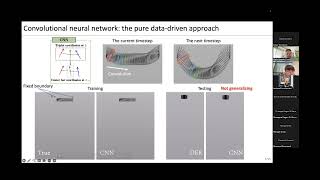
Promoting Data-Efficiency of Deep Learning for Dynamical Systems
Exploring data-efficient deep learning for dynamical systems using Euclidean symmetric neural networks, demonstrated on a 3D Slinky model for accelerated simulation and generalization.
PECANNs - Physics and Equality Constrained Artificial Neural Networks
Innovative approach to physics-informed neural networks using constrained optimization, addressing hyperparameter challenges and improving accuracy for scientific applications involving multi-dimensional PDEs.

From Geometry to Algebra and Back Again: 4000 Years of Papers
Explore 4000 years of vector algebra history, its applications in art, science, and programming, and discover the potential of Geometric Algebra as a superior alternative.
On Making Mathematical Proof a Business - Allen School Distinguished Lecture
Explore how Amazon leverages automated reasoning and mechanized proof search in mathematical logic for software development, with insights on challenges and future scalability.
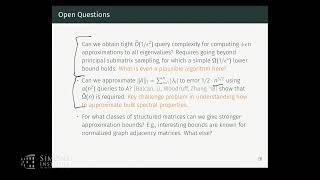
Sublinear Time Eigenvalue Approximation via Random Sampling
Explore efficient algorithms for approximating eigenvalues of large matrices using random sampling techniques, with applications in data analysis and machine learning.

Machine-Checked Proofs and the Rise of Formal Methods in Mathematics - Theoretically Speaking
Explore the Lean proof assistant's role in verifying complex mathematical proofs and software, its extensible design, and its impact on mathematical education and AI research.

Polylogues
Explore the intersection of math and theoretical computer science with Nikhil Srivastava and Venkatesan Guruswami as they discuss their roles at the Simons Institute and Srivastava's research.
Cube Attacks on Non Blackbox Polynomials Based on Division Property
Explore advanced cryptanalysis techniques using division property for cube attacks on non-blackbox polynomials, enhancing understanding of cryptographic vulnerabilities.
The Circle and Cartesian Coordinates in Universal Hyperbolic Geometry - Lecture 5
Explore Cartesian coordinates and the unit circle, covering key theorems on lines, points, and circles. Learn about determinants, parametrization, and the intersection of lines and circles in geometry.