How to Do CS Theory - Lecture 1b: Research Tips for Theoretical Computer Science
Insights and tips for aspiring theoretical computer science researchers, covering research methods, paper writing, presentation skills, and essential resources in the field.
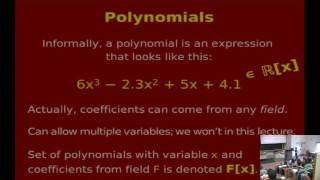
Polynomials
Explore polynomials, from formal definitions to applications in finite fields, interpolation, and error-correcting codes for noisy communication channels.
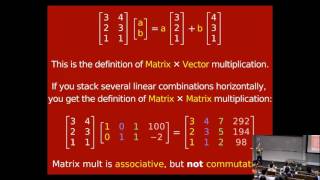
Linear Algebra
Explore vector spaces, linear combinations, and applications in computer science, including Fibonacci sequences and message transmission on noisy channels.
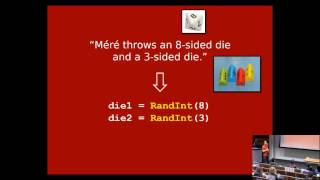
Probability 1
Explore key concepts in probability theory, including events, conditioning, chain rule, and independence, with practical examples and problem-solving techniques.
Great Ideas in Theoretical Computer Science - Polynomials
Explore theoretical computer science through polynomials, covering fields, division, evaluation, interpolation, and error-correcting codes. Gain insights into fundamental concepts and their applications.
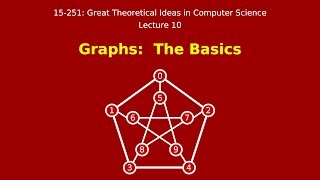
Great Ideas in Theoretical Computer Science - Graphs - The Basics
Explore fundamental concepts of graph theory, including definitions, basic questions, regular graphs, and perfect matching. Gain insights into connecting graphs and equivalence relations.
Understanding Predictive Modeling with R
Learn to create predictive models using R, covering key concepts, training techniques, and practical demonstrations. Gain insights into model selection and explore various applications in data analysis.
Generalized Dilations and Eigenvalues - Wild Linear Algebra A - NJ Wildberger
Explore coordinate systems, basis changes, and similar matrices in linear algebra. Learn about generalized dilations and the fundamental concept of eigenvalues and eigenvectors.

Self-Study Computational Neuroscience - Coding, Textbooks, Math
Comprehensive guide to starting computational neuroscience: programming languages, coding practice, textbooks, math resources, project ideas, and datasets for self-study and skill development.
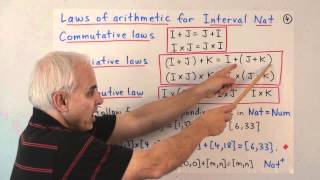
Measurement, Approximation and Interval Arithmetic - Real Numbers and Limits Math Foundations
Explore interval arithmetic, its laws for natural numbers and integers, and the challenges with real number arithmetic. Gain insights into measurement, approximation, and foundational mathematical concepts.
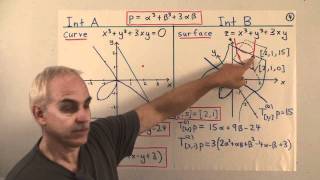
Calculus on a Cubic - The Folium of Descartes - Arithmetic and Geometry Math Foundations
Explore the Folium of Descartes through algebraic calculus, examining its parametrization, Taylor expansions, tangents, and unique properties in both 2D and 3D space.

Cubic Splines - De Casteljau Bezier Curves Using Linear Algebra
Explore de Casteljau Bezier curves and cubic splines using linear algebra, focusing on their elegant formulas and applications in design work from automobiles to modern graphics.
An Introduction to Homology - Algebraic Topology
Explore higher-dimensional topology through homology groups, cycles, and spanning trees. Learn to compute and characterize independent cycles in graphs using algebraic techniques.
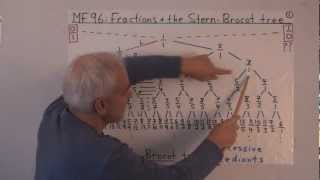
Fractions and the Stern-Brocot Tree - Real Numbers and Limits Math Foundations
Explore the Stern-Brocot tree, a fascinating representation of fractions using a binary tree. Learn its properties, construction, and connections to Ford circles and Farey sequences in this insightful mathematical journey.
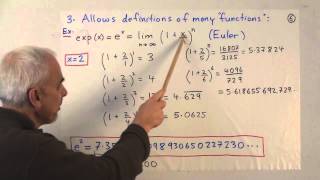
Difficulties With Real Numbers as Infinite Decimals - Real Numbers + Limits Math Foundations
Explores challenges in defining real numbers as infinite decimals from a computational perspective, highlighting technical obstacles in algorithms, arithmetic operations, and number equality recognition.
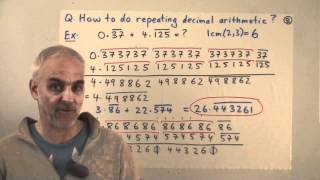
Fractions and Repeating Decimals - Real Numbers and Limits Math Foundations
Explore fractions, repeating decimals, and real numbers. Learn conversion algorithms, arithmetic operations, and gain insights into the foundations of mathematics and rational number theory.
Randomness in Number Theory
Explore randomness in number theory, covering topics like finite fields, graphs, quantum gates, and the Riemann Hypothesis with Princeton's Peter Sarnak.
Benign Overfitting in Linear Prediction
Explore the phenomenon of benign overfitting in linear prediction, its implications for deep learning, and its impact on adversarial examples in machine learning.
Quantum-Inspired Classical Linear Algebra
Explore quantum-inspired classical algorithms for linear algebra, including sketching, sampling, and low-rank approximation techniques in this advanced computational talk.
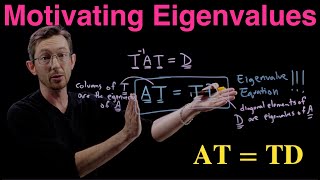
Motivating Eigenvalues and Eigenvectors with Differential Equations
Explore eigenvalues and eigenvectors through differential equations, deriving key concepts and visualizing their applications in matrix systems for a deeper understanding of linear algebra.
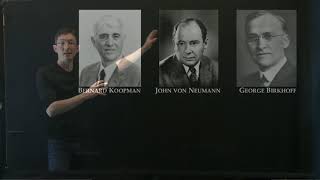
Koopman Spectral Analysis - Overview
Explore Koopman operator theory for dynamical systems, its recent resurgence, and applications like Dynamic Mode Decomposition in this comprehensive overview.